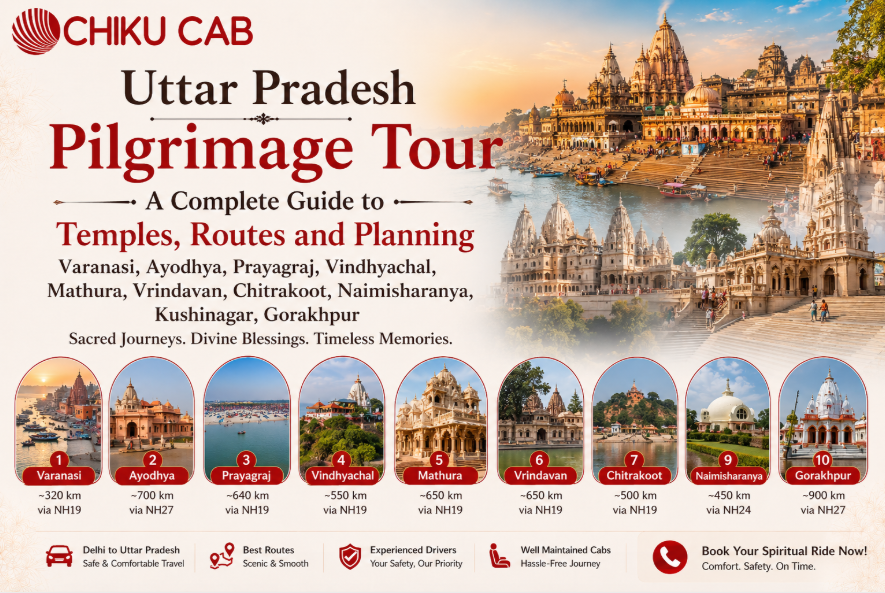
Uttar Pradesh holds more pilgrimage destinations in a single state than most regions of India combined. Varanasi, Ayodhya, Prayagraj, Mathura, Vrindavan, Vindhyachal, Chitrakoot, Naimisharanya, Kushinagar, and Gorakhpur all sit within a single road network. Most major stops are 3 to 6 hours apart by car, which makes covering the entire trip in 10 to 12 days genuinely achievable. This guide covers what to expect at each destination, the temple timings, rituals, and how to plan the full route.
No single train line connects all these places. That’s why it is preferred that you cover this pilgrimage trip by a cab or tempo traveller. Chiku Cab runs outstation taxis, SUVs, and tempo travellers across the entire UP pilgrimage route, with drivers familiar with temple roads, restricted vehicle zones, and the daily darshan schedules at each major site.
Why the UP Pilgrimage is a Perfect Road Trip
The Ganga corridor runs through Mathura, Prayagraj, Vindhyachal, and Varanasi, connecting four major pilgrimage stops on a single highway axis. Ayodhya sits 170 km north of Prayagraj. Chitrakoot is 130 km south. Naimisharanya fits naturally between Lucknow and Ayodhya. Kushinagar and Gorakhpur anchor the northeastern leg, about 300 km from Varanasi.
This pilgrimage trip covers three separate religious traditions; Hindu pilgrimage (Varanasi, Ayodhya, Mathura, Prayagraj, Vindhyachal, Chitrakoot, Naimisharanya, Gorakhpur), Buddhist pilgrimage (Kushinagar, Sarnath near Varanasi), and the Shakti Peetha network (Vindhyachal, Naimisharanya). Most pilgrims travelling on a spiritual tour of Uttar Pradesh can cover all ten destinations in one connected route without major backtracking.
The Ten Pilgrimage Stops: Timings, Rituals and What to Know
1. Varanasi
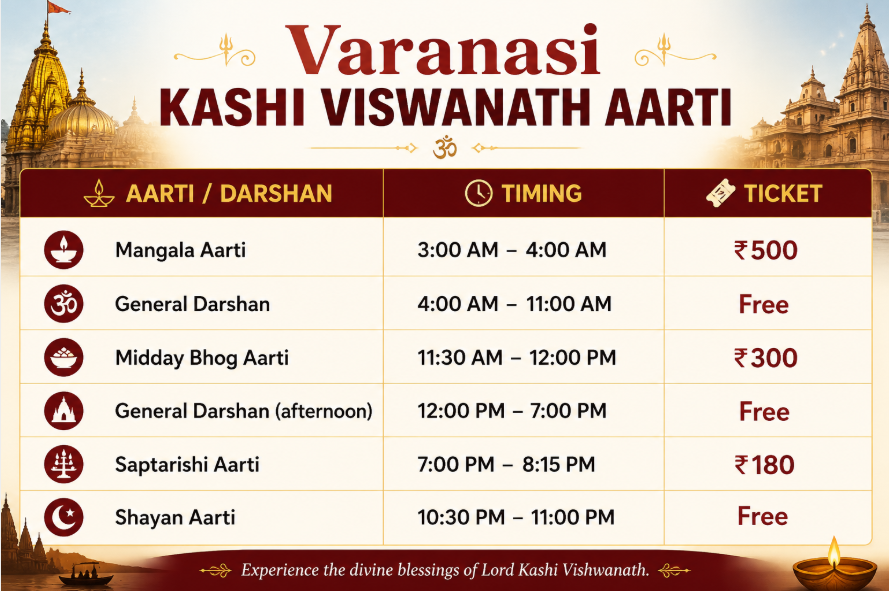
Varanasi is the most visited pilgrimage stop in UP. The two primary visits here are the Kashi Vishwanath Jyotirlinga and the Ganga Aarti at Dashashwamedh Ghat.
i.Kashi Vishwanath Temple opens daily at 2:30 AM for priests. General darshan starts at 4 AM and the temple closes at 11 PM after Shayan Aarti. The Kashi Vishwanath Corridorconnects the temple directly to the Ganga riverfront, which has simplified movement for pilgrims considerably.
| Aarti | Timing | Ticket |
| Mangala Aarti | 3:00 AM – 4:00 AM | ₹500 |
| General Darshan | 4:00 AM – 11:00 AM | Free |
| Midday Bhog Aarti | 11:30 AM – 12:00 PM | ₹300 |
| General Darshan (afternoon) | 12:00 PM – 7:00 PM | Free |
| Saptarishi Aarti | 7:00 PM – 8:15 PM | ₹180 |
| Shayan Aarti | 10:30 PM – 11:00 PM | Free |
Sugam Darshan (priority queue pass) costs ₹250 and is available at Gate No. 2, valid from 6 AM to 6 PM. Mobile phones and bags are not allowed inside. Locker counters are near the main gates. Reach by 4:30 AM on regular days to avoid the longer morning queues. On Mondays, Shravan month, and Mahashivaratri, queues begin hours earlier.
ii. Dashashwamedh Ghat Ganga Aarti runs every evening at 7 PM. Reach by 6:30 PM to get a spot on the steps, or arrange a riverboat through your cab driver for a view from the water.
iii. Other temples worth including on a Varanasi darshan: Kaal Bhairav Temple (visiting before Kashi Vishwanath is considered mandatory by local tradition), Annapurna Devi Temple, Sankat Mochan Hanuman Temple, and Durga Kund Temple. A full day in Varanasi covers the main temples comfortably; two days is better if you want to add Sarnath (12 km away).
2. Ayodhya
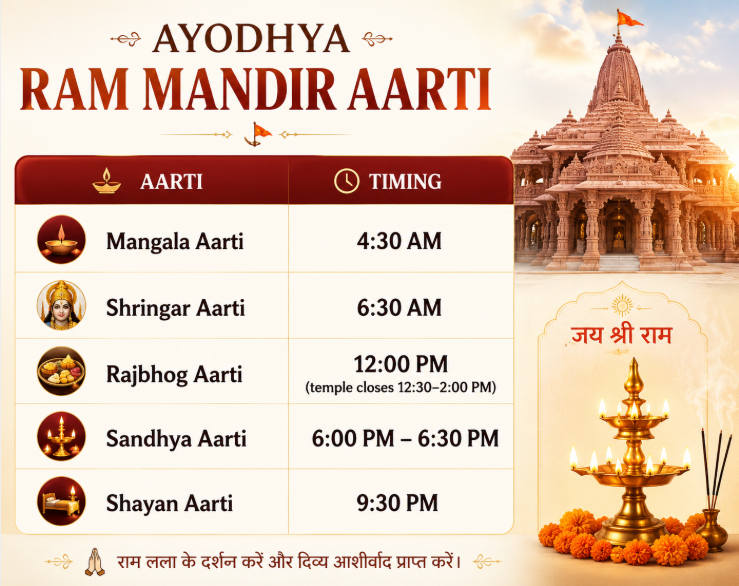
Ayodhya saw over 16 crore visitors in 2024, the year after the Ram Mandir Pran Pratishtha. The town has been significantly rebuilt around the new pilgrimage infrastructure, and the road from Lucknow (130 km) is broad and fast.
i. Ram Mandir darshan runs from 6 AM to 10 PM, with a break from 12 noon to 2:30 PM. Aarti passes are free but require a valid government ID. Collect them from the Shri Ram Janmabhoomi Camp Office 30 minutes before each aarti. Only 30 devotees are permitted inside during aarti at a time, so arrive early.
| Aarti | Timing |
| Mangala Aarti | 4:30 AM |
| Shringar Aarti | 6:30 AM |
| Rajbhog Aarti | 12:00 PM (temple closes 12:30–2:00 PM) |
| Sandhya Aarti | 6:00 PM – 6:30 PM |
| Shayan Aarti | 9:30 PM |
ii. Other key stops in Ayodhya: Hanumangarhi (76-step hilltop temple, daily darshan from 5 AM), Kanak Bhawan, and Saryu Ghat, where the evening aarti is smaller and less crowded than Varanasi’s but worth attending. The distance from Varanasi to Ayodhya is 210 km, roughly 5 hours by cab.

3. Prayagraj
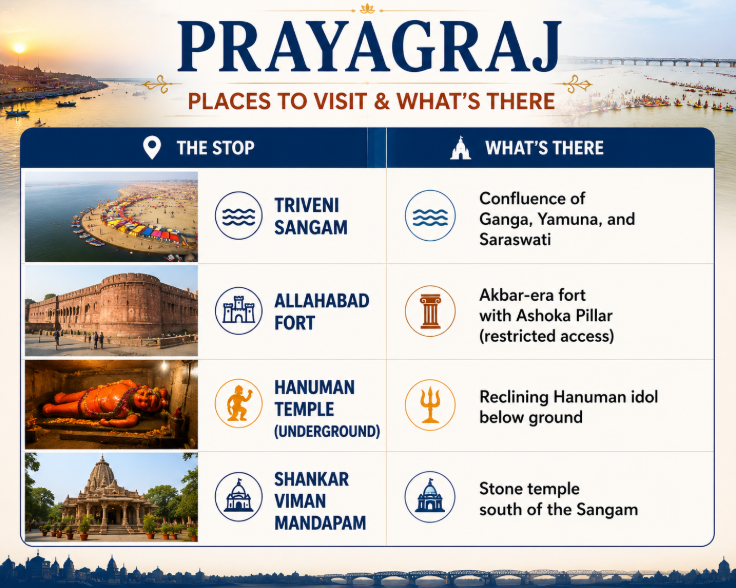
Prayagraj’s main draw is the Triveni Sangam, where the Ganga and Yamuna meet. Boat rides to the actual confluence point cost ₹500 to ₹800 per boat (5 to 6 passengers) and take about 45 minutes. The Ganga Aarti at Triveni Sangam runs at 6 PM daily. For the best conditions, reach the ghat by 6:30 AM.
| The Stop | What’s There |
| Triveni Sangam | Confluence of Ganga, Yamuna, and Saraswati |
| Allahabad Fort | Akbar-era fort with Ashoka Pillar (restricted access) |
| Hanuman Temple (underground) | Reclining Hanuman idol below ground |
| Shankar Viman Mandapam | Stone temple south of the Sangam |
Prayagraj to Chitrakoot is 130 km (3 hours), which makes these two a natural pair on the same day or back-to-back days.
4. Vindhyachal
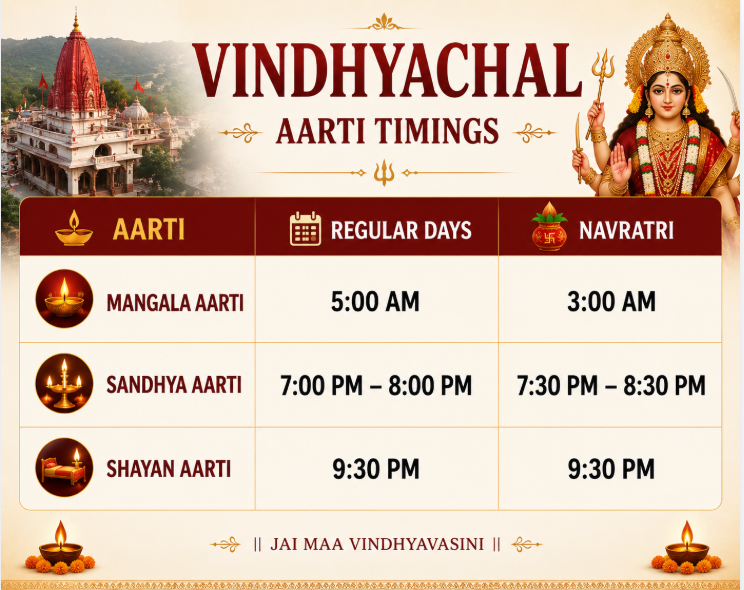
The Vindhyavasini Temple at Vindhyachal, near Mirzapur, is one of the major Shakti Peethas of northern India. The town sits 63 km west of Varanasi and 90 km east of Prayagraj, so it’s a logical stopover on the highway between the two.
Most devotees combine darshan here with the Trikon Parikrama – a triangular route connecting the Vindhyavasini Temple, Kali Khoh Temple (2 km), and Ashtabhuja Temple (3 km). The full parikrama takes about 2 hours on foot or 30 minutes by e-rickshaw.
| Aarti | Regular Days | Navratri |
| Mangala Aarti | 5:00 AM | 3:00 AM |
| Sandhya Aarti | 7:00 PM – 8:00 PM | 7:30 PM – 8:30 PM |
| Shayan Aarti | 9:30 PM | 9:30 PM |
Navratri is the busiest period at Vindhyachal; expect longer queues and extended aarti schedules. During regular days, the temple is far less crowded and a morning stop can be completed in 2 to 3 hours.
5. Mathura and Vrindavan
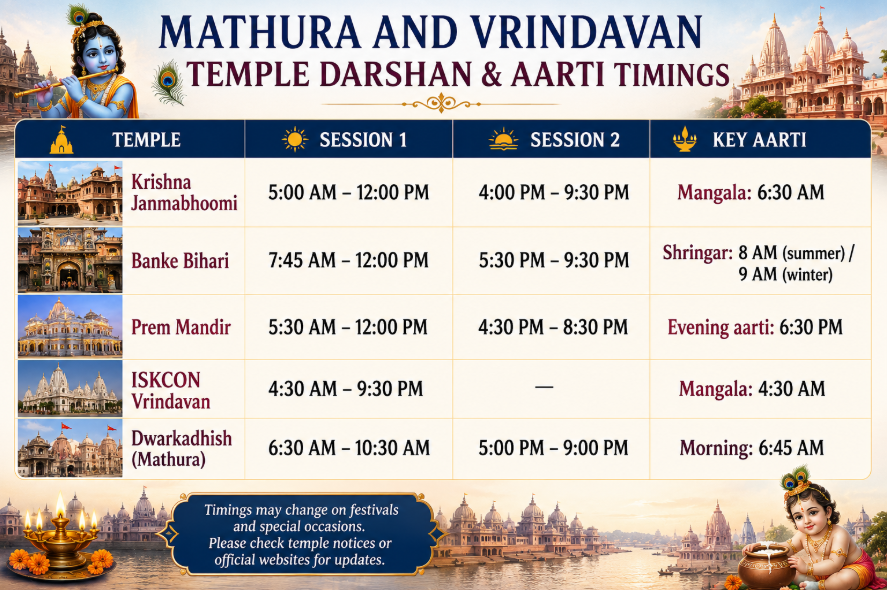
Mathura and Vrindavan are 12 km apart and are best covered together as a single full-day visit. The Krishna Janmabhoomi temple in Mathura marks the birthplace of Lord Krishna and is open from 5 AM to 12 PM and 4 PM to 9:30 PM. Mangala Aarti starts at 6:30 AM.
At the Banke Bihari Temple in Vrindavan, the darshan style is distinctive. The curtain before the idol opens and closes every few minutes (Jhanki Darshan). The aarti timings shift seasonally.
| Temple | Session 1 | Session 2 | Key Aarti |
| Krishna Janmabhoomi | 5:00 AM – 12:00 PM | 4:00 PM – 9:30 PM | Mangala: 6:30 AM |
| Banke Bihari | 7:45 AM – 12:00 PM | 5:30 PM – 9:30 PM | Shringar: 8 AM (summer) / 9 AM (winter) |
| Prem Mandir | 5:30 AM – 12:00 PM | 4:30 PM – 8:30 PM | Evening aarti: 6:30 PM |
| ISKCON Vrindavan | 4:30 AM – 9:30 PM | — | Mangala: 4:30 AM |
| Dwarkadhish (Mathura) | 6:30 AM – 10:30 AM | 5:00 PM – 9:00 PM | Morning: 6:45 AM |
No entry fee at any of the major temples in Mathura or Vrindavan. Photography inside the sanctum is generally not permitted. Varanasi to Mathura is approximately 330 km, 6 to 7 hours by cab. Many pilgrims combine Mathura and Vrindavan with a Delhi leg or break the drive at Agra.
6. Chitrakoot
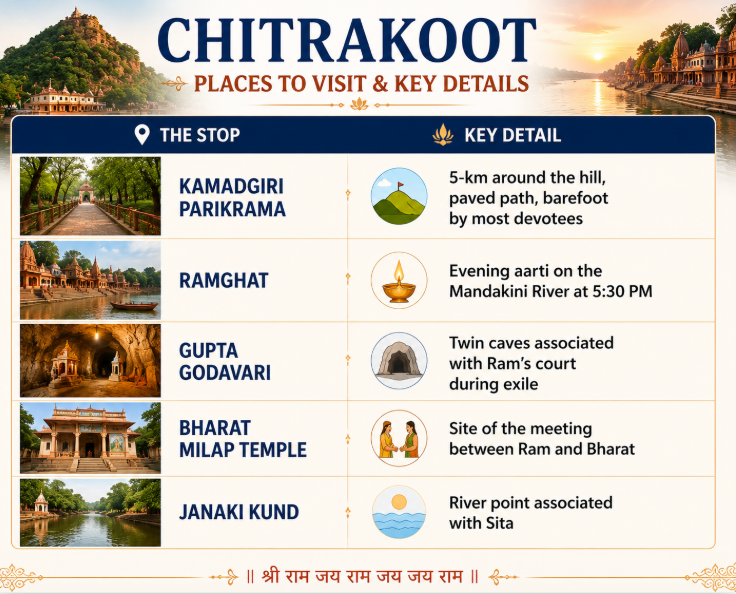
Chitrakoot, on the UP-Madhya Pradesh border, is where Lord Ram spent the longest time of his exile, about 11.5 of the 14 years. It’s a smaller, quieter town compared to Ayodhya or Varanasi. Carry cash before arriving because UPI and card acceptance is limited at most temple counters and shops here.
The two main sites: Kamadgiri, a forested hill with a 5-km paved parikrama path that takes 1.5 to 2 hours on foot, and Ramghat on the Mandakini River, where an evening aarti runs at 5:30 PM. The parikrama is best started before 8 AM.
| The Stop | Key Detail |
| Kamadgiri Parikrama | 5-km around the hill, paved path, barefoot by most devotees |
| Ramghat | Evening aarti on the Mandakini River at 5:30 PM |
| Gupta Godavari | Twin caves associated with Ram’s court during exile |
| Bharat Milap Temple | Site of the meeting between Ram and Bharat |
| Janaki Kund | River point associated with Sita |
Prayagraj to Chitrakoot: 130 km, 3 hours. Chitrakoot to Ayodhya via Prayagraj: about 300 km, 6 to 7 hours. Plan Chitrakoot as a day trip from Prayagraj or an overnight stay.
7. Naimisharanya
Naimisharanya, also called Neemsar, is in Sitapur district on the Gomti River, 90 km from Lucknow. It’s one of the oldest pilgrimage sites in the Mahabharata’s geography, where 88,000 sages are said to have gathered for the composition of the Puranas. It’s less visited than Varanasi or Ayodhya, which also means shorter queues and a quieter temple experience.
The main sites: Chakra Teertha (a sacred pond where a holy dip on Purnima is considered especially significant), the Lalita Devi Temple (one of the 51 Shaktipeethas), and Vyas Gaddi (where Vedavyasa is said to have divided the Vedas). The complex opens from 6 AM to 12 PM and 4 PM to 8 PM. The afternoon break runs from 12 PM to 4 PM.
Naimisharanya fits best on a Lucknow-to-Ayodhya leg.Leave Lucknow early, visit Naimisharanya (90 km, 2.5 hours), then continue to Ayodhya (210 km from Naimisharanya, about 4 hours).
8. Kushinagar
Kushinagar is where Gautama Buddha attained Mahaparinirvana around 480 BCE. The site draws Buddhist pilgrims from across Asia year-round. It’s 55 km east of Gorakhpur and about 300 km northeast of Varanasi.
The Parinirvana Stupa and Temple is the primary site, maintained by the Archaeological Survey of India, and opens from sunrise to sunset. Entry is free for Indian nationals. The 6.1-metre reclining Buddha statue inside the temple dates to the 5th century.
| Site | What It Marks |
| Parinirvana Stupa and Temple | Exact site of Buddha’s Mahaparinirvana |
| Ramabhar Stupa | Cremation site of the Buddha |
| Mathakuar Shrine | 10th-century seated Buddha with inscription |
| Kushinagar Museum | Sculptures and artefacts from site excavations |
Kushinagar and Gorakhpur work well as a combined day trip from a base in Gorakhpur, or as the final leg before returning to Varanasi.
9. Gorakhpur
The Gorakhnath Temple in Gorakhpur is a functioning monastery, not just a shrine. Baba Gorakhnath is the presiding deity of the Nath tradition, and thousands of devotees visit daily. The temple opens from 5 AM to 9 PM. Main aarti times are 6 AM and 7 PM. The campus includes a Kali Mandir, a large sacred tank, and a dharamshala complex for pilgrims. Gorakhpur is well connected by train from both Varanasi (4 hours) and Lucknow.
Suggested 10-Day Route from Varanasi
| Day | Leg | Distance | Main Stops |
| Day 1 | Arrive Varanasi | — | Ganga Aarti at Dashashwamedh |
| Day 2 | Varanasi full day | — | Kashi Vishwanath, Kaal Bhairav, Sarnath |
| Day 3 | Varanasi to Prayagraj via Vindhyachal | 153 km | Trikon Parikrama, Sangam boat ride |
| Day 4 | Prayagraj to Chitrakoot | 130 km | Kamadgiri, Ramghat aarti |
| Day 5 | Chitrakoot to Ayodhya via Prayagraj | 300 km | Saryu Ghat, Ram Mandir, Hanumangarhi |
| Day 6 | Ayodhya to Lucknow with Naimisharanya | 230 km | Chakra Teertha, Lalita Devi Temple |
| Day 7 | Lucknow to Mathura | 340 km | Long drive; arrive Mathura by evening |
| Day 8 | Mathura and Vrindavan full day | — | Krishna Janmabhoomi, Banke Bihari, Prem Mandir |
| Day 9 | Mathura to Gorakhpur | 560 km | Long drive day; overnight Gorakhpur |
| Day 10 | Gorakhpur to Kushinagar to Varanasi | 350 km | Parinirvana Stupa, Ramabhar Stupa |
Day 7 and Day 9 are the longest driving days. Families with elderly members should break Day 9 into two legs by adding an overnight stop at Lucknow, extending the trip to 11 days.
Best Time to Visit
October to March is the most practical window for a UP pilgrimage tour. Temperatures across the journey will stay between 10°C and 28°C. Stone temple floors in Mathura and Varanasi can hit 50°C in May and June. Monsoon (July–September) brings high humidity and occasional road disruptions on the Prayagraj–Chitrakoot route.
Key festivals that significantly change the experience:
- Dev Deepawali (November): All ghats in Varanasi lit with lakhs of diyas. Book boats at least two weeks in advance.
- Mahashivaratri (February/March): Kashi Vishwanath stays open overnight. Queues start from the night before.
- Janmashtami (August/September): Temples in Mathura and Vrindavan extend darshan through midnight.
- Navratri (October):Vindhyachal sees its largest crowds of the year.
- Ram Navami (March/April): Ayodhya’s Surya Tilak ceremony directs sunlight onto Ram Lalla’s forehead at exactly 12 PM.
Useful Tips Before You Start
- Carry a valid government-issued photo ID at every stop. Aarti passes at both Kashi Vishwanath and Ram Mandir require ID verification.
- Mobile phones are not allowed inside Kashi Vishwanath or Ram Mandir. Deposit them at locker counters before joining the queue.
- Carry ₹2,000 to ₹3,000 in cash per day for Chitrakoot and Naimisharanya legs. Cards and UPI are unreliable at smaller temples in these towns.
- Dress code: covered shoulders and covered knees are required at most temples. Keep a stole or dupatta accessible.
- For Kashi Vishwanath: arrive by 4:30 AM on regular days for manageable queues. On festival days and Mondays, arrive an hour earlier.
- For senior citizens: avoid scheduling two high-footfall stops (Varanasi and Mathura) on consecutive days without a rest day between.
Travelling the UP Pilgrimage with Chiku Cab
The UP pilgrimage can’t be fully covered by train because smaller dham sites like Vindhyachal, Naimisharanya, and Chitrakoot require road access. Chiku Cab’s servicescovers all ten destinations in this guide, with drivers who know temple parking zones, entry gate schedules, and highway stopovers.
Available vehicles:
| Vehicle | Capacity | Best For |
| Sedan (Swift Dzire / Amaze) | 4 passengers | Couples, solo pilgrims |
| SUV (Ertiga / Innova Crysta) | 6–7 passengers | Families, senior groups |
| Tempo Traveller | 12–17 passengers | Group pilgrimages |
Pricing is transparent, covering fuel, driver allowance, toll, and state tax. No additional charges are applied at the end of the trip. For exact rates for your specific route and dates, call 844-844-5504 or book through the Chiku Cab app.
What’s included in Chiku Cab’s pilgrimage tour service:
- 24/7 customer support and booking assistance
- AC vehicles cleaned between outstation legs
- Drivers with knowledge of temple access roads and restricted vehicle zones
- Flexible itineraries with no penalties for route changes
- Multi-city UP pilgrimage tour packages covering the full 10-destination.
- Assistance with luggage for elderly and senior travellers
FAQs About UP Pilgrimage Tour
1. Which are the top pilgrimage places in Uttar Pradesh?
Varanasi, Ayodhya, Prayagraj, Mathura, Vrindavan, Vindhyachal, Chitrakoot, Naimisharanya, Kushinagar, and Gorakhpur are the ten major pilgrimage destinations in Uttar Pradesh.
2. Why is Varanasi famous for pilgrimage?
Varanasi is home to the Kashi Vishwanath Jyotirlinga, one of the twelve sacred Shiva shrines in India, and the Dashashwamedh Ghat where the Ganga Aarti runs every evening. It’s considered the holiest city in Hinduism.
3. Why should I visit Ayodhya?
Ayodhya is the birthplace of Lord Ram and home to the newly consecrated Ram Mandir. Pilgrims visit for Ram Mandir darshan, Saryu Ghat aarti, Hanumangarhi, and Kanak Bhawan.
4. What is special about Prayagraj (Allahabad)?
Prayagraj sits at the Triveni Sangam, where the Ganga, Yamuna, and the invisible Saraswati meet. A boat ride to the confluence point and a holy dip here are considered among the most significant acts of pilgrimage in Hinduism.
5. Why is Vindhyachal important?
Vindhyachal is one of the major Shakti Peethas of northern India, home to Maa Vindhyavasini Temple. Most devotees complete the Trikon Parikrama connecting three temples across the town, which takes two to three hours.
6. What is Naimisharanya known for?
Naimisharanya is the ancient forest site where 88,000 sages gathered for the composition of the Puranas. It holds the Chakra Teertha, Lalita Devi Shaktipeeth, and Vyas Gaddi, and is significantly less crowded than the major temple towns.
7. Why are Mathura and Vrindavan visited together?
Mathura is the birthplace of Lord Krishna, and Vrindavan is where he spent his childhood. The two towns are just 12 km apart, and most pilgrims cover both in a single day across five to six major temples.
8. What makes Chitrakoot sacred?
Lord Ram is believed to have spent 11.5 of his 14 exile years in Chitrakoot. The Kamadgiri parikrama and the evening aarti at Ramghat on the Mandakini River are the two main draws for pilgrims.
9. Why is Kushinagar important for Buddhists?
Kushinagar is where Gautama Buddha attained Mahaparinirvana around 480 BCE. The Parinirvana Stupa, Ramabhar Stupa, and Mathakuar Shrine make it one of the four most sacred sites in global Buddhism.
10. What is Gorakhpur famous for spiritually?
Gorakhpur is home to the Gorakhnath Temple, the spiritual centre of the ancient Nath tradition. The temple is a functioning monastery visited by thousands of devotees daily, open from 5 AM to 9 PM.
11. How many days are needed for a Uttar Pradesh pilgrimage tour?
Ten days covers the full trip at a reasonable pace. Families with elderly travellers or those wanting unhurried darshan at each stop should plan for 12 days.
12. Which pilgrimage city should I visit first?
Most pilgrims start from Varanasi, as it’s the best-connected city on the circuit by air, rail, and road. Chiku Cab also uses Varanasi as its primary base for UP pilgrimage outstation tours.
13. What is the best time for pilgrimage in Uttar Pradesh?
October to March is the most practical window, with temperatures between 10°C and 28°C. April to June is manageable but the stone temple floors in Varanasi and Mathura get extremely hot. Monsoon months bring high humidity and occasional road disruptions.
14. Can these places be covered by taxi?
Yes, and a private cab is the most practical option for the full trip. Several sites, including Vindhyachal, Chitrakoot, and Naimisharanya, require road access and don’t connect directly by train. Chiku Cab offers outstation taxis, SUVs, and tempo travellers across the entire UP pilgrimage route.
15. Is one week enough for these destinations?
Seven days is tight for all ten stops. A focused week-long trip can comfortably cover Varanasi, Ayodhya, Prayagraj, Vindhyachal, and Mathura-Vrindavan, skipping the longer-drive legs to Gorakhpur and Kushinagar.
16. Which places are best for Krishna devotees?
Mathura (birthplace), Vrindavan (childhood leelas), and the Dwarkadhish Temple in Mathura are the primary stops. Vrindavan’s Banke Bihari Temple, Prem Mandir, and ISKCON campus round out the Krishna pilgrimage circuit.
17. Which places are best for Ram devotees?
Ayodhya (birthplace, Ram Mandir), Chitrakoot (where Ram spent his exile), and Prayagraj (where Ram crossed the Ganga into the forest) form the core Ram pilgrimage route in Uttar Pradesh.
18. Which Buddhist pilgrimage places are in Uttar Pradesh?
Kushinagar (Mahaparinirvana site), Sarnath near Varanasi (site of Buddha’s first sermon), and Shravasti in Balrampur district (where Buddha spent 24 monsoon retreats) are the three principal Buddhist pilgrimage sites in UP.
19. Are these pilgrimage sites family-friendly?
Most major temples, including Kashi Vishwanath, Ram Mandir, and Banke Bihari, now have ramps, priority darshan for elderly visitors, and dedicated queues for families. Booking a private cab with Chiku Cab allows families to manage schedules, rest stops, and luggage without the stress of public transport.
20. Why choose Uttar Pradesh for pilgrimage travel?
UP covers more sacred ground per square kilometre than any other state in India; three faith traditions, twelve pilgrimage cities, and a road network that connects all of them within a 10 to 12-day trip. No other state offers this range in a single trip.

I’m a wanderer who loves venturing on to unknown and unseen places. I explore freely to various fun and adventurous places, whether it be spiritual temple tours, captivating landscapes, and more. I wonder around in search of hidden gems and tourist attractions, temples, and other places.