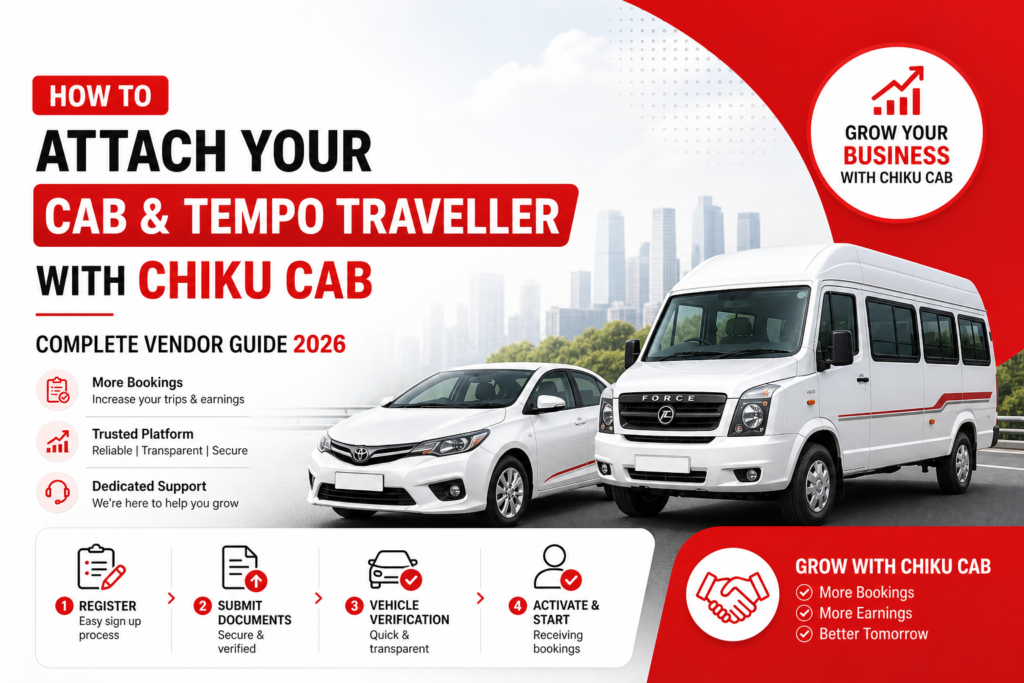
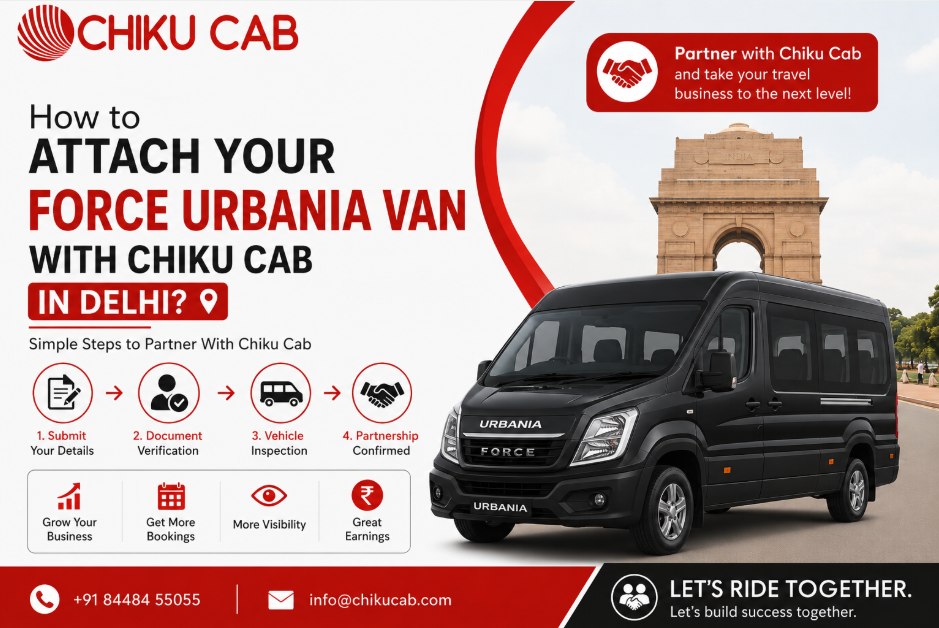
Delhi runs on movement. Weddings in Dwarka, corporate offsites in Gurugram, school trips from Rohini, pilgrimages to Haridwar. Every one of those trips needs a large, comfortable van, and the Force Urbania has become the vehicle of choice for group travel across the capital. If you own one and you’re trying to figure out how to turn it into a consistent income source, attaching it with Chiku Cab is the most structured path to doing that. Here, you will get the entire Urbania van attachment process in Delhi: what it means, what it takes, what the income looks like, and how Chiku Cab specifically makes the process work.
Attaching your van with a travel company means you stop chasing customers and start receiving bookings. It’s a shift from operating in the dark to running a structured, income-generating business with the backing of an established platform.
What Does Urbania Van Attachment Actually Mean?
Vehicle attachment is the formal process of registering your Force Urbania van with a licensed travel or taxi company. Once attached, your vehicle operates under that company’s network. You get bookings through their platform. They handle customer acquisition, payment processing, and trip dispatch. You focus on operations.
For van owners in Delhi, this matters because the demand for Urbania vans in Delhi NCR is growing steadily across corporate travel, airport transfers, weddings, and outstation trips. Running those bookings independently means managing your own marketing, customer complaints, payment follow-ups, and route planning. Attaching with a company like Chiku Cab shifts all of that. The result is a van that earns money consistently, not just when you find a customer.
Why Attach Your Urbania Van with Chiku Cab?
There are operators in Delhi who run their Urbania vans independently. Some do well. Most spend more time managing WhatsApp inquiries and chasing payments than they do actually running trips. Chiku Cab’s attachment model removes that friction.
Steady Bookings Across Trip Types
Chiku Cab covers the full range of group travel use cases in Delhi. Attached vans get bookings for local sightseeing, outstation trips (both one-way and round), and airport transfers from Delhi. Outstation routes and airport runs tend to generate the highest fare per trip, which makes the income more predictable across the month.
Low Commission, High Take-Home
Chiku Cab’s platform commission sits at 8%, which is significantly lower than what other aggregator platforms charge. That difference has a direct impact on your monthly take-home. On top of that, you earn an 8% incentive on every booking with a 5-star customer rating, effectively letting you claw that commission back through good service.
Income-Linked Rewards
The platform runs a Chiku Points system where 1 point equals Rs. 1. You earn bonus points on successful rides, and you get a joining bonus of Rs. 250 to Rs. 1,000 depending on your vendor category at the time of attachment. After 15 bookings with a 5-star rating, your category upgrades automatically, unlocking higher-value booking types.
You Keep Control of Your Schedule
You decide your availability. The platform fills your calendar when you’re active. This isn’t a contract that forces you to run trips at 2 AM. Flexibility matters, especially for owner-operators managing driver shifts and vehicle maintenance.
Marketing and Support Are Handled
Chiku Cab manages customer acquisition and service. You don’t run ads. You don’t answer pre-trip inquiries. You don’t resolve billing disputes. The platform handles that end, so your driver is focused on the road and you’re focused on keeping the van in good shape.
How Much Can You Earn from an Attached Urbania Van in Delhi?
This is the question that matters most, so here’s an honest breakdown.
Chiku Cab’s outstation Urbania rate starts at Rs. 30 per km, with a full-day local rental starting at Rs. 7,000 covering 80 km and 8 hours. Airport and outstation trips generate the highest per-trip income. Full-time operation in a metro city like Delhi can produce a monthly net profit of Rs. 20,000 to Rs. 1.5 lakhs after expenses.
| Expense / Income Item | Low Estimate | Average Estimate | High Estimate |
| Gross monthly fare income | Rs. 60,000 | Rs. 90,000 | Rs. 1,50,000+ |
| Fuel cost per month | Rs. 15,000 | Rs. 22,000 | Rs. 30,000 |
| Driver salary per month | Rs. 15,000 | Rs. 20,000 | Rs. 25,000 |
| Maintenance per month | Rs. 5,000 | Rs. 7,500 | Rs. 10,000 |
| Platform fee (8%) | Rs. 4,800 | Rs. 7,200 | Rs. 12,000 |
| Estimated net profit | Rs. 20,200 | Rs. 33,300 | Rs. 73,000+ |
Note: These are illustrative estimates based on industry averages for Delhi NCR. Your actual income depends on trip volume, route mix, and van utilization. Outstation trips to Agra, Haridwar, and Jaipur, and airport runs near IGI Airport, consistently produce the highest per-trip returns.

Who Can Attach Their Urbania Van with Chiku Cab?
You don’t need to be a large fleet operator to attach your van. Chiku Cab accepts three types of vehicle owners:
- Driver-cum-owner: You own the van and drive it yourself.
- Single cab owner: You own the van and hire a driver to operate it.
- Fleet operator: You own multiple vans with separate drivers for each.
Regardless of which category you fall into, the eligibility requirements are the same:
| Eligibility Criteria | Details |
| Van ownership | Must be the registered owner or authorized lessee of the Urbania van |
| Vehicle age | Typically not older than 5 to 7 years (varies by company policy) |
| Registration type | Must hold or be eligible for commercial vehicle registration in Delhi (yellow number plate) |
| Valid permits | All-India Tourist Permit or Delhi State Permit required |
| Driver license | Valid commercial driving license with badge license issued by Delhi Transport Authority |
| Insurance | Valid commercial vehicle insurance, mandatory before onboarding |
Documents Required to Attach Your Urbania Van in Delhi
Keep these ready before you approach Chiku Cab. The verification team checks all of these before the vehicle inspection is scheduled.
Vehicle documents:
- RC (Registration Certificate) showing commercial registration status
- All-India Tourist Permit or Delhi State Permit
- Vehicle Fitness Certificate issued by the RTO (valid for 1 to 2 years)
- Valid commercial vehicle insurance certificate
Driver documents:
- Transport Vehicle license (Heavy Motor Vehicle or LMV-Transport category)
- Badge license issued by the Delhi Transport Authority
- Police verification certificate
Owner documents:
- PAN card
- Aadhaar card
- Owner details form with contact information
If you’re attaching as a fleet operator, you’ll need the driver details for each vehicle, including their license copies and police verification certificates, filed separately.
The Urbania Van Attachment Process with Chiku Cab: Step by Step
The process is more straightforward than most people expect. Here’s what it looks like from start to first trip.
Step 1: Get Your Van Commercially Registered
Your Urbania van must carry a yellow number plate. This isn’t a Chiku Cab rule; it’s a legal requirement under the Motor Vehicles Act for any vehicle operating commercially in India. If your van is currently on a private (white) plate, visit your nearest Delhi RTO to convert the registration. No travel company will accept a private plate vehicle for attachment.
Step 2: Obtain the Right Permit
You need either an All-India Tourist Permit or a Delhi State Permit depending on the routes you intend to run. The All-India permit is worth getting if you plan to take outstation trips to Agra, Jaipur, Haridwar, or Manali. The state permit covers routes within Delhi and parts of NCR.
Step 3: Clear the RTO Fitness Inspection
Your van has to pass a fitness inspection at the RTO. The certificate is valid for 1 to 2 years. Keep the renewal date in your calendar; an expired fitness certificate is one of the most common reasons van owners face delays during the attachment process.
Step 4: Arrange the Driver’s Commercial License
If you’re not driving the van yourself, your driver must hold a Transport Vehicle license in the HMV or LMV-Transport category. They also need the badge license from the Delhi Transport Authority. Both are mandatory under the Motor Vehicles Act. This can’t be bypassed.
Step 5: Gather All Documents
Pull together everything listed in the documents section above. Having incomplete paperwork is the single biggest reason the attachment process gets delayed. The verification team at Chiku Cab reviews all documents before they schedule the physical inspection.
Step 6: Apply Online or Visit Chiku Cab’s Office
You can apply online through Chiku Cab’s website or visit their office directly. Submit your documents for verification. The process runs faster online since you can upload scanned copies and track the status of your application.
Step 7: Vehicle Inspection
Once your documents clear, the team schedules a physical inspection of the van. They check the mechanical condition, interior cleanliness, and safety features. The inspection typically takes 1 to 2 working days to get cleared.
Step 8: Sign the Attachment Agreement
Read the agreement carefully before signing. It covers the commission structure, booking allocation, payment cycle, responsibilities of both parties, and the terms for exit. Chiku Cab’s 8% commission rate and the incentive structure should be spelled out here. If anything isn’t clear, ask before signing.
Step 9: Branding and Onboarding
Your van gets branded with the Chiku Cab logo. After that, you’re added to the active fleet and start receiving bookings. You also get access to the driver portal for real-time trip management, so you know what’s coming before the driver gets the call.
Where Chiku Cab Operates in Delhi NCR
Chiku Cab covers Delhi NCR as a whole, with strong booking volumes across several key corridors. The Dwarka to IGI Airport route is one of the highest-frequency corridors for airport transfers. South Delhi accounts for a large share of corporate and wedding bookings. Rohini and parts of North Delhi feed into outstation departures toward Haridwar and Chandigarh.
The platform also covers Noida, Gurgaon, and Ghaziabad as NCR extension zones. Outstation routes out of Delhi go to Agra, Jaipur, Haridwar, Shimla, and Manali, all of which are high-value routes for attached Urbania vans.
If your van is based near IGI Airport or in South Delhi, your utilization rate is likely to be higher simply because of the trip density in those areas.
Urbania vs Tempo Traveller: Why the Urbania Earns More in Delhi
If you’re deciding between attaching an Urbania and an older tempo traveller, here’s what the difference actually looks like in practice.
| Feature | Force Urbania | Standard Tempo Traveller |
| Seating capacity | 12 or 17 seater options | 9 to 17 seater (older builds) |
| Cabin height | Full stand-up height | Lower roof, cramped on long trips |
| Ride quality | Air suspension, smoother on highways | Standard suspension |
| Corporate demand | High; preferred by corporates and airports | Lower for premium segments |
| Fare premium | Commands 15 to 25% higher rate | Base rate |
| Interior features | Reclining seats, charging points, AC, sliding windows | Basic AC and seating |
The Urbania’s air suspension and full stand-up cabin are the reasons corporate clients and airport transfer customers specifically request it over older vans. That preference translates directly into higher per-trip earnings and better booking consistency.
A Few Things to Keep in Mind Before You Attach
Starting the attachment process before your documents are fully in order wastes time for everyone involved. Get the commercial registration, fitness certificate, and permits sorted first. Then approach the platform.
If you’re hiring a driver rather than operating yourself, make sure their badge license and police verification are complete before you apply. The driver verification is part of the onboarding process and it runs in parallel with vehicle inspection.
Your van’s condition at inspection matters. Clean interiors, working AC, and functioning charging ports determine whether the vehicle gets accepted into the premium Urbania category or gets downgraded to a standard listing. A vehicle in good condition earns more from day one.
Aim for consistent 5-star ratings in your first 15 trips. That’s the threshold for category upgradation, and the upgrade unlocks higher-value booking types that directly improve monthly income.
Ready to attach your Urbania van? Call Chiku Cab at 844-844-5504 or fill out the attachment form on chikucab.com to get started.
FAQs About Urbania Van Attachment in Delhi
How can I attach my Force Urbania van with a taxi company in Delhi NCR?
Get your Urbania van commercially registered with a yellow number plate, arrange the required permits and fitness certificate, then apply online or visit Chiku Cab’s office directly. Submit your documents, clear the vehicle inspection, sign the attachment agreement, and you’re onboarded. The full process takes about a week if your paperwork is in order.
What documents are required for Urbania van attachment in Delhi?
You’ll need the RC book showing commercial registration, an All-India Tourist Permit or Delhi State Permit, the RTO fitness certificate, commercial vehicle insurance, the driver’s Transport Vehicle license, a Delhi Transport Authority badge license, police verification certificate, and the owner’s PAN and Aadhaar. Have all of these ready before you apply.
How much can I earn by attaching my Urbania van in Delhi NCR?
Urbania van Net monthly income ranges from Rs. 20,000 on the low end to Rs. 73,000 and above for vans running full-time outstation and airport trips. Gross fare income can reach Rs. 1.5 lakhs, with fuel, driver salary, maintenance, and Chiku Cab’s 8% commission as the main deductions. Airport and outstation routes produce the highest per-trip returns.
What is the Urbania van attachment process in Delhi?
The process runs in nine steps: commercial registration, permit acquisition, fitness certificate, driver license verification, document preparation, application submission, vehicle inspection, agreement signing, and van branding. Chiku Cab accepts both online applications and in-office visits. Once documents clear, inspection takes one to two working days, after which you start receiving bookings for Urbania Van.
Which is better for attachment in Delhi: Urbania Van or Tempo Traveller?
The Urbania Van earns more. Its full stand-up cabin, air suspension, reclining seats, and charging points make it the preferred choice for corporate clients and airport transfers, which are the highest-paying trip categories. It commands a 15 to 25 percent fare premium over standard tempo travellers on the same routes, and corporate bookers specifically request it.

I’m a wanderer who loves venturing on to unknown and unseen places. I explore freely to various fun and adventurous places, whether it be spiritual temple tours, captivating landscapes, and more. I wonder around in search of hidden gems and tourist attractions, temples, and other places.