
The Panchkoshi Yatra (also spelled Panchkroshi or Panch Kosi Parikrama) is one of Hinduism’s most ancient and revered pilgrimages — a sacred circuit of 88 kilometres around the holy city of Kashi (Varanasi).
Mentioned in the Kashi Khanda and other ancient scriptures, the yatra traces a clockwise circle around Kashi covering 25 Kos (one Kos ≈ 3.2 km), passing through five major halting points called padavs. The route encompasses 108 Shiva temples, 11 Vinayaka temples, 10 Devi temples, 4 Vishnu temples, 2 Bhairava temples, and 15 temples of other deities — over 150 sacred sites in total.
According to ancient texts, completing the Panchkoshi Yatra is spiritually equivalent to visiting all four Char Dhams. It is said that Lord Shiva himself whispers the Taraka Mantra into the ears of those who die in Kashi — and those who complete this sacred circuit receive his direct blessings, purification of all karmas, and liberation from the cycle of rebirth.
What Is Panchkoshi Yatra?
All 5 sacred padavs, 108 temples, exact timings, pickup points, road conditions, and transparent taxi fares — everything you need to complete the holy circuit of Kashi in a single day.
88 km total circuit · 5 sacred padavs · 108 Shiva temples · Fares from ₹2,200
Mythological Significance: Lord Rama completed the Panchkoshi Yatra with his brothers after the Lanka war to seek absolution from Brahmahatya (the sin of killing the Brahmin Ravana). The Pandavas also walked this route during their Agnyatvas. The yatra is believed to have been practised continuously since Treta Yuga.
Traditionally, the yatra is completed over five days on foot, with pilgrims spending one night at each padav. Today, thousands of families, elderly devotees, and out-of-town pilgrims choose to complete the entire circuit in one day by taxi — covering all five padavs with complete darshan and rituals.
Starting Time, End Time & Pre-Rituals
Timing is critical for the one-day yatra. Temples open early, and completing the circuit before sunset is considered auspicious.
One-Day Panchkoshi Yatra Timings (by Taxi):
- Start Time: 4:30 AM – 5:00 AM (Sankalp at Manikarnika Kund)
- Road Circuit Begins: 6:00 AM from Assi Ghat (after boat ritual)
- Return to Manikarnika Ghat: 5:00 PM – 6:00 PM
- Ideal Completion: Before sunset for maximum auspiciousness
Pre-Departure Rituals (4:30 AM – 6:00 AM)
The yatra does not simply begin with getting into a taxi. Proper pre-departure rituals at Manikarnika Kund are an integral part of the pilgrimage:
- Holy Dip at Manikarnika Kund — Pilgrims take a sacred bath in this ancient tank adjacent to Manikarnika Ghat before sunrise.
- Sankalp (Sacred Vow) at Dhundhiraj Ganesh Temple — Pilgrims hold water in cupped hands and declare their intention to complete the yatra. This vow activates the spiritual merit of the journey.
- Boat Ride from Manikarnika Ghat to Assi Ghat — Pilgrims cross the Ganga by boat. This river crossing is itself considered purifying. The road circuit officially begins at Assi Ghat.
- Your taxi meets you at Assi Ghat — Your dedicated driver will be waiting after your boat ritual to begin the circuit.
Previous Evening Tip: It is highly recommended to do darshan of Kashi Vishwanath Temple, Maa Annapurna Devi, and Kal Bhairav the evening before your yatra day. This “pre-yatra darshan” is considered an essential spiritual preparation by Kashi pandits.
One-Day Panchkoshi Yatra Itinerary by Taxi
This carefully planned schedule allows comfortable darshan at all five padavs and key temples, with adequate time for rituals, prasad, and rest breaks.
| Time | Stop | Details |
|---|---|---|
| 4:30 AM | Hotel/Ghat Pickup | Driver arrives at your hotel or guesthouse. Proceed to Manikarnika Ghat area. |
| 4:50 AM | Manikarnika Kund + Sankalp | Holy dip in the Kund, Sankalp at Dhundhiraj Ganesh Temple, then boat to Assi Ghat. (~60 min) |
| 6:00 AM | Assi Ghat — Circuit Begins | Taxi waits at Assi. Clockwise circuit begins toward Kardameshwar. (~25 min drive, 9.6 km) |
| 6:30 AM | Padav 1 — Kardameshwar Mahadev | Darshan of Kardameshwar Mahadev and Bindu Madhav Vishnu. Offer rice grains at Kardam Kund. (~45 min) |
| 8:00 AM | Drive to Padav 2 | South-east through rural Varanasi. Some narrow sections near Ramna. (~35 min, 16 km) |
| 8:45 AM | Padav 2 — Bhimchandi Devi | Darshan of Bhimchandi Devi and Chandikeshwar Mahadev. Visit Gandharva Sagar Kund. (~60 min) |
| 10:15 AM | Drive to Padav 3 | Best-maintained stretch via Ramnagar road. Varuna River crossing. (~45 min, 22 km) |
| 11:00 AM | Padav 3 — Rameshwar Mahadev | Most spiritually powerful padav. Banks of Varuna River. Tulja Bhavani shrine. Optional river dip. (~60 min) |
| 12:30 PM | Lunch Break | Dharamshalas and dhabas near Rameshwar. Many pilgrims carry packed sattvic food. (~30 min) |
| 1:15 PM | Padav 4 — Shivpur, Panch Pandav Mandir | Five Pandava Shiva lingas. Draupadi Kund nearby. A place of profound stillness. (~45 min) |
| 2:30 PM | Padav 5 — Kapildhara Mahadev | Final major padav. Shiva linga of Sage Kapila. Kapila Kund for Pitru Tarpan merit. (~50 min) |
| 4:00 PM | Return Drive | 17.6 km back to Manikarnika via Panchkoshi Marg. Stop at Jaun Ganesh Temple. (~40 min) |
| 5:00 PM | 🎉 Yatra Complete — Manikarnika Ghat | Final prayers, light a diya on the Ganga. 25 Kos, 88 km, all 5 padavs — Yatra Sampurna. Drop to hotel. |
All 5 Padavs of Panchkoshi Yatra
Each padav is a dedicated halting and worship point with its own cluster of temples, kunds, and divine significance.
Padav 1 — Kardameshwar Mahadev
3 Kos · ~9.6 km from Start
One of the oldest Shiva temples in all of Kashi, founded by the ancient sage Kardam who performed penance here. This padav connects the yatra to the story of Lord Rama’s visit for atonement after the Lanka war. The sacred Kardam Kund pond sits adjacent to the main temple.
Temples: Kardameshwar Mahadev · Bindu Madhav Vishnu · Kardam Kund · Bindu Sarovar
Padav 2 — Bhimchandi Devi
8 Kos · ~25.6 km from Start
The fierce form of Goddess Shakti, installed here by Bhima of the Pandavas during their Agnyatvas (incognito exile). Adjacent Chandikeshwar Mahadev temple and the legendary Gandharva Sagar Kund complete this powerful cluster. Pilgrims seek strength and courage.
Temples: Bhimchandi Devi · Chandikeshwar Mahadev · Gandharva Sagar Kund · Bhimchandi Ganesh
Padav 3 — Rameshwar Mahadev
15 Kos · ~48 km from Start
Located on the sacred banks of the Varuna River, this temple was established by Lord Rama to seek forgiveness for Brahmahatya — the sin of killing the Brahmin Ravana. Protected by Tulja Bhavani. Legend holds that no army has ever breached this sacred site.
Temples: Rameshwar Mahadev · Tulja Bhavani Devi · Varuna Sangam Ghat · Ram Kund
Padav 4 — Shivpur, Panch Pandav Mandir
19 Kos · ~60.8 km from Start
Five Shiva lingas here represent each of the five Pandavas. The sacred Draupadi Kund lies nearby. Lord Shiva is believed to rest at this padav during his cosmic Tandava dance — making it a place of extraordinary stillness, surrender, and reflection.
Temples: Panch Pandav Mahadev · Draupadi Kund · Shivpur Ganesh · Surya Dev Mandir
Padav 5 — Kapildhara Mahadev
22 Kos · ~70.4 km from Start
The final major padav, where a Shiva linga was installed by Sage Kapila — son of Sage Kardam, beautifully connecting the last padav back to the first. Located on the western spiritual boundary of Kashi, a dip here confers the same merit as the famous Gaya tirtha.
Temples: Kapildhara Mahadev · Kapila Ashram · Kapil Kund · Yogeshwar Shiva
Completion — Manikarnika Ghat (25 Kos · 88 km): Return to Manikarnika Ghat by boat. Final offerings at Jaun Ganesh Temple overlooking the eternal Ganga. The yatra is considered Sampurna (complete) once the pilgrim returns to the starting point.

Key Temples on Panchkoshi Yatra — Detailed Guide
Beyond the five padavs, the route passes dozens of sacred temples. Here are the most important ones every pilgrim must know.
1. Dhundhiraj Ganesh (Dhundi Vinayaka) — Pre-Yatra · Manikarnika
Located near Manikarnika Ghat, Dhundhiraj Ganesh is the first and most essential temple of the entire yatra — the Sankalp temple. No Panchkoshi Yatra is valid without seeking Ganesha’s blessings here and taking the sacred vow (Sankalp) in His presence. One of the Ekadasha (11) Vinayakas of Kashi listed in the Kashi Khanda. Open from 4:00 AM; busiest before 6:00 AM on yatra days.
“Without Dhundhiraj’s blessing, the Panchkoshi Yatra is like a journey begun without a map.” — Kashi Pandit tradition
2. Kardameshwar Mahadev Mandir — Padav 1
Established by the primordial sage Kardam, this temple has adjacent Kardam Kund and Bindu Sarovar sacred ponds. Lord Rama’s first stop on his own Panchkoshi Yatra after the Lanka war. Pilgrims offer rice grains into the kund to symbolically dissolve accumulated karma. The adjacent Bindu Madhav Vishnu shrine is a rare Vaishnava inclusion at a Shaiva padav. Temple opens at 5:00 AM; morning aarti at 6:00 AM is especially powerful.
Kardam Kund is believed to be the spot where Sage Kardam meditated for thousands of years before marrying Devahuti, their union producing Sage Kapila — connecting the first and last padavs across time.
3. Bhimchandi Devi Mandir — Padav 2
A fierce, powerful form of Goddess Shakti — literally “Chandi who belongs to Bhima.” According to the Mahabharata, during the Pandavas’ Agnyatvas, Bhima secretly installed this Shakti idol in the dense forest surrounding Kashi’s southern boundary. The adjacent Chandikeshwar Mahadev temple represents the divine union of Shakti and Shiva. Red hibiscus flowers and sindhur are the prescribed offerings. Believed to grant immense courage and protection from enemies.
4. Rameshwar Mahadev Mandir — Padav 3
The most mythologically significant padav on the circuit. It was here — on the peaceful banks of the Varuna River — that Lord Rama installed a Shiva linga to seek absolution from Brahmahatya. The Tulja Bhavani Devi shrine ensures no invader has ever reached this sacred site. The Varuna–Ganga Sangam (confluence) is visible a short walk from the temple. A dip in the Varuna River here is considered equivalent to bathing at all holy rivers simultaneously.
It is said that the moment Rama’s Shiva linga touched the earth at this spot, every accumulated sin of the entire Treta Yuga dissolved.
5. Panch Pandav Mandir (Shivpur) — Padav 4
Five Shiva lingas — Yudhishthira Linga, Bhima Linga, Arjuna Linga, Nakula Linga, Sahadeva Linga — stand in a single sanctum. The Pandavas installed these five lingas during their Agnyatvas as an act of deep surrender. Draupadi Kund is nearby, where Draupadi performed austerities for the safe return of her husbands. The atmosphere at this padav is notably still and meditative compared to the others.
6. Kapildhara Mahadev Mandir — Padav 5
Sage Kapila — father of the Sankhya philosophy and son of Sage Kardam — installed this Shiva linga after completing years of penance. The yatra thus forms a closed cosmic loop between father and son. Kapila Kund: a dip here grants the merit of performing Pitru Tarpan at Gaya. Especially important for those performing the yatra as an ancestor ritual.
7. Jaun Ganesh Temple — Return Journey
On the return journey to Manikarnika Ghat, pilgrims stop at Jaun Ganesh Temple, which commands a stunning panoramic view of the holy Ganga. One of Kashi’s 11 Vinayakas. The view of the Ganga from here is considered a darshan of the Goddess herself. Final offerings and gratitude prayers are made here before returning to Manikarnika.
Road Conditions on the Panchkoshi Yatra Route 2026
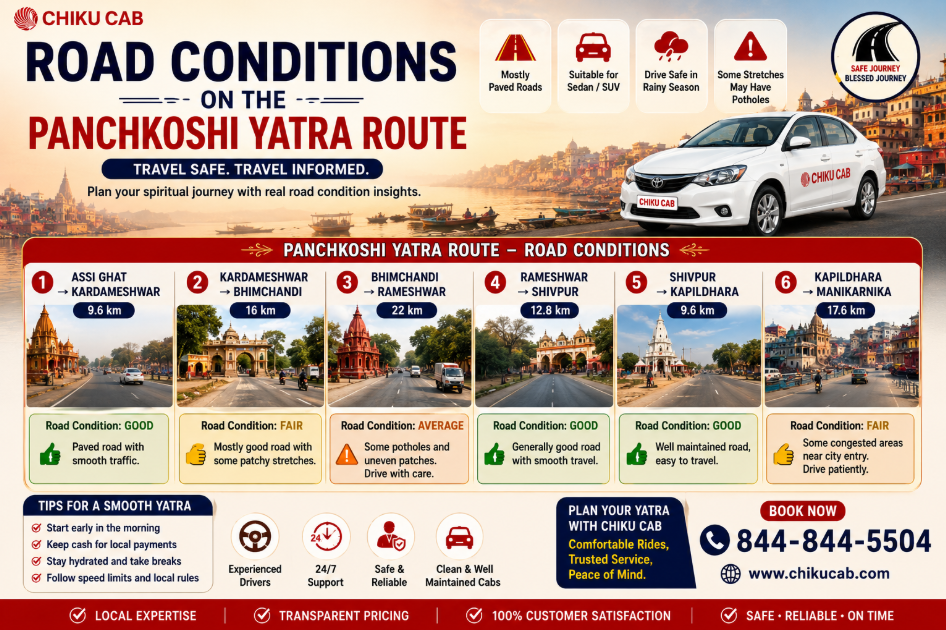
The Panchkoshi Marg passes through the outer belt of Varanasi — a mix of urban roads, rural stretches, narrow village lanes, and riverside tracks. Here is what to expect on each stretch:
Assi Ghat → Kardameshwar (9.6 km) — ✓ Good Condition Mostly surfaced roads through the southern urban fringe of Varanasi. Some traffic near Assi Chowk. The stretch near Kardam Kund village narrows to a single lane — driver experience is essential. No major potholes in 2026.
Kardameshwar → Bhimchandi (16 km) — ⚡ Fair, Some Patches Mix of paved and semi-paved roads. The Ramna bypass stretch has some surface patches repaired in early 2026. Village roads near Harahua area can be uneven. Speed bumps are frequent near school zones. Avoid during monsoon (July–September).
Bhimchandi → Rameshwar (22 km) — ✓ Good — Best Stretch The longest and best-maintained stretch of the circuit. The Ramnagar road is wide and well-surfaced. Varuna River bridge is two-lane and in good repair. Light to moderate traffic in the morning hours.
Rameshwar → Shivpur (12.8 km) — ⚡ Fair — Rural Roads Mostly rural district roads. Some stretches through farmland are unpaved or laterite-surfaced. Recommended to drive at moderate speed. Dust can be an issue in summer (April–June).
Shivpur → Kapildhara (9.6 km) — ⚠ Narrow — Proceed Slowly The narrowest section of the entire circuit. Village lanes near Kapildhara are barely two-car-width in places. Tempo Travellers and Urbania buses may face difficulty here. Sedan (Dzire) or Ertiga/Innova strongly recommended for this final stretch.
Kapildhara → Manikarnika (17.6 km) — ✓ Good — Urban Return Re-enters the city grid via northern Varanasi roads. Well-maintained but can have heavy traffic from 3:00 PM onward near Lahartara and Kabir Chaura. Factor in 20–30 minutes extra during evening rush.
Monsoon Note (July–September): The Panchkoshi Yatra route has several low-lying rural stretches that can become waterlogged during heavy monsoon rain. Experienced drivers are familiar with alternate routes and will navigate accordingly. If you plan the yatra during Sawan (July–August) — one of the most auspicious times — book your taxi at least 2–3 days in advance as demand is extremely high.
Pickup Points, Drop Points & Taxi Halt Points
ChikuCab offers flexible pickup from across Varanasi.
Available Pickup Points:
- Your Hotel / Guesthouse (anywhere in Varanasi city)
- Varanasi Junction (Cantt) — night train arrival welcome
- Manduadih Railway Station — popular for Kashi pilgrims
- Lal Bahadur Shastri Airport — early morning flights landing
- Dashashwamedh Ghat Area
- Godowlia / Vishwanath Gali (near Kashi Vishwanath temple)
- Assi Ghat — direct start of road circuit
- BHU / Lanka Gate Area
Key Taxi Halt Points on the Circuit:
Your driver will park at designated waiting areas near each temple while you complete darshan and rituals:
- Manikarnika Ghat Approach — arrival and departure point
- Assi Ghat Parking — after boat ritual; circuit start
- Kardameshwar Village — temple parking area available
- Bhimchandi Devi Road — taxi halts on main approach road
- Varuna River Ghat — near Rameshwar temple
- Shivpur Chowk — village parking for Pandav mandir
- Kapildhara Approach Road — park before the narrow lane entry
Taxi Options & Fares for One-Day Panchkoshi Yatra 2026
| Vehicle | Type | Seats | Fare (Full Circuit) | Best For |
|---|---|---|---|---|
| Maruti Dzire | Sedan | 4 | ₹2,200 | Solo or couple |
| Maruti Ertiga ⭐ Popular | MUV | 6 | ₹2,800 | Small family of 4–5 |
| Toyota Innova Crysta ⭐ Most Preferred | SUV | 7 | ₹3,500 | Family with elderly members |
| Tempo Traveller | Mini-bus | 12 | ₹5,500 | Extended family / group |
| Force Urbania | Luxury Van | 17 | ₹8,500 | Large group / yatra samiti |
What’s Included: Driver charges · Fuel · Toll taxes · Parking fees at all padavs · Full-day waiting (up to 12 hours) · Hotel pickup and return drop.
What’s Not Included: Pooja items, prasad, boat fare (~₹50–150 per person), guide charges if taken separately.
Which Taxi Should You Choose?
- Solo / Couple → Dzire ₹2,200 — Budget-friendly and agile. Fits easily through the narrow village roads near Kapildhara that larger vehicles struggle with.
- Family of 4–5 → Ertiga ₹2,800 — Best value for families. Extra legroom versus the Dzire, with AC performance even during Varanasi summers.
- Elderly Pilgrims → Innova Crysta ₹3,500 — The most recommended vehicle for senior pilgrims. Higher ground clearance, comfortable suspension over rural roads, and easy entry/exit.
- Group of 10–12 → Tempo Traveller ₹5,500 — Ideal for extended family yatras or small yatra samitis. Note: may face difficulty on the narrowest stretch near Kapildhara.
Essential Tips for One-Day Panchkoshi Yatra by Taxi
Start Before Sunrise — A 4:30–5:00 AM start ensures you complete all 5 padavs before 5:30 PM, avoiding evening traffic and completing the circuit in daylight, which is considered essential.
Dress Appropriately — Wear clean, simple, traditional attire. Avoid leather belts or footwear with leather inside temples. Carry a separate pair of slippers for the temples. Sandals are ideal.
Sattvic Food Only — Eat only vegetarian (sattvic) food on yatra day. Avoid onion, garlic, alcohol, and non-veg. Many pilgrims observe a partial fast (fruits and milk only) for maximum spiritual merit.
What to Carry — Pooja thali, gangajal (holy Ganga water), milk for abhishek, flowers, incense, camphor, small cash for donations, water bottles, ORS sachets, a light shawl.
Book in Advance — During Adhik Maas, Sawan, Kartik, and Mahashivratri, demand for Panchkoshi Yatra taxis surges 3–4x. Book at least 3–5 days in advance during these periods.
Elderly Pilgrim Care — For senior pilgrims, carry basic medicines, a foldable walking stick, and a small cushion. The Innova Crysta is highly recommended for its comfortable ride and easy entry.
Stay Hydrated — Carry at least 2 litres of water per person, more in summer. The Varuna River stretch (Padav 3) offers clean water from temple premises.
Best Season — October–March (winter) is the most comfortable. Sawan (July–August) is the most spiritually auspicious. Avoid midday summer heat if possible — start even earlier at 4:00 AM in May–June.
Frequently Asked Questions
Can Panchkoshi Yatra be completed in one day by taxi in Varanasi?
Yes — the complete 88 km circuit, traditionally done over five days on foot, can be comfortably completed in 10–12 hours by a dedicated taxi. Departure at 4:30–5:00 AM from your hotel, Sankalp at Manikarnika Kund, boat to Assi Ghat, then all five padavs (Kardameshwar → Bhimchandi → Rameshwar → Shivpur → Kapildhara), returning to Manikarnika by 5:00–6:00 PM.
What is the taxi fare for Panchkoshi Yatra in Varanasi 2026?
ChikuCab 2026 fares for the full circuit: Maruti Dzire ₹2,200 (4-seater), Maruti Ertiga ₹2,800 (6-seater), Toyota Innova Crysta ₹3,500 (7-seater), Tempo Traveller ₹5,500 (12-seater), Force Urbania ₹8,500 (17-seater). All fares include driver charges, fuel, tolls, and full-day waiting time.
Where does Panchkoshi Yatra start and end?
The Panchkoshi Yatra starts and ends at Manikarnika Kund (adjacent to Manikarnika Ghat) on the banks of the Ganga in Varanasi. After the Sankalp ritual, pilgrims take a boat to Assi Ghat where the road circuit begins. After completing all five padavs, pilgrims return to Manikarnika Ghat by boat to complete the circuit.
What time should Panchkoshi Yatra start?
The Panchkoshi Yatra should start at 4:30–5:00 AM with the Sankalp ritual at Manikarnika Kund before sunrise. The road circuit from Assi Ghat begins at approximately 6:00 AM. Starting early is essential to complete all five padavs with proper darshan and return before sunset.
What are the 5 padavs of Panchkoshi Yatra?
- Kardameshwar Mahadev — 3 Kos / 9.6 km
- Bhimchandi Devi / Chandikeshwar Mahadev — 8 Kos / 25.6 km
- Rameshwar Mahadev at Varuna River — 15 Kos / 48 km
- Shivpur Panch Pandav Mandir — 19 Kos / 60.8 km
- Kapildhara Mahadev — 22 Kos / 70.4 km
The circuit returns to Manikarnika Ghat completing 25 Kos / 88 km total.
How many temples are on the Panchkoshi Yatra route?
The route Panchkoshi Yatra encompasses 108 Shiva temples, 11 Vinayaka temples, 10 Devi temples, 4 Vishnu temples, 2 Bhairava temples, and 15 temples of other deities — totalling over 150 sacred sites along the 88 km circuit. Most pilgrims doing the yatra by taxi in one day focus on the primary temples at each of the five padavs.
What is the distance of Panchkoshi Yatra?
The Panchkoshi Yatra covers approximately 88 kilometres (25 Kos) in a complete clockwise circuit around the holy city of Kashi. The name “Panchkoshi” refers to this circuit of five Kos — though the actual modern measurement is 25 Kos (one Kos ≈ 3.2 km).
What is the best time of year to do Panchkoshi Yatra?
The most auspicious time is Adhik Maas (Purushottam Maas), Panchkoshi Yatra an intercalary month in the Hindu calendar occurring every 2–3 years. Other highly auspicious periods include Sawan (July–August, especially Mondays), Kartik (October–November), Falgun (February–March, near Mahashivratri), and Chaitra (March–April). Weather-wise, October–March is most comfortable for the 88 km circuit.
Which is the most important padav of Panchkoshi Yatra?
All five padavs are considered essential in Panchkoshi Yatra, but Rameshwar Mahadev (Padav 3) is regarded as the most spiritually potent by most Kashi pandits — because it was established by Lord Rama himself for the atonement of Brahmahatya. Kardameshwar (Padav 1) is the most ancient, and Kapildhara (Padav 5) is the most important for Pitru Tarpan (ancestor rituals).
Is Panchkoshi Yatra equivalent to Char Dham Yatra?
According to ancient Hindu texts including the Kashi Khanda, completing the Panchkoshi Yatra once is spiritually equivalent to visiting all four Char Dhams (Badrinath, Kedarnath, Gangotri, Yamunotri). This is because the entire sacred geography of India is said to be spiritually contained within Kashi’s Panchkoshi circuit.

I’m a wanderer who loves venturing on to unknown and unseen places. I explore freely to various fun and adventurous places, whether it be spiritual temple tours, captivating landscapes, and more. I wonder around in search of hidden gems and tourist attractions, temples, and other places.