
Dhanushkodi is not a detour. It is the reason most people make the drive out to Rameshwaram in the first place. Eighteen kilometres of coastal road, the ruins of a town that a cyclone erased overnight, and a narrow sand tip where two bodies of water press up against each other. That is the destination.
The 1964 cyclone came ashore on December 22nd and turned a functioning port town into a ghost settlement in hours. What survived is now one of the most striking stretches of road in peninsular India. The railway station shell. The facade of St. Anthony’s Church. A water tank still upright in the sand. And at the far end, the Ashokan pillar at Arichal Munai, where India’s land runs out.

At a Glance
| Detail | Data |
| Distance (Rameshwaram to Dhanushkodi) | 18 km by road |
| Travel time by car or taxi | 30 to 40 minutes |
| Road surface | Paved highway for most of it. Compacted sand for the last 6 km |
| Checkpost entry hours | 6:00 AM to 5:00 PM (no fresh entry after 5:00 PM) |
| Last departure from site | By 6:00 PM. No overnight stay permitted |
| Entry fee | Free. Vehicle parking charge applies at Arichal Munai |
| One-day trip possible | Yes, comfortably |
| Best months to visit | October to March |
| Monsoon risk | High. Road sections flood June to September |
The Route Overview of Rameshwaram to Dhanushkodi
The road out of Rameshwaram town toward Dhanushkodi is part of the NH 544E extension. It runs straight down the Pamban Island spine, with water visible on both sides at several points. There is no other route. No shortcuts. You drive south-east and the road takes care of the rest.
The first 12 kilometres are paved and in reasonable condition. Past the Kothandaramaswamy Temple, the road narrows and the sand starts appearing on the tarmac. Around the 12-km mark, there is a police checkpoint where private cars and hired cabs stop. Beyond that point, the remaining 6 kilometres to Arichal Munai is a sandy track that only modified 4×4 jeeps and Mahindra Maxi vans can handle. Private sedans do not go further.
The sand-track section is the part people remember. The vans drive partly through shallow water. The ocean is on the left. The ocean is on the right. The strip of compressed sand in between is the only thing connecting you to the tip of India.

Route Waypoints
- Ramanathaswamy Temple area or Rameshwaram Railway Station (starting point)
- Pamban Bridge junction (roughly 2 km from Rameshwaram)
- Kothandaramaswamy Temple (13 km from Rameshwaram)
- Police checkpost, end of paved road (approximately 12 to 14 km mark)
- Dhanushkodi town ruins (16 to 17 km)
- Arichal Munai, land’s end (approximately 18 km)
One important detail: the checkpost timing is enforced by police, not a gate. Officers are present from sunrise. Arriving before 6:00 AM gets you a wait, not an early pass.
How to Get There: Local Transport Options
There are three ways to cover this route. Each works differently depending on group size and how much flexibility you want.
Public Bus
Buses depart from Agni Theertham in Rameshwaram approximately every 30 minutes. The ticket costs around Rs. 30 per person. Bus numbers 3 and 7 are the ones to look for, though confirming locally before boarding is wise. The bus drops passengers at the Dhanushkodi village stop. It does not go to the ruins or Arichal Munai. From the bus drop, visitors walk or switch to a local van.
Auto-Rickshaw
An auto-rickshaw round trip from Rameshwaram costs between Rs. 700 and Rs. 800. Autos are practical for groups of one to three people. The auto takes you to the checkpoint at the end of the paved road, not the beach tip. The final 6 km still requires a local van.
Shared Jeep or Maxi Van
Shared jeeps run from the Rameshwaram bus stand to Dhanushkodi town for approximately Rs. 50 to 70 per person. They run roughly every 30 to 60 minutes during daylight. For the sandy final stretch, Mahindra Maxi vans operate from the checkpoint. The fare is Rs. 150 per person, and the van waits about 30 minutes at Arichal Munai before returning. These vans are not on any app. The drivers are stationed at the checkpoint and the negotiation happens on the spot.
Private Cab
A private car or taxi covers the 18 km to Dhanushkodi town in one go. Round-trip hire costs roughly Rs. 1,500 for a sedan and Rs. 2,000 to 2,500 for a full jeep. The cab stops at the paved road checkpoint. Passengers then transfer to the Maxi van for the last section.

| Transport Option | Coverage | Approx. Cost | Suitable For |
| Public bus | Rameshwaram to village stop | Rs. 30/person | Budget travellers, solo |
| Auto-rickshaw | Rameshwaram to checkpoint | Rs. 700 to 800 (round trip) | Groups of 1 to 3 |
| Shared jeep | Rameshwaram to Dhanushkodi town | Rs. 50 to 70/person | Budget groups |
| Maxi van (beach section only) | Checkpoint to Arichal Munai | Rs. 150/person | All visitors beyond checkpoint |
| Private cab (sedan) | Rameshwaram to checkpoint | Rs. 1,500 (round trip) | Families, comfort seekers |
| Private jeep (full hire) | Rameshwaram to checkpoint | Rs. 2,000 to 2,500 | Large groups |
Kothandaramaswamy Temple: The One Thing the Cyclone Did Not Take
About 13 kilometres from Rameshwaram, a narrow elevated approach road branches off the main highway toward the sea. Drive it and you reach the Kothandaramaswamy Temple, sitting on a raised granite platform with water on three sides.
This temple is over a thousand years old. On December 22, 1964, a cyclone with winds exceeding 260 km/h and a storm surge seven and a half metres high hit Dhanushkodi and flattened it. The railway station collapsed. The church lost everything but its facade. Houses, the hospital, the post office, dharmshalas built for pilgrims. All gone.
The temple stood. Every other structure in Dhanushkodi came down. This one, built in granite and positioned on elevated ground above the immediate shoreline, absorbed the storm and survived intact. Priests continued worship without interruption.
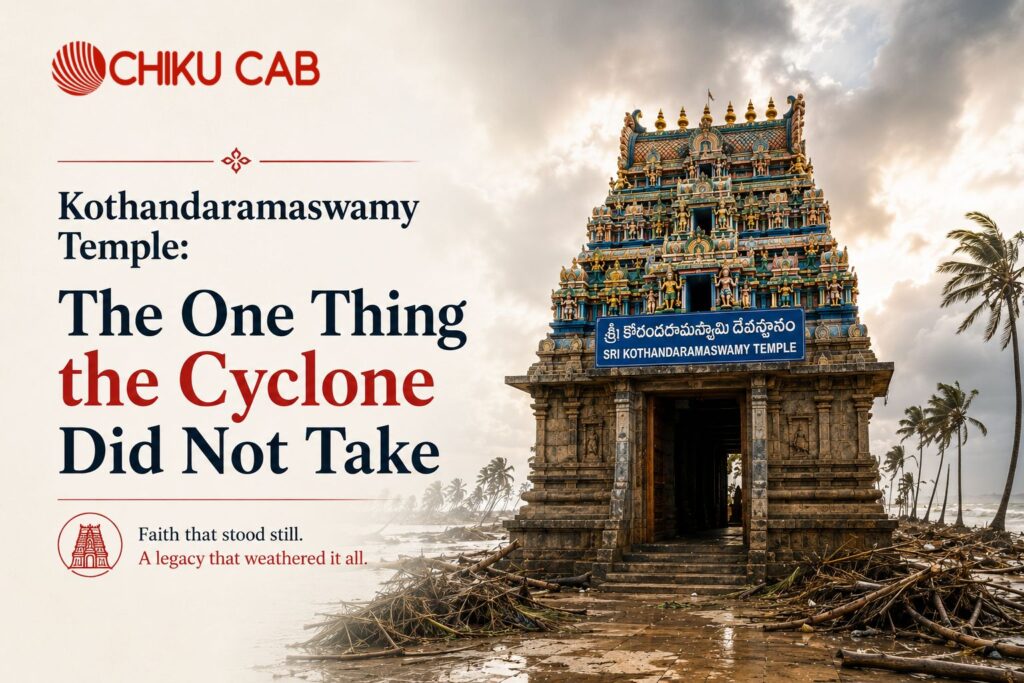
The temple is dedicated to Lord Rama, shown here holding his bow, the Kothandam, which gives the deity his name. The sanctum holds Rama alongside Sita, Lakshmana, Hanuman, and Vibhishana. That last figure is significant. This is the only temple in India where Vibhishana, Ravana’s younger brother, is enshrined as a primary deity. According to Ramayana tradition, this is where Vibhishana crossed to Rama’s side and was later crowned king of Lanka by Rama himself. The walls inside carry painted panels of that story.
The temple is also one of the 108 Abhimana Kshethrams of the Vaishnavite tradition. Swami Vivekananda is said to have visited after returning from Chicago.
Current condition: the temple is active. Darshan is available during the day. The approach road is paved and accessible by car.
The Ruins of Dhanushkodi: What Is Left and What You Will See
First-time visitors often expect a dramatic, clearly defined ruin site. What Dhanushkodi gives you is stranger. The structures appear as the road ends. They are not fenced off or labelled with information boards. You walk toward them on open sand.
The Railway Station
The station was originally the terminus of the Pamban to Dhanushkodi branch line, with two platforms and three tracks. Train No. 653, the overnight passenger from Pamban, was crossing that night in 1964 when the tidal surge hit. The train went into the sea. More than 200 passengers died.
What stands now is the outer stone wall structure of the station building. The walls were built in load-bearing masonry and have been softened by six decades of salt air. Rusted iron rails and wooden sleepers lie in the sand around it, partly buried. A large water tank, also from the original station complex, still stands upright near the ruins. It is the most complete original structure left at the site.
St. Anthony’s Church
The Roman Catholic church was built in stone masonry with a rocky altar. What survives is the front facade, stripped of everything except its walls. The saline air has eaten into the stone over the decades, and the remaining portions are visibly degraded. The altar area and most of the interior are gone.
On the same stretch of road, the outlines of the post office, the customs office, the hospital, and what may have been a school are partially visible. Nothing is intact. What the sand has not buried, the salt has corroded.
A handful of fishing families live in thatch homes built among these ruins. Small tea stalls and shell shops operate along the stretch. Peacocks have been spotted walking through the station ruins. The place has a particular quality: not dramatic, not silent either, but suspended.
Arichal Munai: The Last Point of Indian Land
Beyond the ruins, the sandy track continues for another kilometre or two until the land simply runs out. Arichal Munai is the name of this point. A pillar bearing the Ashokan Emblem marks the terminus, sitting on a small circular island that allows vehicles to turn around. There is nowhere further to drive.
The geography here is specific. The Bay of Bengal presses in from the north, its water clear and blue. The Gulf of Mannar comes in from the south, choppier and darker. At the tip, the two bodies of water converge. You can see the colour difference where they meet. The sand shifts every day with the tide. At high tide, a portion of the tip submerges. At low tide, the walkable land extends further south.
Sri Lanka is approximately 18 kilometres from this point across the maritime border. Talaimannar, the nearest Sri Lankan town on Mannar Island, sits about 35 kilometres away. Neither is visible to the naked eye. Binoculars on a clear day might give you a faint suggestion of the Sri Lankan coast.
This is where Adam’s Bridge, the chain of limestone shoals also known as Ram Setu, begins its run toward Sri Lanka. At low tide, the shoals are partially visible in the shallow water. The chain stretches roughly 48 kilometres across the strait.
The BSF maintains a presence at this final section. No one is permitted to remain at Arichal Munai after sunset.
When to Go and What to Expect at Different Times

Pre-Sunrise (Arrive by 5:45 AM)
This is the timing most visitors aim for. The checkpost opens at 6:00 AM, so arriving at 5:45 AM means you are first through. On a clear morning, the light at Arichal Munai is worth the early alarm. The Bay of Bengal catches it on one side, the Gulf of Mannar on the other. The ruins are empty at this hour. The stall operators are just setting up. There is no crowd yet.
One honest note: the checkpost timing is not rigid. Officers on duty determine when vehicles pass. Some travellers report being waved through at 5:45 AM. Others have waited until well past 6:00 AM. Build buffer time into any sunrise plan.
Late Afternoon (3:00 PM to 5:00 PM)
This window works for travellers doing Ramanathaswamy Temple darshan in the morning and heading to Dhanushkodi after lunch. The crowds at the ruins thin out by mid-afternoon. The light at the ruins from the west is flat and direct. Not ideal for photography, but the temperature drops and the walk is more manageable than midday.
Critically: you must be back at the checkpost by 5:00 PM. The Maxi vans stop running their final run around this time. If you time this window incorrectly, return transport gets difficult.
Monsoon (June to September)
The road conditions deteriorate badly during heavy monsoon months. Parts of the coastal stretch flood. The Maxi van service suspends on days with rough weather. The BSF may not allow entry at all.
If visiting between June and September, check locally on the morning of your trip. Do not rely on information from the previous day. Conditions change overnight. October onwards is when the road reliably opens back up.
A Practical One-Day Plan
This sequence assumes you are staying in Rameshwaram and want to cover both the temple and Dhanushkodi in a single day.
| Time | Activity |
| 4:30 AM | Leave hotel or railway station area |
| 5:00 to 5:15 AM | Reach Dhanushkodi ruins. Walk toward Arichal Munai |
| 5:30 to 6:30 AM | Sunrise at Arichal Munai |
| 7:00 to 7:30 AM | Return to Rameshwaram |
| 8:00 to 11:30 AM | Ramanathaswamy Temple darshan (22 sacred wells inside) |
| 11:30 AM to 12:30 PM | Lunch near the temple. Local mess options are cheaper and faster than hotel dining rooms |
| 1:00 to 3:30 PM | Remaining Rameshwaram stops: Agni Theertham, Pamban Bridge viewpoint |
| 4:30 PM onward | Rest or departure preparation |
Book the cab the previous evening, not the morning of. October to March is peak season. Morning availability at a fixed price is not guaranteed. Fixing the pickup time the night before also ensures you leave on schedule for the sunrise window.
Practical Tips Before You Drive Out
- Dhanushkodi has no ATMs and no pharmacy. The small stalls near the ruins sell coconut water, snacks, and shell souvenirs. That is the extent of commercial life out there. Stock up in Rameshwaram town before leaving.
- Carry more water than you think you will need. The sun at Arichal Munai has no shade cover. A hat is not optional for the walk from the checkpoint to the tip, particularly between 8:00 AM and 4:00 PM.
- Mobile signal is patchy near Arichal Munai. Download offline maps before leaving Rameshwaram. Note the driver’s number before you step out at the checkpoint.
- For the sandy stretch: sedans manage the paved section without trouble. Do not attempt the last 6 km in a private sedan. The sand track is not consistently firm, and a stuck vehicle means a long wait for help in an area with no tow services.
- Family trips with children are doable. The walk from the checkpoint to Arichal Munai is roughly 1 to 2 km depending on where the van drops you. Manageable for most ages if you carry water and start before 9:00 AM. The van ride itself, partially through shallow coastal water, is something children usually find memorable.
- Photography note: the ruins face east. Sunrise light hits the station walls and church facade directly. Arrive at the ruins by 5:30 AM for the best angle before the light gets harsh.
Booking Your Cab for the Dhanushkodi Trip
Local cabs in Rameshwaram are concentrated around the railway station and the temple’s main entrance. They are available, but the pricing is negotiated on the spot. In peak season, fares go up in the mornings. Drivers who know you have a train to catch later that day have some leverage.
There is also the return-wait problem. Most Dhanushkodi trips involve the driver waiting at the checkpoint for 2 to 3 hours while you walk out and come back. Some drivers quote a base one-way fare and add a waiting charge on return. That conversation, in a remote location with no alternatives, is never comfortable.
Booking through Chiku Cab removes that dynamic entirely. Chiku Cab operates intercity and local cab services across 1,000 cities in India and has been running this category of route since 2018. The fare is quoted at booking, before the trip begins, not renegotiated at the checkpoint. The driver is assigned and confirmed in advance. You know who is picking you up and at what time.
For a sunrise trip, that advance confirmation matters. Scrambling for a cab at 4:30 AM outside Rameshwaram railway station is not a plan; it is a gamble. Pre-booking through Chiku Cab fixes the pickup time, the fare, and the driver’s contact number the evening before.

Confirm three things before finalising any booking for this trip, regardless of the platform.
- Whether the fare covers the round trip, including the return wait at the checkpoint
- The driver’s direct contact number, since signal is unreliable in the area
- Pickup time, specified to the minute, especially for pre-sunrise departures
One Last Thing Before the Drive
Check the road status on the morning of your trip if you are visiting between June and October. The Dhanushkodi coastal stretch can close without notice after overnight rain or rough tides. A quick inquiry at your hotel or to the cab driver the night before is sufficient. October to March is the window where you drive out with confidence.
Book the cab the previous evening. Fix the pickup time. Carry cash, carry water, and get there before the sun clears the horizon. Arichal Munai at first light, with the two seas lit up and the ruins still in shadow, is worth every bit of the early start.
FAQs About Rameshwaram to Dhanushkodi
What is the distance from Rameshwaram to Dhanushkodi?
Dhanushkodi is approximately 18 km from Rameshwaram by road. The first 12 km are paved highway. The remaining 6 km to Arichal Munai is a sandy coastal track that only modified 4×4 jeeps and Maxi vans can cover. Private cars stop at the checkpoint where the paved road ends.
How much time does it take to travel from Rameshwaram to Dhanushkodi?
The drive from Rameshwaram to Dhanushkodi town takes 30 to 40 minutes by car or taxi. Add another 20 to 30 minutes for the Maxi van ride on the sandy stretch to Arichal Munai. Budget at least 3 to 4 hours for the full round trip, including time at the ruins and land’s end.
How can I reach Dhanushkodi from Rameshwaram?
Four options are available. Public buses (routes 3 and 7) depart from Agni Theertham every 30 minutes for Rs. 30 per person. Auto-rickshaws charge Rs. 700 to 800 for a round trip. Private taxis cost Rs. 1,500 upward. Beyond the paved road checkpoint, all visitors transfer to a Maxi van at Rs. 150 per person for the final 6 km sandy stretch to Arichal Munai.
What is the taxi fare from Rameshwaram to Dhanushkodi?
A private sedan round trip costs approximately Rs. 1,500. An SUV or full jeep hire runs Rs. 2,000 to 2,500. These fares cover the paved road section only. The Maxi van for the final sandy stretch to Arichal Munai is a separate Rs. 150 per person charge, payable at the checkpoint. Always confirm the return wait charge before leaving Rameshwaram.
Is Dhanushkodi worth visiting from Rameshwaram? Yes, and it is the kind of place that is difficult to describe accurately before you have been. The ruins of a cyclone-destroyed town, a functioning 1,000-year-old temple that survived the same storm, and a sand tip where the Bay of Bengal and Gulf of Mannar converge. It is 18 km from Rameshwaram and takes half a day. Most visitors say it is the part of the trip they remember longest.

I’m a wanderer who loves venturing on to unknown and unseen places. I explore freely to various fun and adventurous places, whether it be spiritual temple tours, captivating landscapes, and more. I wonder around in search of hidden gems and tourist attractions, temples, and other places.


