
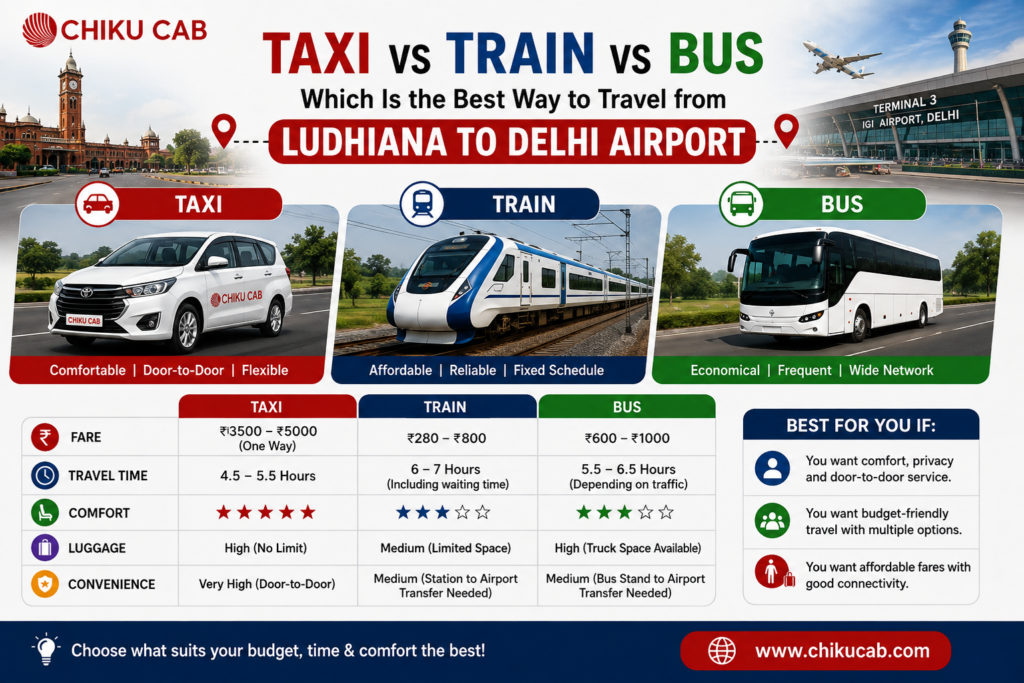
Travelling from Ludhiana to Delhi Airport is one of the most common journeys for people in Punjab flying out for domestic or international trips. But the moment you start planning, one question comes up every time: should you book a taxi, take a train, or travel by bus?
Each option has its own fare, travel time, comfort level, and convenience. A student catching a budget flight has different priorities than a family flying out at 4 AM with three suitcases and an elderly grandparent. This guide breaks down taxi, train, and bus travel from Ludhiana to Delhi Airport taxi in detail fares, timings, comfort, safety, and hidden costs so you can decide what actually works best for your situation, not just the “cheapest on paper” option.

Ludhiana to Delhi Airport Taxi Booking – 24×7 Instant Service
24×7 Instant Service | Safe & Comfortable Ride
Ludhiana to Delhi Airport Route Overview
The distance between Ludhiana and Delhi Airport (IGI Airport, Terminal 3) is approximately 300 to 310 km by road, depending on the exact pickup point in Ludhiana and the terminal you’re headed to.
- Best highway: Most road travel uses the taxi service Ludhiana to Delhi stretch via NH44, connecting through Ambala, Kurukshetra, Panipat, and Sonipat before reaching Delhi. Large sections of this route are now expressway-grade with smooth, divided carriageways.
- Average travel time: Around 5 to 6 hours by road under normal traffic conditions, though this can stretch to 7–8 hours during fog season (December–January) or heavy holiday traffic.
- Toll roads: The route passes through multiple toll plazas along NH44, which add to the total trip cost for road travel.
- Fuel stops: Well-developed highway with numerous dhabas, fuel stations, and rest stops near Ambala, Karnal, and Panipat, making road travel convenient for breaks.
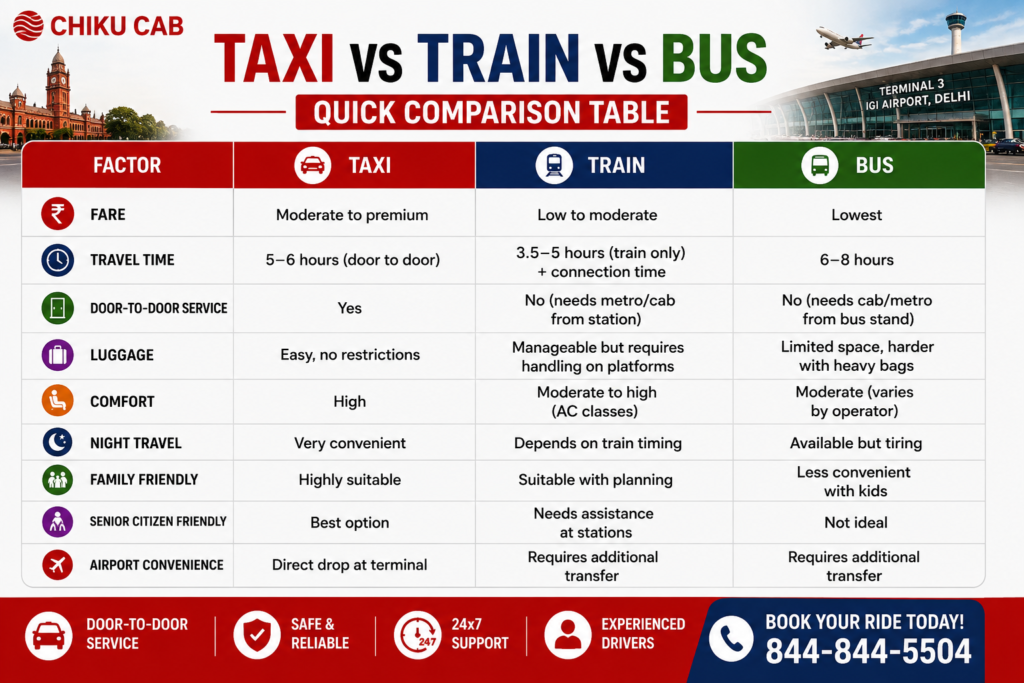
Taxi vs Train vs Bus Quick Comparison Table
| Factor | Taxi | Train | Bus |
| Fare | Moderate to premium | Low to moderate | Lowest |
| Travel Time | 5–6 hours (door to door) | 3.5–5 hours (train only) + connection time | 6–8 hours |
| Door-to-Door Service | Yes | No (needs metro/cab from station) | No (needs cab/metro from bus stand) |
| Luggage | Easy, no restrictions | Manageable but requires handling on platforms | Limited space, harder with heavy bags |
| Comfort | High | Moderate to high (AC classes) | Moderate (varies by operator) |
| Night Travel | Very convenient | Depends on train timing | Available but tiring |
| Family Friendly | Highly suitable | Suitable with planning | Less convenient with kids |
| Senior Citizen Friendly | Best option | Needs assistance at stations | Not ideal |
| Airport Convenience | Direct drop at terminal | Requires additional transfer | Requires additional transfer |
This table gives you the shape of the decision at a glance. Now let’s go deeper into what actually matters for your trip.
Which Is the Fastest Option?
Speed depends heavily on flight timing, traffic, and how many connections you need to make.
Taxi: A direct taxi typically covers Ludhiana to Delhi Airport in 5 to 6 hours, door to door, with no transfers. Since the driver takes you straight to the terminal, there’s no time lost figuring out connections.
Train (Vande Bharat/Shatabdi-class options) + metro/taxi: Premium trains can complete the rail portion of the journey in roughly 3.5 to 4.5 hours, which sounds faster on paper. However, you still need to travel from Ludhiana city to the railway station, then from New Delhi Railway Station to the airport via metro or cab — adding 1 to 1.5 hours to the total.
Bus: Buses generally take the longest, around 6 to 8 hours, since they make multiple stops along the way and are more exposed to traffic congestion, especially near Delhi’s outer ring roads.
Peak traffic impact: Road travel (taxi and bus) is more sensitive to traffic near Panipat, Sonipat, and Delhi’s entry points during morning and evening rush hours. Trains are less affected by road congestion but can face their own delays during fog season or festival rush.
Bottom line: For true door-to-door speed with no transfer hassle, a taxi usually wins. For the train to be genuinely faster, everything — connections, metro timing, luggage handling — needs to align perfectly.
Taxi Fare from Ludhiana to Delhi Airport
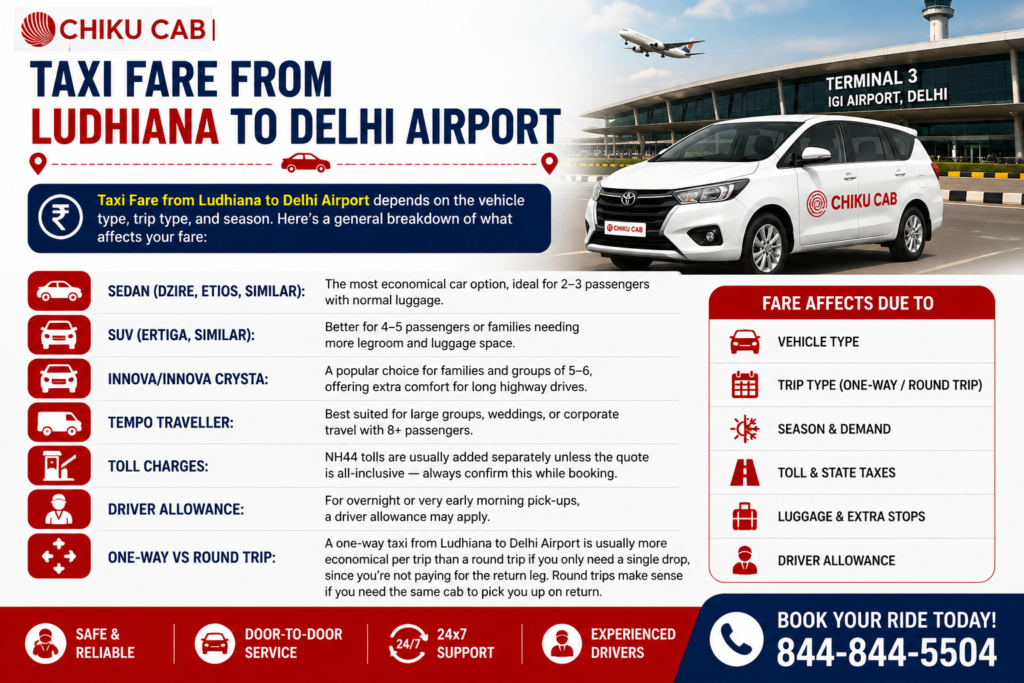
Taxi Fare from Ludhiana to Delhi airport depends on the vehicle type, trip type, and season. Here’s a general breakdown of what affects your fare:
- Sedan (Dzire, Etios, similar): The most economical car option, ideal for 2–3 passengers with normal luggage.
- SUV (Ertiga, similar): Better for 4–5 passengers or families needing more legroom and luggage space.
- Innova/Innova Crysta: A popular choice for families and groups of 5–6, offering extra comfort for long highway drives.
- Tempo Traveller: Best suited for large groups, weddings, or corporate travel with 8+ passengers.
- Toll charges: NH44 tolls are usually added separately unless the quote is all-inclusive — always confirm this while booking.
- Driver allowance: For overnight or very early morning pickups, a driver allowance may apply.
- One-way vs round trip: A one-way taxi from Ludhiana to Delhi Airport is usually more economical per trip than a round trip if you only need a single drop, since you’re not paying for the return leg. Round trips make sense if you need the same cab to pick you up on return.
Since fares vary by season, fuel prices, and vehicle availability, it’s best to get a live quote when booking rather than relying on estimates. Chiku Cab offers transparent, all-inclusive one-way taxi fares from Ludhiana to Delhi Airport with no last-minute surprises.
Train Fare and Railway Options
Train travel is often seen as the “middle ground” between cost and comfort.
- Popular trains: Several trains connect Ludhiana with New Delhi, including fast options in AC chair car and executive class categories, alongside regular express trains with sleeper and AC coaches.
- Travel duration: The train journey itself typically takes 3.5 to 5 hours depending on the specific train and number of stops.
- Reaching New Delhi Railway Station: You’ll first need to reach Ludhiana railway station from your home or locality, then, after arrival, get from New Delhi Railway Station to the airport.
- Metro or cab to IGI Airport: From New Delhi Railway Station, the Airport Express Metro Line is a common way to reach the airport, or you can book a local cab. Either way, factor in extra time for security checks, walking with luggage, and possible metro crowding.
- Reservation tips: Popular trains fill up fast, especially during festival and wedding seasons. Booking well in advance and choosing AC classes for comfort on a long journey is recommended if you go the rail route.
Train travel works well if you don’t mind the extra connection and enjoy a fixed schedule, but it demands more planning and physical effort with luggage compared to a direct taxi.

Bus Fare and Available Services
Buses remain the most budget-friendly option for many travelers.
- Volvo buses: AC Volvo coaches offer a reasonably comfortable experience for the price, with reclining seats and onboard amenities on select routes.
- AC Sleeper buses: Useful for overnight travel, allowing you to sleep through part of the journey, though comfort varies by operator quality.
- Government buses: The most economical option, though generally less comfortable and with fewer amenities for a 300 km journey.
- Private buses: Offer a range of comfort levels and pricing, often with more frequent departure times than government services.
- Airport drop availability: Very few buses drop passengers directly at the airport terminal. Most bus services end at a Delhi bus stand (like Kashmere Gate or Majnu Ka Tila), requiring an additional cab or metro ride to reach the airport.
Bus travel is best suited for budget travelers who aren’t short on time and don’t mind an extra transfer at the end of the journey.
Which Option Is Cheapest?
On a strict per-ticket basis, bus travel is typically the cheapest, followed by train (especially non-AC or standard classes), with taxi being the most expensive upfront.
However, “cheapest” changes when you calculate the full door-to-door cost. A train or bus ticket doesn’t include the metro fare, auto-rickshaw, or cab needed to actually reach the airport terminal from the station or bus stand and for a family of four with luggage, those add-on costs can close the gap significantly. If you’re travelling solo with light luggage, bus or train will usually save you money. If you’re travelling as a family or group, a shared taxi cost often works out comparable, sometimes even cheaper, once you add up everyone’s individual ticket plus connection costs.
Which Option Saves the Most Time?
If your priority is minimizing total door-to-door travel time, a direct taxi is generally the most time-efficient choice because it eliminates every transfer point. Trains can be fast for the rail segment alone, but the added time for station-to-home travel on one end and station-to-airport travel on the other often brings the total time close to, or even above, a direct taxi ride — especially if your flight requires an early morning departure when metro services haven’t started yet.
Which Option Is Most Comfortable?
For long-distance comfort, especially over a 5+ hour journey, a private taxi offers the most control: you choose the vehicle type, set your own pace, take breaks when needed, and avoid crowded platforms or bus stands. AC train classes come a close second, offering a smooth ride with less physical strain than road travel. Buses, even premium ones, involve more fixed stops and less flexibility, which can make a long journey feel more tiring.
Best Choice for Families with Children
Families traveling with young children benefit most from a innova taxi in Ludhiana, mainly because of the flexibility it offers — you can stop for feeding, diaper changes, or bathroom breaks whenever needed, without worrying about missing a train or bus departure. Direct door-to-door pickup and drop also removes the stress of managing children through crowded railway platforms or bus terminals while juggling luggage.
Best Option for Senior Citizens
Senior citizens generally do best with direct taxi travel. Long walks through railway platforms, navigating stairs or escalators at metro stations, and standing in queues at bus stands can be physically demanding. A taxi offers home pickup, minimal walking, and a direct drop at the terminal, which significantly reduces the physical strain of the journey.
Best Option with Heavy Luggage
If you’re carrying multiple suitcases, oversized bags, or sports/musical equipment, a taxi is by far the most practical choice. Trains and buses both involve carrying your own luggage across platforms, through security checks, and during transfers — which becomes genuinely difficult with heavy bags. A taxi loads everything once at your doorstep and unloads it directly at the terminal, with no in-between handling.
Best Choice for Business Travelers
Business travelers who value predictability and productive time often prefer a taxi for its flexibility to work, take calls, or rest during the journey without the noise and interruptions common on trains and buses. That said, for travelers comfortable working around a fixed schedule, a premium AC train can also work well, provided the connection timing to the airport is planned carefully to avoid the risk of missing a flight.
Best Transport for International Flight Passengers
International flights require earlier check-in (often 3+ hours before departure) and leave less room for delays. For this reason, a direct taxi with a pre-planned pickup time is usually the safest choice, since it removes dependency on train punctuality or bus stand transfers. If a delay in reaching the airport means missing an international flight, the cost of rebooking far outweighs any savings from a cheaper travel mode.
Taxi vs Train During Peak Holiday Season
During festivals, wedding season, and major holidays, train tickets on the Ludhiana–Delhi route get booked out weeks in advance, and last-minute availability is often limited to waitlisted or higher-class tickets. Bus fares also tend to rise, and road traffic increases with more vehicles on NH44. A pre-booked taxi avoids the ticket availability problem entirely you are not competing for a seat, and pricing is generally more predictable when booked a few days ahead, even during peak season.
Night Travel – Which Is Safest?
For late-night or early-morning flights, a trusted, pre-booked taxi service is typically the safest and most practical option. It offers home pickup without needing to travel to a station or bus stand in the dark, and a verified driver with a tracked vehicle adds a layer of security that solo late-night travel by public transport doesn’t offer. Overnight trains and sleeper buses are reasonably safe on well-established routes, but they still require reaching the station or boarding point, which can be inconvenient and less secure late at night, particularly for solo travelers or women travelling alone.
Home Pickup vs Railway Station vs Bus Stand
This is one of the most overlooked factors in the taxi vs train vs bus decision. A taxi picks you up from your home, hostel, or office — no travel to a separate boarding point needed. A train requires you to reach Ludhiana railway station first, and a bus requires reaching a specific bus stand, both of which may involve their own local transport, time, and cost before your “main” journey even begins. When you add this pre-journey travel to the total trip time and cost, door-to-door services like a taxi often become more competitive than they first appear.
Hidden Costs You Should Know
Before comparing fares on a purely ticket-price basis, factor in these commonly overlooked costs:
- Metro fare: From New Delhi Railway Station or a Delhi bus stand to the airport.
- Auto fare: For last-mile connectivity if metro isn’t convenient with luggage.
- Waiting charges: If a local cab or auto waits while you handle bags or tickets.
- Platform tickets: For anyone accompanying you to see you off at the station.
- Extra luggage: Some train and bus operators charge for oversized or excess baggage.
- Toll and parking: Applicable for road travel, sometimes bundled into taxi quotes, sometimes not — always confirm.
Once these are added up, the real cost difference between taxi, train, and bus is often smaller than the sticker price suggests.
Advantages of Booking a Direct Airport Taxi
- No transfers, no platform walking, no waiting at a bus stand
- Fixed, transparent pricing agreed upon before the trip
- Flexible pickup time, including very early mornings or late nights
- Comfortable for families, senior citizens, and passengers with heavy luggage
- Reduces the risk of missing a flight due to transfer delays
- Doorstep pickup from anywhere in Ludhiana, not just central locations
Best Route from Ludhiana to Delhi Airport
The most reliable route for road travel is via NH44, passing through Khanna, Ambala, Karnal, Panipat, and Sonipat before entering Delhi and connecting to the airport via the Delhi–Gurugram corridor near Terminal 3. Experienced drivers familiar with this stretch can also suggest alternate routes during heavy congestion or expressway closures, which is another advantage of booking with an established local taxi service that knows current road conditions.
Important Travel Tips Before Leaving
- Book your taxi, train, or bus at least a few days in advance, especially during peak season.
- For flights, plan to reach the airport at least 3 hours before an international flight and 2 hours before a domestic flight.
- Keep a buffer of 1–2 extra hours for fog season (December–January) when road and rail delays are common.
- Confirm toll and driver allowance charges upfront when booking a taxi to avoid surprises.
- Keep valid ID proof handy, as it’s required for both train travel and airport entry.
- If travelling with elderly passengers or children, prioritize door-to-door options over multi-transfer routes.
Frequently Asked Questions
Is taxi better than train for Ludhiana to Delhi Airport?
A taxi is generally better if you value door-to-door convenience, comfort, and predictable timing, especially with luggage or family members. A train can work well if you’re travelling light, solo, and are comfortable managing the connection from Ludhiana to New Delhi Railway Station to the airport.
Which is cheaper taxi, train, or bus for Ludhiana to Delhi Airport?
On a solo, per-ticket basis, bus and train fares are usually lower than a taxi for Ludhiana. But once you add metro, auto, or connecting cab costs on both ends of the journey, and split taxi fare across multiple travelers, the total cost difference often narrows considerably.
Which is the fastest way to reach Delhi Airport from Ludhiana?
A direct taxi is typically the fastest overall due to zero transfers. Fast trains can be quicker for the rail segment alone, but added connection time to the airport often brings the total travel time close to a direct taxi ride.
Can I reach Terminal 3 directly from Ludhiana?
Yes, a taxi can drop you directly at Terminal 3 (or any other terminal) without any transfers. Train and bus travelers need to take a metro or local cab from the station/bus stand to reach the specific terminal.
Is one-way taxi available from Ludhiana to Delhi Airport?
Yes, one-way taxi bookings are commonly available and are usually more cost-effective than a round trip if you only need a single drop to the airport.
Can I book a return taxi as well for Ludhiana to Delhi Airport?
Yes, round-trip bookings can be arranged, which is useful if you want the same taxi service to pick you up again on your return flight.
Which option is best for elderly passengers for Ludhiana to Delhi Airport?
A taxi is generally the best option for senior citizens due to home pickup, minimal walking, and a direct drop at the terminal, avoiding the physical strain of stairs, platforms, and transfers.
Which is best for families travelling with children for Ludhiana to Delhi Airport?
A taxi offers the most flexibility for families, allowing stops as needed and avoiding the stress of managing kids and luggage through crowded stations or bus stands.
How early should I leave from Ludhiana for a Delhi Airport flight?
Given the 5–6 hour road journey (or longer during fog or peak traffic), it’s advisable to start at least 8–9 hours before an international flight and 7–8 hours before a domestic flight, factoring in a comfortable buffer for check-in.
Is night travel safe from Ludhiana to Delhi Airport?
Night travel is generally safe when using a pre-booked, verified taxi service with a tracked vehicle. This is often considered more secure and convenient than traveling to a train station or bus stand alone late at night.
Ready to Book Your Ludhiana to Delhi Airport Taxi?
Skip the transfers, platform walks, and waiting at bus stands. Chiku Cab offers direct, door-to-door taxi service from Ludhiana to Delhi Airport with transparent pricing, sedan/SUV/Innova/Tempo Traveller options, and 24×7 availability for early morning and late-night flights. Book your one-way or round-trip airport taxi online, or call now to reserve your ride.

I’m a wanderer who loves venturing on to unknown and unseen places. I explore freely to various fun and adventurous places, whether it be spiritual temple tours, captivating landscapes, and more. I wonder around in search of hidden gems and tourist attractions, temples, and other places.