
There are some debts a son or daughter carries that cannot be repaid in this lifetime only honoured. The Pind Daan ritual at Gaya is precisely that honouring a sacred act of remembrance, gratitude, and spiritual release for the souls of departed ancestors that the Hindu tradition has preserved and transmitted for over three thousand years. And for millions of pilgrims beginning this journey from Varanasi the city that Lord Shiva himself is said to reside in permanently the Varanasi to Gaya Cab route carries a depth of meaning that no words in any language can fully capture.
This complete guide to the Pind Daan Package from Varanasi to Gaya is built to serve you practically and spiritually covering everything from the theological significance of Gaya as the world’s supreme site for ancestral rites, to the precise 2-day itinerary, the sacred sites where each ritual is performed, the best time to undertake the journey, the route from Varanasi, accommodation in Gaya, what to carry, what to expect, and the detailed FAQ that answers every question pilgrims ask before, during, and after the journey.

Book Affordable Taxi Service for Varanasi to Gaya – 24×7 Instant Service
24×7 Instant Service | Safe & Comfortable Ride
What Is Pind Daan? The Spiritual Foundation of the Gaya Pilgrimage
Pind Daan from the Sanskrit words Pinda (a ball of cooked rice, sesame, barley, and sacred ingredients representing the physical body) and Daan (offering or gift) is the central Hindu ancestral rite performed to ensure the liberation (moksha) and peaceful onward journey of departed souls. It belongs to the broader category of Shraddha ceremonies rituals of reverence for pitrus (departed ancestors) that form one of the oldest and most universally observed threads of Hindu religious practice.
The theological basis for Pind Daan rests on the Hindu belief that the soul after death passes through various states including a transitional state called Pretayoni before attaining its final spiritual destination. The Pinda offerings, made by living descendants (typically the eldest son, though daughters and other family members also perform the rite), provide spiritual nourishment to the ancestor’s soul and assist its liberation from the cycle of death and rebirth.
The Garuda Purana, the Vayaviya Samhita of the Shiva Purana, and the Vayu Purana all emphasise Gaya specifically the Vishnupad Temple and the banks of the Phalgu River as the supreme locus on earth where Pind Daan carries the greatest spiritual merit (punya). The Vayu Purana states directly: “The Pind Daan performed at Gaya liberates 101 ancestors on both the paternal and maternal sides.”
Why Gaya Is the World’s Most Sacred Site for Pind Daan
Gaya’s supremacy as the destination for ancestral rites has its origin in one of Hinduism’s most significant Puranic narratives. A powerful demon named Gayasura performed such intense tapasya (austerities) that Lord Vishnu granted him the boon that whoever touched his body would attain moksha. However, this created chaos the living began dying and attaining liberation without completing their karmic journey, upsetting the cosmic balance. Lord Vishnu, along with other devas, pressed a large sacred stone (the Dharmasila) onto the body of Gayasura, and when Gayasura ultimately yielded his body to the divine purpose, Lord Vishnu planted his sacred foot on the stone, creating the eternal Vishnupad (footprint of Lord Vishnu).
This Vishnupad preserved in the sanctum sanctorum of the Vishnupad Temple in Gaya is the most sacred point of the entire Pind Daan ritual geography. When a pilgrim performs Pind Daan at the Vishnupad Ghat with the footprint of Lord Vishnu as witness, the tradition holds that the liberation of the ancestor’s soul is assured.
The Ramayana adds another layer of sacred authority to Gaya. Lord Rama, Goddess Sita, and Lakshmana are said to have stopped at Gaya on their way through the forests and performed Pind Daan for King Dasharatha. The famous narrative of Sita Mata independently offering a Pinda to King Dasharatha’s soul using river sand witnessed by the Phalgu River, the Akshayavat tree, and a cow is embedded in Gaya’s sacred landscape and explains the particular reverence accorded to the Akshayavat (immortal banyan tree) at the Vishnupad Temple complex as an eternal witness.
Why Start the Pind Daan Journey from Varanasi?
Varanasi (Kashi) the eternal city of Lord Shiva holds its own profound significance in the Hindu ancestral rites tradition. Before undertaking the Pind Daan at Gaya, many pilgrims begin with a Kashi Shraddha performing preliminary ancestral rites at Varanasi’s sacred Manikarnika Ghat, Assi Ghat, and Kashi Vishwanath Temple. The completion of rites at both Kashi and Gaya is considered the most complete fulfilment of a Hindu’s ancestral duty.
The Varanasi to Gaya journey is thus not merely a logistical transfer between two cities it is a continuation of a single sacred arc that begins at Kashi, the city of liberation, and reaches its completion at Gaya, the city of ancestral deliverance.
For pilgrims beginning their journey from Varanasi, a well-structured 2-day Pind Daan package from Varanasi to Gaya covers:
- Day 1: Preliminary Kashi Shraddha in Varanasi (optional but highly recommended) → Drive to Gaya → First evening rituals at Gaya
- Day 2: Full Pind Daan at all major sacred sites in Gaya → Return journey to Varanasi
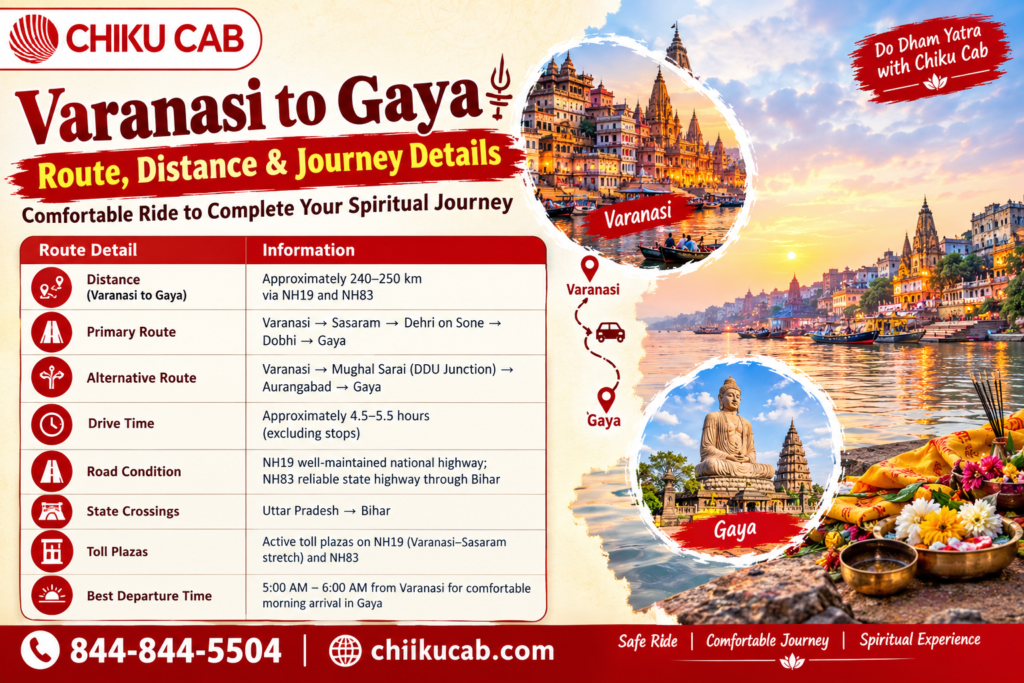
Varanasi to Gaya: Route, Distance & Journey Details
| Route Detail | Information |
| Distance (Varanasi to Gaya) | Approximately 240–250 km via NH19 and NH83 |
| Primary Route | Varanasi → Sasaram → Dehri on Sone → Dobhi → Gaya |
| Alternative Route | Varanasi → Mughal Sarai (DDU Junction) → Aurangabad → Gaya |
| Drive Time | Approximately 4.5–5.5 hours (excluding stops) |
| Road Condition | NH19 well-maintained national highway; NH83 reliable state highway through Bihar |
| State Crossings | Uttar Pradesh → Bihar |
| Toll Plazas | Active toll plazas on NH19 (Varanasi–Sasaram stretch) and NH83 |
| Best Departure Time | 5:00 AM – 6:00 AM from Varanasi for comfortable morning arrival in Gaya |
| Nearest Railway Station | Gaya Junction (GAYA) — direct trains from Varanasi available |
| Cab Booking | Pre-book a verified cab from Varanasi for the round trip — most economical and reliable option |
Complete 2-Day Pind Daan Package Itinerary: Varanasi to Gaya
Day 1: Varanasi Kashi Shraddha → Departure → Arrival at Gaya → Evening Rituals
4:30 AM – 7:00 AM: Kashi Shraddha at Varanasi (Optional but Highly Recommended)
Before departing for Gaya, many pilgrims perform the preliminary Kashi Shraddha at Varanasi. This involves:
- Holy bath at Manikarnika Ghat or Assi Ghat before sunrise
- Puja and initial Pinda offering at the ghat with the family’s designated panda (priest)
- Darshan at Kashi Vishwanath Temple
- Receiving blessings for the onward Gaya journey
If your family’s tradition includes the Kashi Shraddha, plan departure from Varanasi by 7:00–7:30 AM after completing the morning rites.
7:00 AM – 7:30 AM: Departure from Varanasi for Gaya
Leave Varanasi in your pre-booked cab on NH19 towards Sasaram and then Gaya. The early departure ensures you cross into Bihar and reach Gaya by noon or early afternoon, leaving time for registration with your Gaya panda and the first evening ritual.
En Route Stopover (Optional): Sasaram — Sher Shah Suri’s Tomb
Approximately 100 km from Varanasi, the city of Sasaram in Bihar is home to the magnificent Sher Shah Suri Tomb — one of India’s finest examples of Sur-period Afghan architecture, a massive sandstone mausoleum rising from the centre of an artificial lake. For pilgrim families making their first Gaya trip and wishing to see a significant historical monument en route, a 30-minute stop at Sasaram adds cultural dimension to the journey.
12:00 PM – 1:00 PM: Arrival in Gaya
On arrival in Gaya, check into your pre-booked hotel or dharamshala near the Vishnupad Temple area. The area around the Vishnupad Temple has a range of accommodation from simple dharamshalas to comfortable hotels — your panda or a pilgrimage organiser can recommend options suited to your budget.
1:30 PM – 2:30 PM: Panda Registration and Ritual Preparation
The panda system at Gaya is the backbone of the Pind Daan ritual experience. Pandas are hereditary priestly families who have maintained the right to conduct Shraddha rites at specific sites in Gaya across generations. Your family’s association with a particular Gaya panda is often transmitted from your parents or grandparents — ask older family members which panda family conducted previous family Pind Daan visits. If this is your family’s first time, the Gaya Teertha Purohit Sangh (the official association of Gaya pandas) can assist with allocation.
Your panda will:
- Record your family’s details (gotra, father’s/grandfather’s name, home city)
- Brief you on the sequence of rituals to be performed
- Arrange all puja materials (flowers, sesame, barley, river water, tulsi, sacred thread)
- Guide you through each ritual site on both days
3:00 PM – 5:30 PM: Phalgu River Snan and First Evening Puja
The Phalgu River also known as Niranjana is the sacred river at Gaya on whose banks the majority of Pind Daan rituals are performed. The river is unique in that it flows largely underground in Gaya, with only sandy riverbed visible at many points during non-monsoon months a characteristic explained in the Ramayana by the curse Sita Mata placed on the river for providing false testimony.
The first evening ritual involves:
- Sacred bath (snan) in the Phalgu River at the designated ghat
- Offering of Arghya (water offering with sesame and tulsi) to the setting sun and to the pitrus
- Initial Pinda offering at the Phalgu ghat under your panda’s guidance
- Evening aarti at the riverbank
6:30 PM – 8:00 PM: Vishnupad Temple Darshan
The Vishnupad Temple the central sacred monument of Gaya is one of the most significant Vaishnava temples in India. The temple was built in its current form in 1787 CE by Maharani Ahilyabai Holkar of Indore, the renowned queen-administrator who also rebuilt the Kashi Vishwanath Temple in Varanasi after Aurangzeb’s destruction. The temple’s inner sanctum houses the sacred Dharmasila stone bearing the 40-cm footprint of Lord Vishnu encircled by a silver basin. Touching the Vishnupad is the most sacred physical act of the Gaya pilgrimage.
Allow sufficient time for darshan, especially during peak Pitru Paksha season when queues can be long. Non-Hindus are not permitted inside the main Vishnupad Temple sanctum.
Day 2: Full Pind Daan at All Major Sacred Sites in Gaya
Day 2 is the core of the pilgrimage a full day of Pind Daan rituals conducted at every significant sacred site in and around Gaya under your panda’s guidance. The traditional Gaya Shraddha covers 45 sacred sites (vedis) in and around the city. A complete pilgrimage covering all 45 vedis takes 5–7 days. The 2-day package focuses on the primary and most spiritually significant sites that the tradition considers essential:
5:00 AM – 6:30 AM: Pre-Dawn Phalgu River Rituals
The most auspicious time for Pind Daan at Gaya is the pre-dawn period between the Brahma Muhurta (the 48-minute period approximately 1.5 hours before sunrise, which begins around 4:15–4:30 AM) and sunrise. Begin with:
- Pre-dawn sacred bath in the Phalgu River
- Pitru Tarpan (water libation with sesame) to all departed ancestors by name
- First Pinda offering of the main day’s sequence
6:30 AM – 8:00 AM: Vishnupad Ghat Pind Daan
The Vishnupad Ghat directly in front of the Vishnupad Temple on the Phalgu River is the most important Pind Daan location in the entire Gaya pilgrimage. The Pinda offered here, with the sacred Vishnupad as witness, carries the full weight of the Gaya pilgrimage’s spiritual promise. Your panda will conduct the complete Pind Daan ceremony at the Vishnupad Ghat with the appropriate mantras and ritual sequence.
8:30 AM – 9:30 AM: Akshayavat (Immortal Banyan Tree)
The Akshayavat the immortal banyan tree in the Vishnupad Temple complex is one of the most sacred trees in Hinduism. It is believed to be the same ancient banyan tree under which Sita Mata offered sand from the Phalgu River to King Dasharatha’s soul, with the tree as a divine witness. Pind Daan and Tarpan performed at the Akshayavat are considered to carry permanent (akshaya imperishable) merit hence the name. The tree is enclosed within the Vishnupad Temple complex and is accessible to pilgrims.
10:00 AM – 11:30 AM: Pretshila Hill (Pretagni Kund)
Pretshila literally The Hill of the Pretas (departed spirits) is a rocky hill on the outskirts of Gaya that holds one of the most unique and ritually important sites of the entire pilgrimage. The Pretagni Kund at the hill is where a sacred fire (agni) is maintained and where Pind Daan for ancestors believed to be trapped in the pretayoni (the transitional state between death and their next destination) is performed. The climb to the Pretshila summit involves steps carved into the rock face. The view from the top of Pretshila across the Gaya plain and the Phalgu valley is remarkable.
12:00 PM – 1:00 PM: Lunch Break
Your panda or hotel can arrange a simple sattvic (vegetarian, without onion or garlic) meal appropriate for the day’s spiritual activities. Gaya has numerous vegetarian restaurants and dharamshala kitchens near the Vishnupad Temple area serving thali meals suitable for pilgrims observing the ritual dietary protocols of Shraddha.
1:30 PM – 3:00 PM: Ramshila Hill and Rama Kund
Ramshila Hill is the sacred hill where Lord Rama himself is believed to have rested and performed Pind Daan for King Dasharatha during the Ramayana period. The Rama Kund a sacred tank at the base of the hill is used for ritual bathing. The temple complex atop Ramshila includes shrines to Lord Rama, Sita, and Lakshmana. Pind Daan performed at Ramshila carries the additional sacred resonance of following in the footsteps of the Maryada Purushottam himself.
3:30 PM – 5:00 PM: Mangala Gauri Temple
The Mangala Gauri Temple in Gaya is one of the 51 Shakti Peethas of the Hindu tradition the sacred sites where body parts of Goddess Sati fell to earth after Lord Vishnu’s Sudarshana Chakra dismembered her body during the grief-stricken journey of Lord Shiva. At Gaya, the Shakti Peetha is the breasts (stana) of Goddess Sati, enshrined at the Mangala Gauri Temple atop a hill. The goddess Mangala Gauri is the presiding deity of the temple and is considered the shakti who presides over the auspiciousness of marriage, childbirth, and family welfare.
Visiting Mangala Gauri Temple as part of the Gaya pilgrimage is traditional practice for pilgrims who wish to honour both the ancestral (pitru) and divine feminine (shakti) dimensions of the pilgrimage.
5:30 PM – 6:30 PM: Final Phalgu River Sunset Ritual and Concluding Ceremonies
The 2-day Gaya pilgrimage concludes with the final Pind Daan and Tarpan sequence at the Phalgu River at sunset the formal completion of the ancestral offering sequence. Your panda conducts the concluding mantras and the formal ritual closure (udyapan), after which the spiritual obligation of the Gaya Shraddha is considered fulfilled.
Optional Extension (Evening of Day 2): Bodh Gaya approximately 12–13 km from Gaya city
Bodh Gaya where Siddhartha Gautama attained enlightenment under the sacred Peepal tree (now the Bodhi Tree at the Mahabodhi Temple) and became the Buddha is less than 15 minutes from Gaya city. The Mahabodhi Temple Complex at Bodh Gaya is a UNESCO World Heritage Site and one of the most significant Buddhist pilgrimage sites in the world. For families who arrive in Gaya by noon on Day 1 or conclude Day 2 rituals before sunset, an evening visit to the Mahabodhi Temple at Bodh Gaya is a deeply meaningful addition experiencing both Hindu ancestral reverence and the site of the Buddha’s enlightenment in a single pilgrimage journey.
Return Journey — End of Day 2:
After completing the concluding rituals at Gaya, your cab departs for the return journey to Varanasi in the evening. With a 5-hour drive via NH83 and NH19, a 6:00–7:00 PM departure reaches Varanasi by 11:00 PM–12:00 AM. Families preferring a next-morning return can stay an additional night in Gaya and depart early morning Day 3.
Sacred Sites Covered in the 2-Day Gaya Pind Daan Package
| Sacred Site | Significance | Ritual Performed |
| Phalgu River Ghats | Sacred river where Pind Daan carries supreme merit | Tarpan, Snan, Pinda offering |
| Vishnupad Temple | Lord Vishnu’s sacred footprint; central shrine | Darshan, Pinda at Vishnupad Ghat |
| Akshayavat | Immortal banyan tree; witness to Sita’s Pind Daan | Pinda offering; Tarpan |
| Pretshila Hill / Pretagni Kund | Site for liberation of souls in pretayoni | Pinda in sacred fire; Tarpan |
| Ramshila Hill and Rama Kund | Where Lord Rama performed Pind Daan | Pinda offering; sacred bath |
| Mangala Gauri Temple | One of the 51 Shakti Peethas | Devi darshan; ancestral blessing |
| Brahma Kund | Sacred tank associated with Lord Brahma | Ritual bath |
| Surya Kund | Sun-dedicated sacred tank | Arghya to Surya for pitrus |
| Bodh Gaya — Mahabodhi Temple | Optional; UNESCO World Heritage Site | Darshan; meditation |
Book Your Reliable Taxi Service for Varanasi to Gaya Today?
We have 8000+ Varified Drivers and cover 500+ routes across India. Call us for custom routes and special packages!
What to Carry for Pind Daan at Gaya: Complete Checklist
Ritual Items (Your Panda Provides Most — But Carry These)
- Black sesame seeds (kala til) — a small bag; your panda supplements
- Sacred thread (janeu) — family members should wear as applicable
- White clothing preferred for Pind Daan rituals — avoid dark or coloured clothes on ritual days
- Copper vessel (lota) for water offerings if your family has one
- List of departed ancestors’ names — full name, relationship, gotra (lineage), year of passing if known
- Family gotra (lineage name) — absolutely essential; ask elder family members before leaving
- Photo of departed ancestor (for the panda’s records; not used in ritual directly)
Personal Items
- Government photo ID (Aadhaar / passport) for accommodation check-in in Gaya
- Cash in small denominations — panda dakshina (offering), dharamshala fees, small purchases are often cash-based
- Simple, clean clothing — white or light colours preferred for both days
- Walking sandals comfortable for stone steps and ghat surfaces
- Water bottle for personal hydration between ritual sites
- Sunscreen and cap for outdoor ritual sites (Pretshila, Ramshila climbs)
- Any personal medications
What Not to Carry or Consume During Pind Daan
- Non-vegetarian food — strictly avoided on Shraddha days
- Onion and garlic — avoided during Shraddha rituals
- Leather items at temple premises where restricted
- Intoxicants of any kind
Best Time to Perform Pind Daan at Gaya
Pitru Paksha — The Most Auspicious Period (September–October)
Pitru Paksha (also called Mahalaya Paksha or Shradh) — the 16-day fortnight in the Hindu month of Bhadrapada dedicated entirely to ancestral rites — is the single most auspicious period in the year for Pind Daan at Gaya. During Pitru Paksha, the tradition holds that the gates of the ancestral world open specially for souls to receive offerings from their descendants, amplifying the spiritual merit of every Pind Daan performed. Gaya during Pitru Paksha draws hundreds of thousands of pilgrims from across India and the Indian diaspora worldwide. In 2026, Pitru Paksha falls in September–October — confirm the exact dates from the Hindu Panchang for the current year.
Practical note: Pitru Paksha is the busiest period at Gaya. Hotels and dharamshalas book out weeks in advance. Cab availability from Varanasi spikes dramatically. If planning a Pitru Paksha Pind Daan trip, book your transport, accommodation, and panda arrangement at least 3–4 weeks in advance.
Amavasya (New Moon Day) — Every Month
Every Amavasya (new moon night) throughout the year is considered auspicious for Shraddha and Pind Daan. Monthly Amavasya visits to Gaya are made by families who wish to perform Shraddha rites regularly. The Amavasya closest to Pitru Paksha (Mahalaya Amavasya, also called Sarvapitru Amavasya) is the most significant single day in the year for ancestral rites.
Specific Shraddha Tithis (Death Anniversaries)
Performing Pind Daan at Gaya on the specific tithi (lunar date) of an ancestor’s death (their annual Shraddha date) is considered especially meritorious. Families plan their Varanasi–Gaya trip to coincide with this date annually.
Year-Round Pilgrimage
While Pitru Paksha is peak season, Gaya’s Pind Daan sites are fully functional year-round. October to March offers the most comfortable weather for the pilgrimage. April to June (summer) is hot but manageable with early morning rituals. July to August (monsoon) sees occasional heavy rain but the Phalgu River area is particularly alive.
Accommodation in Gaya for the 2-Day Pind Daan Package
| Accommodation Type | Location | Price Range | Best For |
| Dharamshalas near Vishnupad Temple | Walking distance from main temple | ₹200–₹800 per night | Budget pilgrims; simple facilities |
| Mid-Range Hotels (Gaya city) | 1–3 km from Vishnupad | ₹800–₹2,500 per night | Families; basic comfort |
| Hotels near Bodh Gaya | 12 km from Gaya city | ₹1,500–₹8,000 per night | Those extending to Bodh Gaya |
| Upscale Properties (Bodh Gaya) | Bodh Gaya hotel district | ₹4,000–₹15,000 per night | International visitors; luxury preference |
Booking tip: During Pitru Paksha, even basic dharamshalas near the Vishnupad Temple book out. Reserve accommodation 3–4 weeks before Pitru Paksha season. Outside peak season, same-day booking is generally possible but advance booking is always recommended.
Panda System at Gaya: How It Works and What to Expect
The panda (hereditary priestly guide) at Gaya is central to the Pind Daan experience — and understanding how the system works prevents confusion and ensures your rituals are performed correctly.
Hereditary zones: Gaya’s pandas are organised by region of origin — different panda families have hereditary rights to serve pilgrims from specific states, districts, and even specific towns. Pilgrims from Uttar Pradesh, Bihar, Bengal, Maharashtra, Rajasthan, and other states each have traditionally associated panda families.
Finding your family’s panda: Ask elder family members — grandparents, aunts and uncles — which Gaya panda family has previously served your family. The panda’s address in Gaya is often noted in family records. If your family has no prior Gaya panda relationship, the Gaya Teertha Purohit Sangh (located near Vishnupad Temple) can assist with allocation.
Ritual guidance: A good Gaya panda provides comprehensive ritual guidance — correct mantra pronunciation, proper sequence, the right materials for each site, timing for auspicious windows. For first-time Gaya pilgrims, this guidance is essential.
Dakshina (Offering to Panda): The panda’s dakshina is a matter of family tradition and personal capacity. There is no fixed rate — offer respectfully based on your means, in cash, after the completion of each day’s rituals. A typical family offering for a complete 2-day Pind Daan under panda guidance ranges from ₹5,000 to ₹25,000+ depending on the number of ritual sites covered and the family’s tradition.
Varanasi to Gaya Cab Booking for Pind Daan Package: Practical Guide
The most reliable, comfortable, and practical way to travel from Varanasi to Gaya for a 2-day Pind Daan package is a pre-booked cab with a round-trip arrangement. This ensures:
- Confirmed, verified driver waiting for your early morning (5:00–6:00 AM) departure
- Comfortable, AC vehicle for the 4.5–5.5 hour journey through Bihar
- Driver available for local Gaya transfers between ritual sites on both days
- Confirmed return journey without the uncertainty of arranging a cab in Gaya
Recommended Vehicles for Varanasi to Gaya Pind Daan Trip
| Vehicle | Seating | Best For | Notes |
| Maruti Dzire / Honda Amaze | 4 passengers | Small family; couple; solo pilgrim | Economy AC option |
| Maruti Ertiga | 6 passengers | Family of 5–6 | More luggage space than sedan |
| Toyota Innova Crysta | 6–7 passengers | Larger family; elderly pilgrims | Most comfortable for 240 km journey; high ground clearance |
| 12-Seater Tempo Traveller | 12 passengers | Joint family; group pilgrimage | Best per-head value for groups |
| 17-Seater Force Urbania Van | 17 passengers | Large pilgrim group | AC group travel |
Toll Plazas on Varanasi to Gaya Route
The Varanasi–Gaya route via NH19 and NH83 passes through active NHAI toll plazas. All cab bookings through verified services include FASTag-equipped vehicles for cashless, queue-free toll passage. Toll amounts are charged at actuals — confirm at booking.
Cab Booking Contact
Book your Varanasi to Gaya Pind Daan cab at chikucab.com or call [ChikuCab 24/7 Contact Number] for an instant, all-inclusive fare quote. Round-trip Pind Daan packages with local Gaya transfers are available for all vehicle categories.
Frequently Asked Questions (FAQ):
Q1. What is Pind Daan and why is Gaya the most sacred place for it?
Pind Daan is the Hindu ancestral ritual of offering sacred rice balls (pindas) mixed with sesame, barley, and other sacred ingredients to departed souls, ensuring their liberation and peaceful onward spiritual journey. Gaya is the supreme site for Pind Daan because Lord Vishnu’s sacred footprint (Vishnupad) is preserved there, and the Vayu Purana states that Pind Daan at Gaya liberates 101 ancestors on both paternal and maternal sides. The Ramayana records Lord Rama himself performing Pind Daan at Gaya for King Dasharatha, adding the highest Vaishnava spiritual authority to the site.
Q2. How far is Gaya from Varanasi and how long does the drive take?
Gaya is approximately 240–250 km from Varanasi via NH19 (Varanasi–Sasaram) and NH83 (Sasaram–Gaya). The drive takes approximately 4.5–5.5 hours by cab depending on traffic and route. An early morning departure (5:00–6:00 AM) from Varanasi reaches Gaya comfortably by 10:30–11:30 AM, allowing time for panda registration and afternoon rituals on Day 1.
Q3. What is the 2-day Pind Daan package from Varanasi to Gaya?
The 2-day Pind Daan package from Varanasi to Gaya typically covers: Day 1 — optional Kashi Shraddha in Varanasi, drive to Gaya, check-in, panda registration, evening Phalgu River rituals and Vishnupad Temple darshan; Day 2 — pre-dawn Phalgu River Tarpan, Vishnupad Ghat Pind Daan, Akshayavat, Pretshila Hill, Ramshila, Mangala Gauri Temple, and return journey to Varanasi. The package covers all major sacred sites in a focused, spiritually complete itinerary.
Q4. What is the best time to visit Gaya for Pind Daan?
The most auspicious time is Pitru Paksha — the 16-day fortnight in September–October dedicated entirely to ancestral rites. Every monthly Amavasya (new moon) is also auspicious. The most significant single day is Mahalaya Amavasya (Sarvapitru Amavasya). Pind Daan on the specific tithi of an ancestor’s death anniversary carries special merit. Outside peak season, October to March offers the most comfortable weather for the pilgrimage.
Q5. Who should perform Pind Daan at Gaya?
Traditionally, the eldest son performs Pind Daan for his parents and paternal ancestors. However, in families without a son, daughters, sons-in-law, and other close relatives may perform the rite. Any sincere descendant can perform Pind Daan at Gaya — the tradition emphasises sincerity and devotion over strict genealogical hierarchy. Consult your Gaya panda for guidance on who performs which specific ritual in your family’s particular situation.
Q6. What is a Gaya panda and how do I find my family’s panda?
A Gaya panda is a hereditary priestly guide who has the traditional right to conduct Pind Daan rituals for pilgrims from specific regions. Ask elder family members — grandparents or aunts and uncles — which panda family has served your family on previous Gaya visits. If this is your family’s first Gaya pilgrimage, the Gaya Teertha Purohit Sangh near the Vishnupad Temple can assist with panda allocation. Always engage a panda before beginning Gaya rituals.
Q7. What should I carry for Pind Daan at Gaya?
Essential items: your family’s gotra (lineage name), departed ancestors’ full names and relationship, white or light-coloured clothing, a list of ancestors (by name and year of passing if known), small black sesame seeds, cash in small denominations for panda dakshina and temple offerings, government ID for accommodation, water bottle, comfortable walking sandals, and personal medications. Most ritual materials (flowers, pindas, sesame, barley, sacred water) are arranged and provided by your panda.
Q8. Can Pind Daan at Gaya be performed for ancestors who passed away long ago?
Yes. Pind Daan at Gaya can be performed for ancestors who passed away decades or even generations ago. The traditional belief is that unfulfilled ancestral rites can be performed at any time by sincere descendants and the Gaya pilgrimage specifically provides liberation regardless of how long ago the ancestor passed. Many families perform Gaya Pind Daan for ancestors going back three or four generations.
Q9. Is Bodh Gaya included in the Varanasi to Gaya 2-day Pind Daan package?
Bodh Gaya — the site of the Buddha’s enlightenment and the Mahabodhi Temple UNESCO World Heritage Site — is approximately 12–13 km from Gaya city and can be added as an optional evening extension on Day 1 (if arriving early enough) or after completing Day 2 rituals. The Mahabodhi Temple’s sacred atmosphere of the Bodhi Tree and the Vajrasana (Diamond Throne) make it one of the most profound spiritual experiences in the world. It can be included in a pre-booked cab package for an additional local transfer.
Q10. What is the cost of the Varanasi to Gaya Pind Daan package?
The total cost of a 2-day Pind Daan package from Varanasi to Gaya depends on: cab fare (vehicle category and round-trip — sedan typically most affordable; Innova Crysta for comfort), accommodation in Gaya (₹200 dharamshala to ₹8,000+ hotel per night), panda dakshina (₹5,000–₹25,000+ depending on ritual scope and family tradition), meal costs, and toll charges. For an all-inclusive cab fare for your family’s group size from Varanasi to Gaya and return, contact ChikuCab at [Contact Number] or chikucab.com for a confirmed, transparent quote.
Q11. Is it safe to travel from Varanasi to Gaya by cab?
Yes. The NH19 and NH83 route from Varanasi to Gaya is a well-maintained national highway corridor. Travelling with a verified, pre-booked cab service with a known driver — rather than arranging transport at the last minute — ensures the safest, most reliable journey. Pre-book your cab with full driver details confirmed before departure, especially for early morning departures during peak Pitru Paksha season.
Q12. How should I book hotels near Vishnupad Temple in Gaya for the 2-day package?
Options range from simple dharamshalas at ₹200–₹800 per night (basic facilities, walking distance to temple) to mid-range hotels at ₹800–₹2,500 per night. During Pitru Paksha, book accommodation 3–4 weeks in advance as everything near the Vishnupad Temple fills up completely. Your Gaya panda or a pilgrimage organiser can also assist with accommodation near the ritual sites. Contact ChikuCab when booking your cab and we can provide accommodation guidance for the Gaya area.

I’m a wanderer who loves venturing on to unknown and unseen places. I explore freely to various fun and adventurous places, whether it be spiritual temple tours, captivating landscapes, and more. I wonder around in search of hidden gems and tourist attractions, temples, and other places.