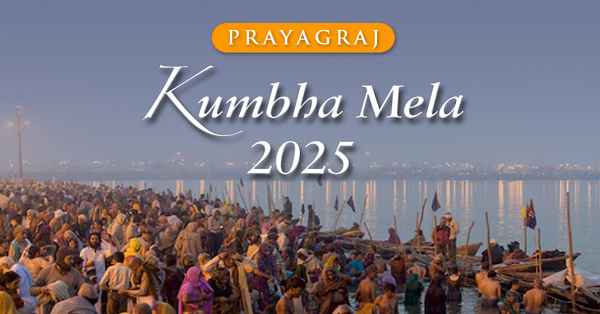

Kanwar Yatra 2026 begins Thursday, 30 July 2026 (the first day of Sawan/Shravan) and peaks on Sawan Shivratri, Tuesday, 11 August 2026, when most Kanwariyas perform jalabhishek. There is no single national registration portal Kanwariyas register through their state police’s Kanwar Yatra portal (Uttarakhand, Delhi, Haryana each run their own) or at offline counters along the route. If you are travelling to or through Varanasi during this period either as a Kanwariya heading to Kashi Vishwanath, or a family member supporting one book a taxi in Varanasi advance, since roads around the ghats and NH corridors see heavy diversions through the peak fortnight.
What is the Kanwar Yatra?
The word “Kanwar” refers to a bamboo pole which is carried on the shoulders by devotees, known as the “Kanwariyas,” with two water vessels hanging at each end. They travel on foot, cycle, or by vehicle to collect water from the holy Ganga River, then carry it back to their hometown temples, especially to offer at Lord Shiva’s temples. People join the yatra with a pure and clean mind to seek the blessings of MAHADEV.
During this holy yatra, people wish for many things like better health of their family members and friends, seek blessings for their spiritual being, diversified wealth, and many more. With the continuous chants of the almighty name, SHIVA SHIVA or BOL BAM, kanwariyas surrender themselves to the GOD. If you are pure and have no deceitful thoughts in mind, he is surely going to help you out even in every hard situation.

Kanwar Yatra 2026: Important Date
| Event | Date |
|---|---|
| Sawan/Shravan begins (North India, Purnimanta calendar) | Thursday, 30 July 2026 |
| Kanwar Yatra begins | Thursday, 30 July 2026 |
| Sawan Somwar (Mondays) — North India | 3, 10, 17, 24 August 2026 |
| Peak Dak Kanwar (non-stop relay run) | 9–11 August 2026 |
| Sawan Shivratri (main jalabhishek day) | Tuesday, 11 August 2026 |
| Sawan month ends / Raksha Bandhan | Friday, 28 August 2026 |
| Shravan Masam (Amanta calendar — Maharashtra, Gujarat, South India) | 13 August – 11 September 2026 |
The Importance of Shravan (Sawan) Month
The month of Shravan (Sawan) is considered the sacred month to worship Lord Shiva. As per the Hindu Mythology, during the churning of the ocean (Samundra Manthan), Lord Shiva drank the deadly poison “Halahal” to save the universe. So, the devotees offer sacred Ganga Jal to Shivlings during this time and thank Lord Shiva for saving us.
Mondays during the month of Shravan (Sawan) are known as “Sawan Somvar” and are very auspicious. People do fasting and visit temples on these days to fulfill their desires and purify their souls.
Major Kanwar Yatra Routes in 2026
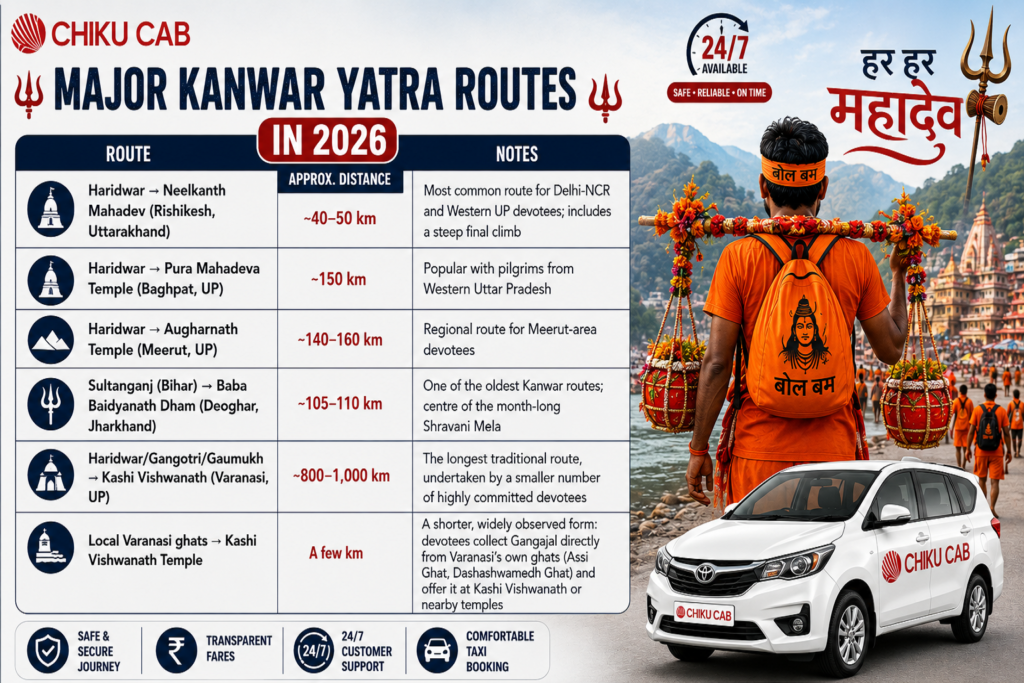
| Route | Approx. Distance | Notes |
|---|---|---|
| Haridwar → Neelkanth Mahadev (Rishikesh, Uttarakhand) | ~40–50 km | Most common route for Delhi-NCR and Western UP devotees; includes a steep final climb |
| Haridwar → Pura Mahadeva Temple (Baghpat, UP) | ~150 km | Popular with pilgrims from Western Uttar Pradesh |
| Haridwar → Augharnath Temple (Meerut, UP) | ~140–160 km | Regional route for Meerut-area devotees |
| Sultanganj (Bihar) → Baba Baidyanath Dham (Deoghar, Jharkhand) | ~105–110 km | One of the oldest Kanwar routes; centre of the month-long Shravani Mela |
| Haridwar/Gangotri/Gaumukh → Kashi Vishwanath (Varanasi, UP) | ~800–1,000 km | The longest traditional route, undertaken by a smaller number of highly committed devotees |
| Local Varanasi ghats → Kashi Vishwanath Temple | A few km | A shorter, widely observed form: devotees collect Gangajal directly from Varanasi’s own ghats (Assi Ghat, Dashashwamedh Ghat) and offer it at Kashi Vishwanath or another local Shivalaya |
Major Kanwar Yatra Routes in India
1. Haridwar to Neelkanth Mahadev (Uttarakhand)
This is the most popular Kanwar Yatra route. Devotees fetch water from the holy river Ganga, Haridwar, and walk approximately 25-30 km uphill to Neelkanth Mahadev Temple in Rishikesh. It is believed that Lord Shiva consumed the Halahal poison here. Lakhs of devotees visit here to perform abhishekam on the Shiva lingam and seek divine blessings
2. Sultanganj to Baba Baidyanath Dham (Jharkhand)
One of the longest and most significant Kanwar yatras, this route covers 105 km from Sultanganj, where the holy river Ganga flows northward (Uttarvahini), to Baba Baidyabath Dham, Deoghar in Jharkhand. The Kanwar Yatra 2025 Bihar Sultanganj Deoghar route is expected to attract lakhs of Kanwariyas due to its spiritual significance.
3. Gaumukh to Kashi Vishwanath (Uttar Pradesh)
Starting from Gaumukh, the source of the holy river Ganga in Uttarakhand, this is a tough and long yatra that concludes at the holy city of Varanasi, Baba Vishwanath Dham Jyotirlinga.
Other Regional Routes of Kanwar Yatra
- Allahabad to Varanasi (UP) – Kanwariyas fetch sacred water from the holy Sangam and offer it to Lord Shiva in Varanasi.
- Patna to Baidyanath (Bihar) – Kanwariyas from Patna, Bihar, visit Deoghar to seek blessings from Baba Baidyanath.
Types of Kanwar Yatra
- Samanya (Normal) Kanwar — walked at a steady, unhurried pace; the most common form
- Dak Kanwar — a fast, non-stop relay, often run rather than walked, timed so the water reaches the temple before it’s considered “stale”; in 2026 the main Dak Kanwar window falls around 9–11 August
- Khari Kanwar — the Kanwar is never set down; the devotee (or a relay of companions) keeps it aloft for the entire journey
- Dandi Kanwar — an especially austere form involving prostration or measured steps as a mark of penance
Kanwar Yatra Registration: How It Actually Works in 2026
There is no single central India-wide registration portal for Kanwar Yatra. Registration is handled state by state, mainly for crowd management, medical support, and security coordination:
- Uttarakhand: Registration via the state’s Kawad Yatra portal (policecitizenportal.uk.gov.in/kavad), primarily for pilgrims collecting water from Haridwar, Gangotri, or Gaumukh.
- Delhi: Registration through the Delhi Police Kawad Yatra portal, mainly for organized groups and camps operating within the capital.
- Uttar Pradesh: UP does not run one unified statewide portal the way Uttarakhand and Delhi do; coordination is handled through district-level police advisories (Meerut zone, Gautam Buddh Nagar, Varanasi, etc.), with on-ground registration counters and camp permissions arranged locally by police and organizing Kanwar Sanghs.
- General process where portals exist: submit name, age, address, a valid ID (Aadhaar, voter card, or passport), mobile number, and your intended route/date. You’ll typically receive a QR-coded slip or pass — carry a physical or digital copy throughout the yatra, since it may be checked at multiple points.
- No internet access? Most states also run offline registration counters at major starting points during peak Sawan weeks.
For UP-specific and Varanasi-specific rules (camp permissions, DJ volume and Kanwar-height limits, route diversions), check directly with your local district police or the official UP Police website (uppolice.gov.in), since these are updated closer to the yatra dates each year.
New Rules to Know for 2026
Ahead of the 2026 season, Uttar Pradesh police (notably in the Meerut zone) have tightened several rules:
- Height limits on Kanwars and DJ sound systems mounted on vehicles, to reduce accidents on narrow roads
- DJ/music-truck size caps — capped around 12 ft × 10 ft with defined volume limits in several states for 2026
- Increased plainclothes and uniformed police presence along major routes and at camps, coordinated at a scale similar to Maha Kumbh crowd-management planning
- Traffic diversions and heavy-vehicle bans on core corridors (e.g., NH-34 through Meerut and Muzaffarnagar) for roughly two weeks before Shivratri, with general traffic rerouted via alternate highways during the peak fortnight
Always confirm the latest local advisory close to your travel date, since specific restrictions are finalized district by district in the weeks before Sawan begins.
Gangajal Rules Every Kanwariya (and Support Family) Should Know
- The Kanwar, once filled, is treated as sacred — it must not touch the ground at any point in the journey; makeshift stands along the route exist specifically so Kanwariyas can rest without setting it down.
- The Gangajal is meant to be offered in a single, unbroken jalabhishek once the devotee reaches their destination temple.
- Many Kanwariyas observe a fast or sattvik (pure vegetarian) diet for the duration of the yatra; roadside dhabas along Kanwar routes often switch to pure-veg menus for the whole month.
- A support vehicle is commonly used by the family, not the Kanwariya themselves — the person carrying the Kanwar walks, while a taxi or Tempo Traveller carries luggage, food, elderly relatives, and rest supplies, meeting the walking group at intervals.
Practical Travel Tips for Kanwar Yatra 2026
- Travel outside the peak fortnight if you’re a leisure traveller. If your trip to Haridwar, Rishikesh, or Varanasi isn’t Kanwar-related, plan it before 30 July or after roughly 13 August to avoid the heaviest congestion.
- Leave before dawn if you must drive through a Kanwar corridor during Sawan — kanwariya foot traffic and diversions build steadily through the day.
- Drive with extra patience and space. Pilgrims frequently walk on the carriageway itself; slow down well in advance, avoid honking near groups, and never attempt to overtake close to a DJ truck or a walking column.
- Expect one-way and closed roads on core Kanwar corridors during the peak days around Shivratri — always check the day’s local traffic advisory rather than assuming your usual route is open.
- Book transport well ahead. Walk-in taxi or cab arrangements during peak Shravan dates are extremely difficult to arrange on short notice — pre-book support vehicles and airport/railway transfers.
- Flying in? For Haridwar/Rishikesh, Dehradun’s Jolly Grant Airport sits north of the main pilgrim corridor and is often faster than driving up NH-34 during peak weeks.
- Carry ID and any required registration pass at all times — checks happen at multiple points, especially near major temples and state borders.
How Chiku Cab Supports Kanwar Yatra Travel in Varanasi
Chiku Cab has arranged local Varanasi transport since 2022, including for Sawan-season pilgrims. For Kanwar Yatra 2026, common requests we handle include:
- Support-vehicle service for Kanwariya families — an AC sedan, Ertiga, or Tempo Traveller that carries luggage, food, and non-walking family members, coordinated to meet the walking group at agreed points
- Airport and railway station transfers timed around Sawan-season traffic diversions in and around Varanasi
- Local Kashi Vishwanath darshan drop-offs, with drivers who know which lanes stay closed on Sawan Mondays and around Shivratri, and where the nearest permitted parking/drop point is on any given day
- Fixed, pre-disclosed fares — no surge pricing during peak Sawan dates, with tolls and any after-hours driver charges shown upfront at booking
The 12 Jyotirlingas & Their Significance in Kanwar Yatra
1. Somnath (Gujarat)
It is the first Jyotirlinga, which is very sacred. It reflects the eternal Lord Shiva. There is no direct Kanwar route, but some of the devotees visit there to seek divine blessings.
2. Mallikarjuna (Andhra Pradesh)
Located in Srisailam, this Jyotirlinga is also one of the 18 Maha Shakti Peethas. Pilgrims from the south India often visit this temple in their regional Kanwar route.
3. Mahakaleshwar (Ujjain, MP)
This is the only south-facing Jyotirlinga, symbolizing the destruction of negativity. This Jyotirlinga sees regional Kanwar yatris from Indore and Bhopal to perform abhishekam of Lord Shiva.
4. Omkareshwar (MP)
It is situated on Mandhata island in the Narmada River, and devotees often walk with Kanwars from Maheshwar to seek blessings from Lord Shiva.
5. Kedarnath (Uttarakhand)
It is one of the Char Dhams and a Jyotirlinga. Kedarnath often sees pilgrims who begin their Kanwar Yatra from Haridwar or Gaumukh.
6. Bhimashankar (Maharashtra)
It is located near Pune. This Jyotirlinga sees local Kanwariyas from all over Maharashtra, mainly from Nashik, Pune, and Mumbai, to offer water collected from the holy river Godavari to Lord Shiva.
7. Kashi Vishwanath (Varanasi, UP)
This is the prime location for the Kanwar Yatra. A large number of Kanwariyas visit here to perform abhishekam on Lord Shiva’s lingam and seek blessings from Baba Kashi Vishwanath.
8. Trimbakeshwar (Nashik, Maharashtra)
It is close to the Holy River Godavari, and local Kanwariyas from Maharashtra visit here to seek blessings from Lord Shiva.
9. Vaidyanath (Deoghar, Jharkhand)
It is the second most visited Lord Shiva temple after the Neelkantha Mahadev Temple in Rishikesh. The Kanwariyas start their yatra from Sultanganj, Deoghar, and seek lakhs of Lord Shiva devotees.
10. Nageshwar (Dwarka, Gujarat)
This Jyotirlinga seeks Kanwariyas from Gujarat, the state itself, and also from Rajasthan, after the darshan from the Somnath temple.
11. Rameshwaram (Tamil Nadu)
Rameshwaram is often visited by the southern pilgrims during the month of Shravan to seek divine blessings and offer holy water to Lord Shiva.
12. Grishneshwar (Aurangabad, Maharashtra)
It is located near the Ellora Caves. This Jyotirlinga completes the pilgrimage. Regional Kanwariyas crowd from Marathawad visit here.

How the Kanwar Yatra is Connected with the Jyotirlingas?
As the Kanwar Yatra is mainly associated with Haridwar, Sultanganj, and Gaumukh, many regional Kanwar Yatris aim to offer the sacred water of the holy river Ganga at the Jyotirlinga temples. This is the reflection of a deep spiritual unity of Sanatan Dharma, where local traditions blend with the pan-India pilgrimages.
Essential Tips for Kanwariyas during the Kanwar Yatra 2026
A. Health & Fitness
You have to start the preparation at least a month before starting the Kanwar Yatra. It includes walking, stretching, and, most importantly to stay hydrated time-to-time in your routine. Carry glucose or ORS to charge up your body also first-aid kits in case of emergency.
B. Things to Pack
- Bamboo Kanwar to carry the holy water.
- Extra clothes to wear in case of rain.
- Torch, and batteries for some routes if they are not well-lighted.
- Waterproof bags to protect your things.
- Mobile power banks to keep your phone charged if there is no place nearby to charge it.
- Water bottles and dry snacks to keep yourself hydrated and munch on if no shops are found.
C. Code of Conduct to be followed
- No alcohol, smoking, or non-veg food is allowed to be consumed by the Kanwariyas or near the people who are carrying the Kanwars.
- Maintain discipline and avoid loud music, mainly during the night hours, to avoid inconvenience to the locals.
- Help fellow Kanwariyas who are on your way, if needed.
D. Safety Tips to follow
- Kanwariyas are advised to walk in groups to help each other if necessary.
- Use reflective clothing at night so that the vehicles can see Kanwariyas from far to avoid any accidents.
- Keep emergency contacts handy in case of any emergency.
- Download the Kanwar Yatra 2025 map routes in advance in case of network connectivity issues.
E. Eco-friendly Yatra
- Carry reusable bottles to avoid littering bottles here and there.
- Avoid plastic as it will harm the environment.
- Dispose of waste responsibly to avoid inconvenience to the locals.
Accommodation, Facilities & Government Support Provided During the Kanwar Yatra
The Kanwar Yatra 2025 state government rules ensure smooth functioning and safety for a comfortable yatra for the devotees. Temporary shelters, also known as Kanwar Camps, medical booths, and langars, are organised on a large scale by both the government, local NGOs, and even by the locals to provide as much comfort as possible for the devotees carrying the Kanwars.
Police forces ensure traffic management under the Kanwar Yatra security guidelines 2025, issued by the government, for a smooth and convenient yatra, along with the daily lives of the people. Special arrangements are made in states like Uttar Pradesh, Bihar, Jharkhand, and Uttarakhand because they are the main places where the yatra commences.
Cultural Impact of the Kanwar Yatra
The Kanwar Yatra is not only a pilgrimage, but it has transformed into a cultural festival. Streets turn colourful with the saffron-attired Kanwariyas, loud noises of devotional music in the air, and local people participating by holding langars for the Kanwariyas. Youth plays an immense role by spreading awareness, supporting Kanwariyas by whatever means to ensure a safe Kanwar Yatra.
Kanwar Yatra is more than a pilgrimage – it is a celebration of faith, unity, and devotion. Whether you are walking from Sultanganj to Deoghar or from Haridwar to Neelkanth, the yatra feels like a spiritual reward from the divine.
Frequently Asked Questions
1. When does Kanwar Yatra start and end in 2026?
Kanwar Yatra 2026 begins on Thursday, 30 July 2026, the first day of Sawan in the North Indian (Purnimanta) calendar, and peaks on Sawan Shivratri, Tuesday, 11 August 2026, when most Kanwariyas perform jalabhishek. The wider Sawan month continues until Friday, 28 August 2026.
2. How do I register for Kanwar Yatra 2026?
Registration is state-specific, not national. Uttarakhand and Delhi run dedicated online Kawad Yatra portals where you submit your ID, route, and travel dates to receive a QR-coded pass. Uttar Pradesh coordinates mainly through district-level police advisories and on-ground registration counters rather than one central UP-wide portal, so check with your local district police or uppolice.gov.in closer to your travel dates.
3. What is the route from Varanasi for Kanwar Yatra?
Varanasi is mainly a collection and offering point: local Kanwariyas fill their pots at Varanasi’s own ghats and walk a short distance to Kashi Vishwanath Temple or another nearby Shivalaya. A smaller number of highly devoted pilgrims also complete the very long Haridwar-to-Varanasi or Gaumukh-to-Varanasi route, carrying Gangajal several hundred kilometres to offer it at the Kashi Vishwanath Jyotirlinga.
4. Can I use a vehicle during Kanwar Yatra?
The Kanwariya carrying the sacred Kanwar traditionally walks (or, in a Dak Kanwar, runs) the route without setting the pot down. However, it’s common and accepted for family members supporting the group to travel by a support vehicle carrying luggage, food, water, and elderly or younger relatives that meets the walking group at intervals along the way.
5. Are roads closed during Kanwar Yatra 2026?
Yes. Core corridors like NH-34 through Meerut and Muzaffarnagar, along with dedicated Kanwar margs near Haridwar and restricted lanes around Varanasi’s ghats, see heavy diversions, one-way restrictions, and heavy-vehicle bans for roughly two weeks before Shivratri (peak restrictions expected around 7–12 August 2026). Always confirm the day’s specific advisory rather than assuming a route is open.
6. What is Sawan Shivratri, and how is it different from Maha Shivratri?
Sawan Shivratri falls on the Krishna Paksha Chaturdashi of the Sawan month and, in 2026, lands on 11 August. It is the day most Kanwariyas complete their jalabhishek. It should not be confused with Maha Shivratri, the larger annual festival that falls in February or March.
7. Is it safe to travel to Varanasi during Kanwar Yatra season?
Yes, with planning. Varanasi remains fully accessible during Sawan, but expect extended queues near Kashi Vishwanath and the ghats, especially on Sawan Mondays and around 11 August. Booking a local taxi in advance, starting darshan visits early in the day, and allowing extra buffer time around peak dates makes the trip smooth.
8. Do I need to carry any documents during Kanwar Yatra?
Yes carry a valid photo ID at all times, along with your registration pass or QR slip if you registered through a state portal. ID checks are common at major temples, state borders, and security checkpoints along the route.
9. Can Chiku Cab arrange a support vehicle for a Kanwariya group in Varanasi?
Yes. Chiku Cab arranges sedans, Ertiga SUVs, and Tempo Travellers as support vehicles for Kanwariya families in and around Varanasi, coordinated to carry luggage and non-walking members and to time arrival around darshan windows at Kashi Vishwanath. Book in advance, since vehicle availability drops sharply during the peak Sawan fortnight.
Book Your Kanwar Yatra Taxi in Varanasi with Chiku Cab
Whether you need a support vehicle for a Kanwariya family, a Kashi Vishwanath darshan drop-off timed around Sawan-season traffic, or an airport/railway transfer during the peak fortnight, Chiku Cab Varanasi team plans routes around the day’s actual road restrictions not a generic map.

I’m a wanderer who loves venturing on to unknown and unseen places. I explore freely to various fun and adventurous places, whether it be spiritual temple tours, captivating landscapes, and more. I wonder around in search of hidden gems and tourist attractions, temples, and other places.