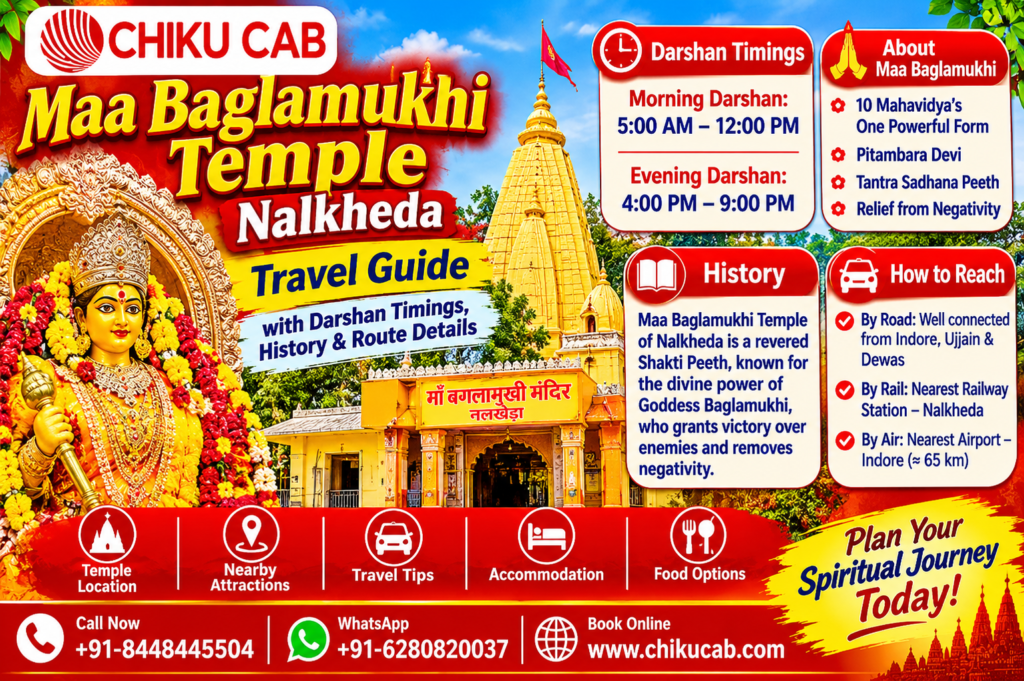
The Maa Baglamukhi Temple in Nalkheda, Madhya Pradesh, is one of the three main shrines of Goddess Baglamukhi in India, along with Datia and Kangra. Local belief ties this baglamukhi temple to the Mahabharata, when Yudhishthira worshipped the goddess here on Lord Krishna’s advice. The present structure on the Lakhundar riverbank dates to a restoration in 1815. Devotees come for havan and puja when they face court cases, rivals or problems that refuse to settle, and the crowds peak during Navratri and Baglamukhi Jayanti. If you’re planning darshan, it save you a lot of trouble to know a few things beforehand.
Darshan timings, havan booking, the road route from Ujjain or Indore, and the right season to visit are the details that shape your trip. We also arrange cabs for pilgrims who’d rather have the drive sorted before they leave home.

Planning Your Maa Baglamukhi Temple Trip in Nalkheda?
Plan your journey for Maa Baglamukhi Temple with a suitable cab for your family or group. Request a fare quote based on your pickup city, travel date, vehicle and return plan.
Maa Baglamukhi Mandir Nalkheda on the Banks of the Lakhundar
Nalkheda is a small town in Agar Malwa district, and the maa baglamukhi mandir is the main reason people visit it. Locals and regular visitors also call it Maa Baglamukhi Dham. You hear the temple before you reach the gate, with bells ringing, pandits chanting at the havan kunds and ghee crackling in the fire.
The Swayambhu Idol and Its Mahabharata Link
No record exists of anyone carving the idol in the sanctum. Devotees believe it is swayambhu, or self-manifested, which is a big part of why this baglamukhi mata temple carries so much weight among Shakti worshippers.
- Maa Baglamukhi in the centre, in her three-faced Pitambara form.
- On her right is Mahalakshmi, with Mahasaraswati on her left, and devotees worship the three together as Trishakti Mata.
- A swastika on the back wall where people make their wishes.
- Krishna, Hanuman and Bhairav have their own shrines inside the complex.
Temple priests tell how the Pandavas reached Nalkheda during their exile. Krishna advised them to worship the goddess here, and Yudhishthira did his sadhana on this riverbank before the war with the Kauravas. That’s why devotees dealing with legal battles or property disputes pick this baglamukhi mata mandir over others.
Pitambara Devi, the Eighth Mahavidya
Maa Baglamukhi is the eighth of the ten Mahavidyas, the tantric forms of the Divine Mother. Her name comes from ‘valga’, a Sanskrit word for bridle, and ‘mukhi’, meaning face. Put together, it describes a goddess with the power to restrain, known as stambhan.
The most famous maa baglamukhi story involves a demon named Madan, who gained vak siddhi, the power to make his words come true. He used it to torment people until Bagalamukhi Devi caught hold of his tongue and silenced him. Another legend says she rose from Haridra Sarovar, a lake of turmeric, to calm a cosmic storm at Lord Vishnu’s request.
Devotees call her Maa Pitambara Baglamukhi, the goddess dressed in yellow. At Nalkheda you’ll see that colour on the chunris, the marigolds, the besan laddoos and the painted walls.
Baglamukhi Temple Timings and Aarti Schedule
The temple opens every day of the week, and darshan has no entry fee.
| Darshan / Aarti | Time |
| Mangala Aarti | 6:00 AM |
| Darshan opens | 6:00 AM |
| Sandhya Aarti | 7:30 PM |
| Darshan closes | 9:30 PM |
| Navratri and festival days | Open till 11:00 PM |
Live darshan of the evening aarti streams on YouTube, which helps you judge the crowd before you set out. Timings change during Navratri, so we’d suggest a quick call to the temple office a day before your trip.
Havan, Puja & Anushthan at Baglamukhi Mata Mandir
Havan is the heart of worship at Nalkheda. Smoke from turmeric, yellow mustard and ghee hangs over the courtyard from early morning, and the sharp smell of burning chilli makes your eyes water near some kunds. Pandits here perform four main kinds of baglamukhi puja.
- A standard Baglamukhi havan uses yellow mustard, turmeric, sesame, barley, ghee and coconut.
- Mirchi havan adds dried red chillies to the fire, and devotees believe it wards off enemies and negative energy.
- For bigger problems, pandits perform an anushthan, a mantra jaap with havan that goes on for several days.
- Devotees who can’t travel book an online puja and receive photos or video once it’s done.
Pandits chant the Baglamukhi mantra through each havan, and many devotees repeat Om Hleem Baglamukhi Namah while they wait their turn. Booking a havan takes four steps.
- Reach out to a temple pandit a few days in advance. For Navratri, 2 to 3 months ahead is safer.
- Your name, gotra and the purpose of the puja go into the sankalp, so keep them ready.
- On the day, the pandit will ask for an Aadhaar card or other photo ID.
- We’d suggest confirming the full cost, samagri included, before you pay.
A full havan can take half a day, so our drivers wait at the temple parking until you’re done. You can give the ritual your full attention without watching the clock.
How to Reach Maa Baglamukhi Temple Nalkheda
Nalkheda has no airport or main-line railway station, so most pilgrims reach the temple by road. Many people search for Maa Baglamukhi in Ujjain, but the temple is 100 km away in Nalkheda, and Ujjain is the base most visitors start from.
Ujjain, Indore & Bhopal to Nalkheda by Road
| From | Road Distance | Drive Time | Route Via |
| Agar Malwa | 35 km | 45 min | Direct road |
| Ujjain | 100 km | 2 hrs | Agar Malwa |
| Dewas | 115 km | 2 hrs | Agar Malwa |
| Indore | 156 km | 3 hrs | Ujjain, Agar Malwa |
| Bhopal | [distance] | [time] | Shajapur |
The Ujjain road is the most used route, with Agar Malwa as the last big town on the way. It has the last reliable ATM before Nalkheda, and fuel stations get scarce after it, so it’s a good place to stop for chai and a refill.
Buses to Nalkheda leave Ujjain every 2 to 3 hours, but the last one back departs by 7 PM. That gets tight if your havan goes late. We provide one way and round trip cabs on all these routes, and you can choose from sedans to tempo travellers as per your group size. Fare starts from ₹10/km.

Baglamukhi Temple Nearest Railway Station and Airport
| Mode | Station / Airport | Distance to Nalkheda |
| Rail | Shajapur | 65 km |
| Rail | Ujjain Junction | 100 km |
| Air | Devi Ahilyabai Holkar Airport, Indore | 156 km |
Shajapur is closer, but Ujjain Junction has far more trains from Delhi, Mumbai and Ahmedabad. We pick up pilgrims at both stations and at Indore airport, and drive straight to the temple.
When to Visit Nalkheda Baglamukhi Mandir
- Chaitra Navratri (March/April) and Sharad Navratri (September/October) bring the biggest crowds, and the temple stays open till 11:00 PM.
- Baglamukhi Jayanti falls on Vaishakh Shukla Ashtami, the goddess’s appearance day, with special havans through the day.
- Sadhaks come in large numbers for tantra sadhana during Gupt Navratri in Magh and Ashadh.
- October to March is the pleasant season in Malwa, while May afternoons cross 40°C.
- Tuesdays and Fridays are considered auspicious for Baglamukhi worship.
For a quieter darshan, we’d suggest a weekday morning outside Navratri with a 6 AM start from Ujjain. You’ll reach Nalkheda by 8 AM and finish darshan before the midday crowd builds up.
Travel Tips for Your Baglamukhi Mata Nalkheda Visit
Try to wear something yellow. It isn’t a rule, but most devotees dress in yellow and bring yellow flowers, turmeric, a chunri or besan laddoos for the goddess. Stalls near the gate sell all of these, so you don’t need to carry them from home.
The temple has a shoe stand, drinking water, CCTV and parking. You can leave footwear at the stand and walk straight into the queue.
Nalkheda has a few dharamshalas and basic lodges close to the temple. Families who want better hotels stay in Ujjain and treat Nalkheda as a day trip.
Plenty of pilgrims split the trip over two days, with Mahakaleshwar, Harsiddhi and Kal Bhairav in Ujjain on day one and Nalkheda on day two. You can book our cab for both days and keep the same driver throughout, which saves you from bargaining with local taxis twice.
Other Baglamukhi Temples in India
Nalkheda is one of three main Baglamukhi Siddha Peeths in the country. If it’s too far, you may find a baglamukhi mandir closer to home.
| Temple | Location | Nearest Transport | Known For |
| Shri Pitambara Peeth | Datia, Madhya Pradesh | Datia station, Gwalior Airport (75 km) | Founded by Swami Ji Maharaj in the 1930s, with a Dhumavati shrine in the same complex |
| Shri Bagalamukhi Mata Temple | Bankhandi, Kangra, Himachal Pradesh | Gaggal Airport (40 km), Kangra Mandir station (40 km) | Legend of the Pandavas building it in one night, night havans |
| Baglamukhi Temple Kotla | Kotla, Kangra, Himachal Pradesh | Pathankot (45 km), Dharamshala (45 km) | Shrine near the old Kotla Fort |
Smaller Baglamukhi mandirs serve devotees in Delhi, Haridwar, Muzaffarpur, Ranchi and Kolkata, and Nepal has its own Bagalamukhi temple in Patan.
The Datia baglamukhi temple is the easiest one to add to a Gwalior or Jhansi trip. Maa Baglamukhi has two shrines in Kangra, Himachal Pradesh, and Bankhandi and Kotla are close enough to cover in one day from Dharamshala.
FAQs About Maa Baglamukhi Temple
Where is Maa Baglamukhi Temple located in India?
The main Maa Baglamukhi Temple is in Nalkheda, a town in the Agar Malwa district of Madhya Pradesh, on the bank of the Lakhundar river. It is 100 km by road from Ujjain and 156 km from Indore. India has two other major Baglamukhi shrines, Pitambara Peeth in Datia and the Bankhandi temple in Kangra, Himachal Pradesh.
What is the history of Maa Baglamukhi Temple?
Devotees trace the Baglamukhi Mandir in Nalkheda back to the Dwapar Yuga. Legend says Lord Krishna sent the Pandavas here during their exile, and Yudhishthira prayed to the goddess on this riverbank before the Kurukshetra war. Nobody has any record of the idol being carved, so devotees consider it swayambhu. The temple building you see today was restored in 1815.
Who is Maa Baglamukhi?
Maa Baglamukhi, also called Bagalamukhi Devi or Pitambara, ranks eighth among the ten Mahavidyas in the Shakti tradition. She holds the power of stambhan, which can freeze an enemy’s speech and movement. In her most told legend, she seized the tongue of the demon Madan to end his misuse of vak siddhi. Devotees pray to her for victory over rivals, court cases and false accusations.
What are the daily opening and closing timings of Maa Baglamukhi Temple?
Maa Baglamukhi Temple opens at 6:00 AM with the Mangala Aarti and closes at 9:30 PM, all seven days. Sandhya Aarti takes place at 7:30 PM. On Navratri and other festival days, darshan continues till 11:00 PM. Entry for darshan is free.
What is the best time to visit Maa Baglamukhi Temple for darshan?
Weekday mornings outside Navratri give you the shortest queues. October to March brings mild Malwa weather, while May afternoons go past 40°C. For the festival experience, plan your trip for Chaitra or Sharad Navratri, or Baglamukhi Jayanti on Vaishakh Shukla Ashtami, and be ready for big crowds. Tuesdays and Fridays are the auspicious days for her puja.
Which pujas and rituals are performed at Maa Baglamukhi Temple?
Havan is the main ritual at the Baglamukhi Temple in Nalkheda. The regular Baglamukhi havan uses turmeric, yellow mustard, sesame, barley, ghee and coconut, while pandits throw dried red chillies into the fire for the mirchi havan. Devotees with serious problems book an anushthan, which combines mantra jaap and havan over several days. You can also book an online puja in your name and get photos or video afterwards.
How can devotees perform Baglamukhi Havan at the temple?
You’ll need to book a temple pandit in advance, a few days ahead on regular dates and 2 to 3 months ahead for Navratri. The pandit prepares the sankalp with your name, gotra and the reason for the havan. Keep an Aadhaar card or any photo ID with you, and settle the full price, samagri included, before the ritual starts. A complete havan can take half a day.
Which festivals are celebrated at Maa Baglamukhi Temple?
Chaitra Navratri and Sharad Navratri are the biggest occasions at the Baglamukhi Mata Mandir, and darshan hours extend till 11:00 PM on these days. Baglamukhi Jayanti, on Vaishakh Shukla Ashtami, is the day the goddess appeared, and the havan kunds stay busy from dawn. Gupt Navratri in Magh and Ashadh brings sadhaks for tantra sadhana. Basant Panchami, Guru Purnima, Dussehra and Diwali are celebrated here too.
How far is Maa Baglamukhi Temple from the nearest railway station and airport?
Shajapur is the closest railway station, 65 km from the temple. Ujjain Junction is 100 km away but connects to more cities, so most pilgrims arrive there. The nearest airport is Devi Ahilyabai Holkar Airport in Indore, 156 km from Nalkheda. We pick up passengers at both stations and at the airport.
How can I reach Maa Baglamukhi Temple by train, bus, or taxi?
By train, get down at Ujjain Junction or Shajapur and cover the last part by road. Buses for Nalkheda depart Ujjain at 2 to 3 hour intervals, and the final one back leaves by 7 PM. A taxi gives you the most control over your schedule. The Ujjain to Nalkheda road distance is 100 km via Agar Malwa, and our drivers cover this route regularly in 2 hours. Fare starts from ₹10/km.
Related Guides and Cab Services from Chiku Cab
Most Nalkheda trips run through Ujjain, Indore or Bhopal. These guides and booking pages help you plan the rest of the route.
Jyotirlinga circuit. Our Omkareshwar to Ujjain road trip guide covers Omkareshwar, the second Jyotirlinga in Madhya Pradesh.
Ujjain darshan. Read our best places to visit in Ujjain guide, and see Mahashivratri in Ujjain if you plan to visit during the festival.
From Indore. Book an Indore to Ujjain cab or an Indore to Ujjain tempo traveller, and read how groups plan a Mahakal darshan from Indore by Force Urbania.
From Bhopal. Book a Bhopal to Ujjain cab and add Nalkheda as a day trip from Ujjain.

I’m a wanderer who loves venturing on to unknown and unseen places. I explore freely to various fun and adventurous places, whether it be spiritual temple tours, captivating landscapes, and more. I wonder around in search of hidden gems and tourist attractions, temples, and other places.