
Every Friday evening, more than 4 lakh vehicles exit Mumbai on the Western and Eastern expressways. That number is not a guess. It comes from MSRDC toll data, and it tells you something straightforward: every Mumbaikar with a free weekend is already heading somewhere. The ghats around Mumbai hold ten credible hill stations within a 300 km radius. A few are famous enough to be mentioned in every WhatsApp travel group. Others barely show up on Google Maps suggestions. All of them solve the same problem, getting out of the concrete and the noise, even if only for 48 hours.
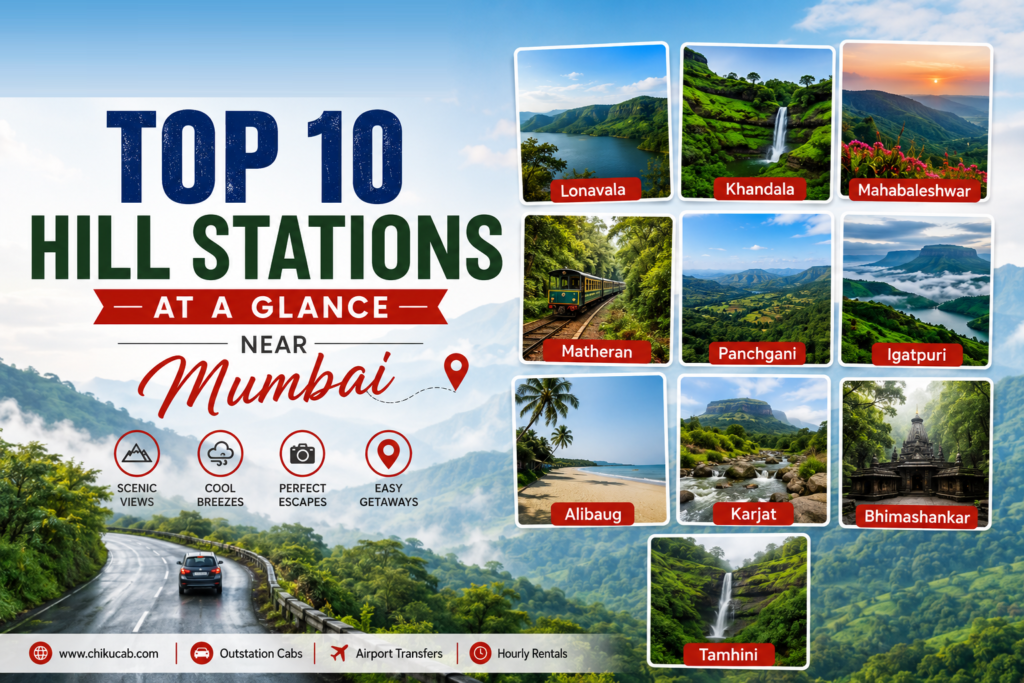
Top 10 Hill Stations at a Glance
| Hill Station | Distance | Drive Time | Best Season | Best For |
| Karjat | 65 km | 1.5 hrs | Year-round | Nature, trekking, day trip |
| Matheran | 85 km | 2 – 2.5 hrs | Oct – May | Walkers, families, no-car peace |
| Lonavala + Khandala | 86 km | 2 – 2.5 hrs | Monsoon, Winter | Couples, groups, road trippers |
| Igatpuri | 127 km | 1.75 hrs | Jul – Feb | Calm stays, trekkers |
| Malshej Ghat | 130 km | 2.5 – 3.5 hrs | Jul – Sep only | Monsoon birdwatching, day trip |
| Panchgani | 215 km | 3 – 3.5 hrs | Nov – Feb | Families, strawberry season |
| Mahabaleshwar | 210 km | 3 hrs | Oct – Feb | 2-day trips, couples, families |
| Jawhar | 145 km | 3.5 – 4 hrs | Jul – Sep, Nov – Feb | Culture, tribal art, offbeat |
| Lavasa | 158 km | 2.5 hrs | Any (with caveats) | Architecture, lakeside walk |
Under 100 km: The One-Day Stations
These three are close enough that you can leave Dadar at 6 AM and be back before sunset. That also means they take the worst of the weekend traffic. Plan around that.
Karjat (65 km, about 1.5 hours from Dadar)
Karjat is not technically a hill station in the classic sense. It sits at the foothills of the Sahyadris along the Ulhas River basin, which means it works differently from the others. You come here for the river, the forts, and the ancient Buddhist caves at Kondana, not for a viewpoint.
Getting there and the logistics trap: The drive from Dadar via the Sion-Panvel Expressway is about 65 km. Clean road, fast exit from the city. You can also take the Central Line local from Dadar to Karjat station in roughly 76 minutes. But here is where most first-timers get stuck. Kondana Caves, the main attraction, are 15 km from Karjat station. No bus goes there directly. An auto-rickshaw from the station to Kondhane village costs around Rs. 300 to 400 one-way. If you are travelling in a group, a hired cab from Karjat station makes far more sense than piecing together shared autos.
When to be there: Weekday mornings are uncrowded. Monsoon weekends see the heaviest footfall at riverside spots and waterfalls, peaking between 10 AM and 2 PM. The caves are a 30 to 40-minute walk from Kondhane village, so arrive early enough that the heat does not kill your enthusiasm.
What to eat: Highway dhabas on the approach road serve solid vada pav and misal pav. Devashree Garden, a few kilometres off the highway, is a locally known family dining spot with decent Maharashtrian meals.
Matheran (85 km, about 2 to 2.5 hours from Dadar)
Matheran is the only automobile-free hill station in Asia. That is not tourism brochure language. That is the actual rule. Once you reach Dasturi Car Point, everything with an engine stops. From there, you walk, take a horse, or hire a hand-pulled rickshaw for the remaining 2 to 3 km to the main market area.
The logistics you need to know before you go: Drive from Dadar via the Mumbai-Pune Highway through Panvel, then turn off toward Neral. At Dasturi Naka, all vehicles must be parked. There is a Rs. 50 entry tax per person. If you plan to take the toy train from Neral, it runs roughly 4 times a day (9:20 AM, 2:45 PM, and 4:20 PM schedules have been reported). It fills up on weekends; book 1 to 3 days ahead. The train is completely suspended during monsoon season, June through September. There is no reliable way to check operational status online before you leave, which is frustrating. Call the Neral station before you plan a monsoon trip. One more practical note: ATMs in Matheran run dry on peak weekends. Withdraw cash at Neral before you board.
Viewpoint timing: Echo Point and Louisa Point get heavily crowded from 10 AM to 3 PM on weekends. Before 8 AM, both are nearly empty. Louisa Point, being farther from the market, stays lighter throughout the day compared to Echo Point. Weekdays Tuesday to Thursday are noticeably quieter overall.
What to eat: Chikki is the food identity of Matheran. Nariman Chikki Mart on MG Road has operated since 1949. Peanut, cashew, sesame, and chocolate varieties are all worth trying. Hot Maggi at roadside stalls sounds basic, but on a cold winter morning in Matheran, it works. Kokum sharbat is the summer drink of choice here.
Lonavala + Khandala (86 km, about 2 to 2.5 hours from Dadar)
Lonavala and Khandala sit 5 km apart on the same ridge. Most people treat them as one destination, which is the right call. Khandala has Tiger’s Leap and some quieter viewpoints. Lonavala has Bhushi Dam, the chikki shops, and the noise that comes with mass tourism.
Drive and parking reality: The Mumbai-Pune Expressway from Dadar gets you there in 2 to 2.5 hours under normal weekend morning conditions. Toll is Rs. 270 one-way for a car. Leaving Mumbai on a Saturday morning adds 30 to 60 minutes due to expressway exit traffic. Parking in Lonavala town is a genuine problem on monsoon weekends. If you are driving, budget an extra 20 minutes just to find a spot near the market area.
The crowd problem: Bhushi Dam is packed from late morning through evening on Saturday, Sunday, and any long weekend during the monsoon. Tiger’s Leap is more manageable but still fills up by mid-morning. The best move is arriving at Tiger’s Leap by 6:30 AM, then heading to Bhushi Dam by 8:30 AM before the crowd wave hits.
What to eat: This is the one hill station where the food is a genuine reason to visit. Maganlal Chikki on Bazaar Road, established in 1880, has over 30 varieties including saffron almond and chocolate walnut. Next door, Cooper’s Fudge is the other institution; their walnut chocolate fudge, made with condensed milk and cocoa, sells out by early afternoon. Go to Cooper’s first. They keep limited stock and close once it is gone.
100 to 200 km: The Overnight Territory
These four destinations reward travellers who stay a night. A day trip is possible but you will spend most of it in the car. If you can plan a Friday departure and a Sunday return, these stations open up properly.
Igatpuri (127 km, about 1 hour 45 minutes from Dadar)
Igatpuri does not try to compete with Lonavala. It is quieter in a way that feels intentional. The terrain is proper Sahyadri, the Vaitarna Dam area is genuinely beautiful, and the town’s main claim to fame, Dhamma Giri, is one of the world’s largest Vipassana centres.
Access and logistics: Via NH-160, the Mumbai-Nashik Highway, from Dadar takes roughly 1 hour 45 minutes to 2 hours. One thing to note: local trains from Mumbai do not run to Igatpuri. The Central Line terminates at Kasara, one station before. If you are travelling by train, you need an express train from Dadar. Dhamma Giri is open to walk-in visitors from 9:30 AM to 4:30 PM. If you want to do a Vipassana course, you must register separately online in advance.
Crowd timing: Igatpuri is considerably less visited than Lonavala or Matheran. December through February are the busiest months. June through November are the quietest. No viewpoint congestion of the kind you see at other stations.
What to eat: Mirchi thecha, a fiery green chilli chutney eaten with bhakri flatbread, is the most distinctive local item. Kothimbir wadi, coriander fritters, and tambda rassa, a spicy mutton gravy, are the other Maharashtrian staples worth trying at local eateries. Vada pav is available everywhere and reliably good.
Malshej Ghat (130 km, about 2.5 to 3.5 hours from Dadar)
Malshej is a monsoon-only destination. There is no point softening that. From October to June, it is pleasant but unremarkable. During July and September, the ghat is covered in waterfalls, the hills turn an aggressive shade of green, and migratory flamingos arrive at Pimpalgaon Joga Dam. That is the window.
Getting there and what to prepare for: Drive via Kalyan and then the Kalyan-Ahmednagar Highway (NH-222) through Murbad. The road through the ghat itself is well-maintained but narrows significantly. During heavy monsoon, visibility on the ghat can drop to near zero due to cloud cover. Drive slowly, use headlights, and do not attempt the ghat after dark. There is no railway station at Malshej. The nearest is Kalyan, 85 km away. A private vehicle is the only practical option.
Food and accommodation, or the lack of it: The MTDC Flamingo Resort at the top of the ghat is the only accommodation. It books up every monsoon weekend. Book two to three weeks in advance. For food, carry your own for a day trip. The resort has a kitchen but the food quality is inconsistent. Highway dhabas before you enter the ghat section are the more reliable meal stop.
When to visit: Monday to Thursday, specifically. Tripadvisor reviews from returning visitors explicitly warn that peak monsoon weekends at Malshej see rowdy crowds. Families are better off on weekdays.
Panchgani (215 km, about 3 to 3.5 hours from Dadar)
Panchgani and Mahabaleshwar are best treated as one trip. They are 19 km apart, and most travellers who drive to one end up seeing both. Panchgani is the smaller, quieter town. Its main draw is Table Land, the second-largest volcanic plateau in Asia at 95 acres.
Logistics: Drive from Dadar via the Mumbai-Pune Expressway, through Pune, then toward Wai and Panchgani. The ghat sections near Wai have sharp bends; fog is common in early morning and late evening. Sunday afternoon return traffic from this route is heavy. If you are on a weekend trip, leave Panchgani by 2 PM on Sunday to avoid a very long return drive.
Crowd timing at Table Land: The plateau gets busy between 11 AM and 3 PM on weekends. Before 9 AM or after 4 PM, it is noticeably more relaxed.
What to eat: Panchgani is all about strawberries. Fresh strawberries with cream, strawberry jams, and chocolate-dipped strawberries are sold at stalls and at Mapro Garden on the approach road from Mahabaleshwar. Strawberry season runs November to February. Outside that window, the usual Maharashtrian spread is available at local restaurants.
Mahabaleshwar (210 km, about 3 hours from Dadar)
Mahabaleshwar is the most complete hill station on this list. It has the viewpoints, the food, the horse rides, the history, and the weather consistency that makes an overnight trip feel worthwhile. It is also the most crowded on a peak weekend, particularly at Bombay Point in the evening.
Drive and ghat caution: Via the Mumbai-Pune Expressway and then NH-48 through Wai, the drive from Dadar takes about 3 hours. The Pasarni Ghat near Wai has sharp bends and gets foggy. Night driving on the ghat is not a good idea. Arthur’s Seat requires a 30-minute walk from its parking area to the actual viewpoint. Plan that into your timing.
Viewpoint strategy: Arthur’s Seat is best before 9 AM or on a weekday. By 11 AM on weekends, the parking and the viewpoint itself are crowded. Bombay Point, or Sunset Point, is always crowded in the evening because it is the only functional sunset viewpoint; all the others lose the light earlier. That crowd is unavoidable, but arriving 30 minutes before sunset gets you a better position than the last-minute rush.
What to eat: Strawberry-based food is the signature experience, identical to Panchgani. Mapro Garden, on the Panchgani to Mahabaleshwar road, is the most famous stop for strawberry cream, jams, and chocolates. November to February is peak season. Beyond the strawberries, local Maharashtrian restaurants in the main bazaar area serve solid thali meals.
Beyond 150 km: The Offbeat Two
These two are not for a quick day trip. They are for people who have already done Lonavala and Matheran and want something that does not feel like a tourist production.
Jawhar (145 km, about 3.5 to 4 hours from Dadar)
Jawhar sits in the Palghar district, north of Mumbai, and is one of the few remaining tribal kingdoms in Maharashtra. The Warli community still lives here, and their paintings, the black-on-white geometric murals, are all over the town walls and in small art shops. It is an authentic cultural experience that the mainstream hill station crowd has not discovered yet.
Getting there: Drive from Dadar via the Western Express Highway and NH-848 toward Palghar and Jawhar. The nearest railway station is Igatpuri, 60 km away, which makes a private vehicle the only practical option. Public transport within Jawhar is infrequent.
What to know before going: Jawhar has limited food options. There are no proper restaurant chains or mid-range eating places. Community kitchens at Kelichapada serve tribal Maharashtrian food, including varan, a curry made from local beans, ukadiche modak, steamed rice dumplings, and zunka bhakar, a spicy chickpea flour preparation with millet flatbread. That is the food experience here, simple and genuinely local. Carry some snacks and water for the drive back.
When to go: July to September for the waterfalls and green hills. November to February for comfortable outdoor exploration and Warli art workshops. The town is not crowded in the way other stations are; you will not need to plan around peak hours.
Lavasa (158 km, about 2.5 hours from Dadar)
Lavasa deserves an honest note before you book. It was built as India’s first private hill city, modelled on Italian waterfront towns. The lakeside promenade looks good in photos. The reality in 2024-2025 is different.
Lavasa Corporation filed for bankruptcy in 2019. A resolution plan collapsed in September 2024, triggering fresh insolvency proceedings. Most promenade restaurants have shut down. Maintenance is poor. The city receives occasional day-trippers on weekends but is largely empty on weekdays.
What still works: The lakeside walk itself is pleasant if you manage expectations. The hills around Lavasa are genuinely scenic. A few accommodation options remain functional. But the ₹500 parking fee charged at the entry gate, cash only, is a known irritant, particularly given the state of facilities inside.
Include Lavasa in a trip if you are curious about the architecture and the story of India’s most ambitious failed planned city. Do not go expecting a lively tourist destination with dining options and activities. It is not that right now.
Season-by-Season: When to Go to Each Station

Picking the right season matters as much as picking the destination. A few of these stations are genuinely bad choices in the wrong month.
| Hill Station | Summer (Mar-May) | Monsoon (Jun-Sep) | Winter (Oct-Feb) | Avoid |
| Matheran | Good (dry, clear views) | Closed – toy train suspended | Peak season, best weather | Jun-Sep |
| Lonavala + Khandala | Quiet, hot | Best – dams overflow, green hills | Pleasant, clear views | Nothing specific |
| Karjat | Fine, less green | Best for rivers and caves | Good for trekking | Nothing specific |
| Igatpuri | Quieter, warm | Good – waterfalls active | Best season overall | Nothing specific |
| Malshej Ghat | Dry, unremarkable | Only real season here | Oct is good post-monsoon | Nov-May |
| Mahabaleshwar | Warm, strawberry tailing off | Ghat roads risky, lush | Peak season, strawberry season | Heavy rains Jun-Jul |
| Panchgani | Good, less crowded | Scenic but return traffic heavy | Best – strawberry season Nov-Feb | Nothing specific |
| Jawhar | Hot and humid | Best for waterfalls | Best for art and comfortable weather | Apr-May |
| Lavasa | Any season, check current status | Scenic drive in | Any season | None specific |
Planning the Road Trip: Routes, Vehicle Choice, and Departure Time
There are two main corridor directions from Mumbai for these hill stations, and understanding which one you are taking shapes your entire morning.
Southward via the Mumbai-Pune Expressway: This route covers Lonavala, Khandala, Karjat, Lavasa, Panchgani, and Mahabaleshwar. From Dadar, you join the expressway at Sion-Panvel and pick up speed. The expressway itself is fast, but the Dadar to Sion stretch on a weekend morning can add 20 to 30 minutes. Try to be on the expressway before 7 AM.
Northward via NH-160 or NH-848: This covers Igatpuri, Malshej Ghat, and Jawhar. The Mumbai-Nashik Highway (NH-160) from Thane or Dadar is the main artery. NH-848 branches north toward Palghar for Jawhar. These roads carry heavy truck traffic toward Nashik, so an early start matters here too.
Vehicle choice by group size: A sedan works well for groups of four or fewer. For five or more, an Innova or similar SUV is more practical for the ghat roads, particularly on routes to Mahabaleshwar, Malshej, and Jawhar where the road narrows and the incline gets steeper. For groups of 8 or more, a Tempo Traveller is the most space-efficient option.
Departure timing from Dadar: 5:30 AM to 6:30 AM is the window that avoids almost all Mumbai city traffic. Leave after 8 AM and you are adding 45 minutes to an hour on any expressway exit, regardless of which direction you are going. The Thane-Mulund belt, the Sion-Panvel junction, and the Airoli exits all log significant congestion after 8 AM on Saturdays.
If you are planning a multi-station trip, the Panchgani-Mahabaleshwar combination is the most natural pairing. They are 19 km apart on the same road, and a two-day trip covers both properly. Matheran and Karjat also work well as a paired trip for those who want the cave experience one day and the no-car quiet the next, staying overnight at Neral or Karjat.
Booking Your Cab for a Mumbai Hill Station Trip

Driving yourself to Lonavala or Karjat is perfectly fine. But for Mahabaleshwar, Malshej, Jawhar, or any destination with ghat roads, an experienced driver is genuinely worth the extra cost. Ghat sections in monsoon, in fog, or at night are a different proposition from the expressway. Your weekend should not start with road anxiety.
Chiku Cab operates cab and van rental services across 1,000 plus cities in India and has been running intercity routes from Mumbai since 2018. For hill station trips, they cover the full range, from a standard sedan for two to an Innova Crysta for five and Tempo Traveller options for larger groups. Pricing is transparent with no hidden toll charges added after the fact.
Why it makes practical sense for these routes: Their drivers are familiar with the specific ghat sections on Mumbai-Mahabaleshwar and Malshej routes. For Matheran, where your car has to stop at Dasturi Naka and park, Chiku Cab handles the drop-off and pickup timing without you having to manage parking fees and location logistics. For Jawhar, where the NH-848 is infrequently travelled and public transport thins out, having a reliable cab that knows the road is the difference between a smooth trip and a stressful one.
Rates for a Mumbai to Lonavala one-way sedan start in the Rs. 1,200 to 1,500 range depending on vehicle type. Mahabaleshwar outstation rates for a sedan are typically in the Rs. 3,500 to 4,500 range for a one-way trip from Dadar. Book at least two to three days ahead for weekend departures, particularly during the October to February peak season.
You can check current pricing and availability on the Chiku Cab website or app. For group travel, their van and Tempo Traveller options often work out cheaper per head than booking multiple sedans.

One Last Note
The stations on this list are not ranked by quality. They are different options for different trips. Karjat for a fast half-day. Matheran for families who want a car-free experience. Igatpuri when you want quiet that Lonavala stopped providing years ago. Mahabaleshwar for a proper two-day escape with good food and real viewpoints.
Pick based on your group, your time, and your season. Leave Dadar before 7 AM. Carry cash for toll booths and hill station markets. And if you are heading to Malshej during monsoon, go on a Tuesday, not a Saturday.
FAQs About Top Hill Station Near Mumbai
Matheran vs Lonavala: Which hill station is better for a family holiday?
Matheran works better for families with younger children. No vehicles inside the town means kids can walk freely on the red mud paths without traffic risk. Lonavala is better for families who want more activity options, Bhushi Dam, viewpoints, and easy restaurant access. Matheran is quieter. Lonavala is more convenient. Pick based on how much you want to do.
What is the closest hill station near Mumbai to escape city life?
Karjat is the closest at roughly 65 km from Dadar, about 1.5 hours by road. Matheran and Lonavala follow at around 85 km each, taking 2 to 2.5 hours. For a clean exit from the city with the least driving, Karjat via the Sion-Panvel Expressway is the fastest option, particularly on a weekend morning departure before 7 AM.
What is the best hill station near me for a one-day road trip from Mumbai?
Lonavala is the most practical one-day option. At 86 km from Dadar, you can cover Tiger’s Leap, Bhushi Dam, and a chikki shop run in a single day. Leave before 6:30 AM to beat traffic and be at Tiger’s Leap before the crowd hits. Booking a cab through Chiku Cab means one less thing to manage, no parking stress on a crowded monsoon weekend.
Is it safe to drive through Malshej Ghat at night during heavy rains?
No. The ghat road loses visibility almost completely in heavy monsoon cloud cover. Landslide risk is real on this stretch. Multiple experienced travellers and local sources specifically advise against night driving here. Cross the ghat section before sunset. If you are held up, wait at a dhaba below the ghat and attempt the climb only after conditions clear.
What are the hidden costs when planning a budget trip to Matheran? Four costs catch first-timers off guard. First, the Rs. 50 per person entry tax at Dasturi Naka. Second, vehicle parking at Dasturi Car Point, charged separately. Third, the toy train ticket from Neral, which ranges from Rs. 35 (second class) upward and sells out fast on weekends. Fourth, Matheran ATMs often run dry on peak days, so carry cash from Neral. Budget Rs. 300 to 500 per person above your accommodation cost.

I’m a wanderer who loves venturing on to unknown and unseen places. I explore freely to various fun and adventurous places, whether it be spiritual temple tours, captivating landscapes, and more. I wonder around in search of hidden gems and tourist attractions, temples, and other places.


