
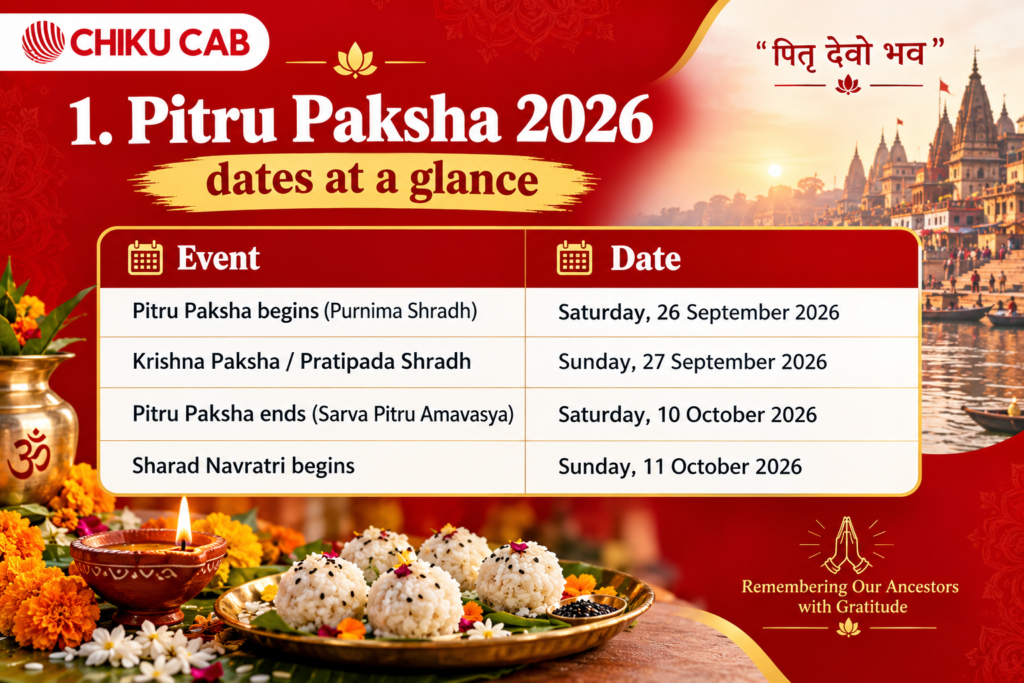
Pitru Paksha 2026 begins on Saturday, 26 September 2026 (Purnima Shradh) and ends on Saturday, 10 October 2026 with Sarva Pitru Amavasya (Mahalaya Amavasya). Krishna Paksha itself starts on 27 September with Pratipada Shradh. Sharad Navratri begins the day after Mahalaya.
Pitru Paksha (also called Shradh Paksha, Pitri Paksha, Mahalaya Paksha or Sola Shradh) is the fortnight when Hindus remember their departed ancestors through Tarpan, Pind Daan and Shradh. It falls in the Bhadrapada month, ending with Ashwin Amavasya.

Book Affordable Taxi Service for Gaya – 24×7 Instant Service
24×7 Instant Service | Safe & Comfortable Ride
1. Pitru Paksha 2026 dates at a glance
| Event | Date |
| Pitru Paksha begins (Purnima Shradh) | Saturday, 26 September 2026 |
| Krishna Paksha / Pratipada Shradh | Sunday, 27 September 2026 |
| Pitru Paksha ends (Sarva Pitru Amavasya) | Saturday, 10 October 2026 |
| Sharad Navratri begins | Sunday, 11 October 2026 |
Pitru Paksha falls in the Hindu month of Bhadrapada (Purnimanta calendar) and ends on the Amavasya of Ashwin. It comes later in 2026 than in 2025, partly because of the Adhik Maas (extra lunar month) earlier in the year, which pushes festivals later.
2. Complete Shradh tithi calendar 2026
| Date | Day | Shradh tithi | Commonly performed for |
| 26 Sept | Saturday | Purnima Shradh | Ancestors who passed away on Purnima |
| 27 Sept | Sunday | Pratipada Shradh | Passed on Pratipada; often also maternal grandparents (nana-nani) |
| 28 Sept | Monday | Dwitiya Shradh | Passed on Dwitiya |
| 29 Sept | Tuesday | Tritiya Shradh | Passed on Tritiya |
| 30 Sept | Wednesday | Chaturthi and Panchami Shradh | Both tithis fall on the same date this year; Panchami is also kept for those who died unmarried |
| 1 Oct | Thursday | Shashthi Shradh | Passed on Shashthi |
| 2 Oct | Friday | Saptami Shradh | Passed on Saptami |
| 3 Oct | Saturday | Ashtami Shradh | Passed on Ashtami |
| 4 Oct | Sunday | Navami Shradh (Matri Navami / Avidhava Navami) | Mother, and married women who died before their husbands |
| 5 Oct | Monday | Dashami Shradh | Passed on Dashami |
| 6 Oct | Tuesday | Ekadashi Shradh | Passed on Ekadashi |
| 7 Oct | Wednesday | Dwadashi Shradh | Passed on Dwadashi; sannyasis and saints |
| 8 Oct | Thursday | Trayodashi Shradh | Passed on Trayodashi; children (bal shradh) |
| 9 Oct | Friday | Chaturdashi Shradh | Untimely, accidental, violent deaths |
| 10 Oct | Saturday | Sarva Pitru Amavasya / Mahalaya | All ancestors, and anyone whose tithi is unknown |
Note: Tithi timings differ by city and by panchang. When a tithi overlaps two dates, follow the tithi that prevails at Aparahna (afternoon) and confirm with your family pandit. Practices vary by region and family tradition.
3. What is Pitru Paksha?
Pitru Paksha is a 15-16 day period in the Hindu calendar devoted to remembering and offering gratitude to ancestors (Pitras), up to three generations on each side. It is also called:
- Shradh Paksha / Shraddh / Shradha
- Pitri Paksha / Pitr Paksha
- Mahalaya Paksha
- Sola Shradh (the “sixteen Shradhs”)
- Kanagat (in some regions)
The word Shraddha comes from shraddha, meaning faith and sincerity. A Shradh is an offering made with faith. Pitru refers to the departed forefathers, and Paksha is a lunar fortnight.
Why it matters in Hindu belief
- Ancestors are believed to be remembered and nourished through water, food and prayers offered by descendants.
- Tradition views repaying the ancestral debt (Pitru Rina) as one of the three debts, along with the debts to the gods (Dev Rina) and to the sages (Rishi Rina).
- It is a time for family reflection, charity and gratitude, whatever one’s personal beliefs about the afterlife.
4. Mythology and origin
The story of Karna. In the Mahabharata, Karna was known for his generosity. After his death, he was served gold and jewels in the heavens, but no food. Karna said that he had donated gold all his life but had never offered food or water to his ancestors. He was permitted to return to earth for 16 days to offer food and water to his forefathers. Many families cite this as the origin of the 16-day Pitru Paksha.
The Garuda Purana. It describes the duties of descendants toward the departed and the journey of the soul, and stresses Shradh as an act of duty.
Rama, Sita and the Phalgu River. Tradition holds that Rama, Lakshmana and Sita came to Gaya to perform Pind Daan for King Dasharatha. While Rama and Lakshmana went to gather materials, Sita is said to have made the offering with sand, with the Phalgu river, a cow, the Akshayavat tree and a Brahmin as witnesses. Only the Akshayavat is said to have confirmed it, and the Phalgu is said to have been cursed to flow underground. This is why the Phalgu is called a river that flows beneath the sand (antahsalila), and why Akshayavat is so revered at Gaya.
Gayasur. The legend says the demon Gayasur performed severe penance and gained a boon making his body sacred. Lord Vishnu pressed him down, and the footprint of Vishnu remains at the Vishnupad Temple. Gayasur is said to have asked that those who offer Pind at his place receive liberation for their ancestors, and Gaya became the best-known tirtha for Pind Daan.
These stories come from traditional sources and local belief, and their details vary between texts and regions.
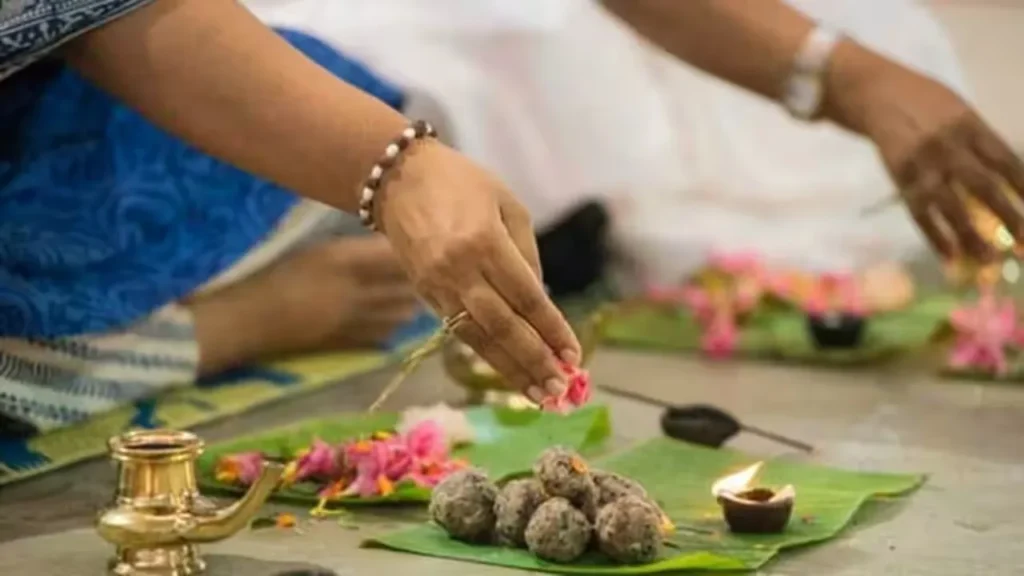
5. How to find your ancestor’s Shradh tithi
This is the most common question. The Shradh date is based on the Hindu lunar tithi of death, not the English date.
- Note the exact date and approximate time of death.
- Look up that date in a Hindu panchang, which will show the tithi and paksha (Shukla or Krishna) at that time.
- Note the tithi (for example, Saptami).
- Perform Shradh on that tithi during Pitru Paksha 2026 (see the calendar above).
- If you cannot find the tithi: Perform Shradh on Sarva Pitru Amavasya, 10 October 2026.
- If death occurred in Shukla Paksha: In many traditions, the Shradh is performed on the same numbered tithi in Krishna Paksha. Confirm with your priest.
- Two tithis on one day or a skipped tithi: In 2026, Chaturthi and Panchami both fall on 30 September. Families whose ancestor died on either can perform Shradh that day.
- More than one person on the same tithi: One Shradh ritual can include all family members whose tithi is the same.

6. Types of Shradh
Texts such as the Matsya Purana and the dharma shastras describe different classifications. The Matsya Purana lists twelve types:
| Type | Meaning |
| Nitya | Daily offering |
| Naimittika | Performed for a specific occasion, such as a death anniversary |
| Kamya | Performed for a particular wish |
| Vriddhi | Performed on joyous occasions (birth, marriage) |
| Sapindana | Performed on the 12th day after death or at the end of the year, uniting the departed with the ancestors |
| Parvana | Performed on specific parva days such as Amavasya |
| Goshthi | Group Shradh |
| Shuddhi | For purification |
| Karmanga | Performed as part of a samskara |
| Daivika | Offered to the deities |
| Yatra | Performed during a pilgrimage |
| Pushti | For physical or economic wellbeing |
The three types most often mentioned are Nitya, Naimittika and Kamya. The Pitru Paksha Shradh is generally considered a Parvana Shradh.
Book Your Reliable Taxi Service for Gaya Today?
We have 8000+ Varified Drivers and cover 500+ routes across India. Call us for custom routes and special packages!
7. Who can perform Shradh?
- Traditional view: The eldest son, or other male descendants, perform Shradh. Next in line are grandsons, brothers and other male relatives.
- Modern practice: Many families and priests accept daughters, wives, daughters-in-law or other relatives, especially when there is no male heir. Some texts allow this, and many pandits agree today.
- Living on your own or abroad: You can perform a simple Tarpan at home with water and sesame, offer food to those in need, or arrange the ritual through a priest.
- Women: Many families allow women to perform Tarpan and offer food, though customs differ.
Check with your family pandit for the practice followed in your lineage (kula parampara).
8. Tarpan, Pind Daan and Shradh: the differences
| Ritual | What it is | What you offer |
| Tarpan | Offering water to satisfy the ancestors | Water with black sesame, barley and kusha grass, offered facing south |
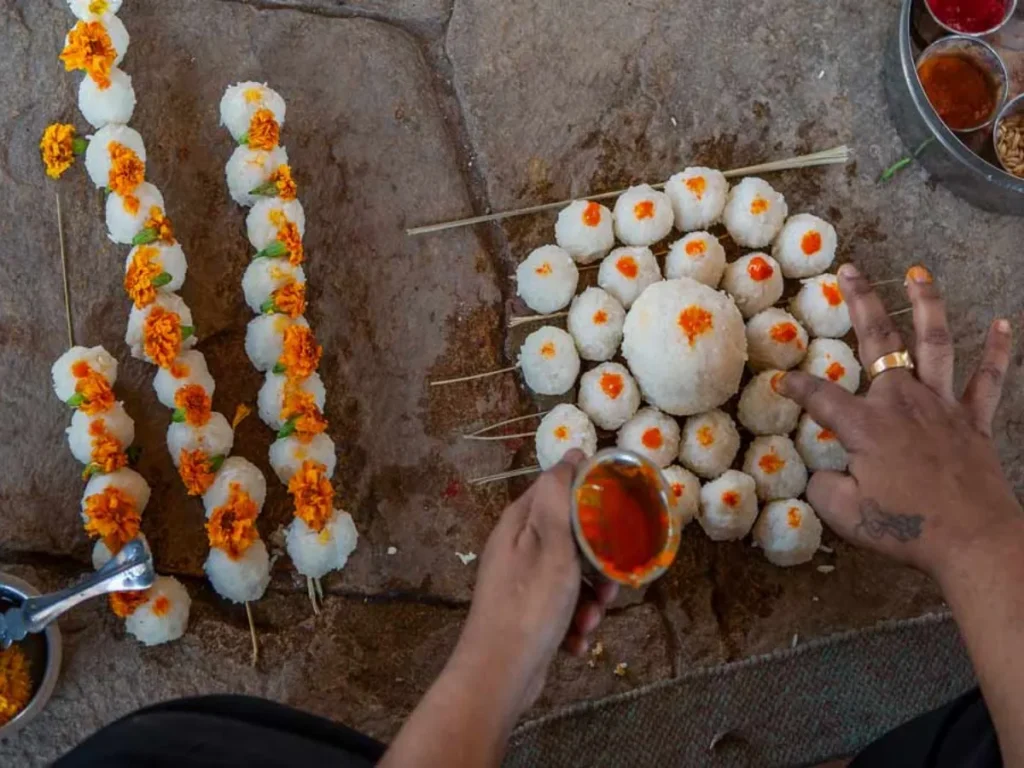
| Pind Daan | Offering rice balls to ancestors | Pindas made of cooked rice, barley flour, black sesame, ghee, honey and milk |
| Shradh | The full ritual with faith | Sankalp, Tarpan, Pind Daan, food offering, feeding a Brahmin and charity |
9. Shradh vidhi at home, step by step
This is a general outline. Practices vary by region (North India, Bengal, South India, Maharashtra), so use it as a guide and adapt it with your pandit.
Before the day
- Identify the tithi and fix the date.
- Clean the house and the puja area.
- Gather the samagri (items) listed below.
- Arrange a Brahmin or priest if you plan to include one.
Samagri (items needed)
- Black sesame seeds (til)
- Barley (jau)
- Kusha (darbha) grass
- Ganga jal or clean water
- Rice, barley flour, ghee, honey and milk (for pindas)
- Tulsi leaves
- White flowers
- A copper or brass vessel (tamra patra) and a plate
- Clean cloth, a seat (aasan) and a lamp
- Fruits, sweets and the cooked satvik meal
On the day
- Bathe and wear clean clothes, preferably white or light-coloured.
- Sit facing south (the direction associated with ancestors) on a clean seat. Wear a ring made of kusha grass on the ring finger if your tradition does so.
- Take Sankalp. Hold water, sesame and kusha in your right hand and state your name, gotra, the ancestor’s name and relation, the date and the tithi, and your intent to perform Shradh.
- Offer Tarpan. Pour water mixed with sesame and barley from your right palm so that it flows between the thumb and index finger (the pitru tirtha). A commonly used short invocation is “Om Pitribhyah Namah”. Your pandit can give the full mantras for your lineage.
- Prepare Pindas. Make small balls from cooked rice, barley flour, sesame, ghee and honey, and place them on kusha grass. Offer them with the appropriate mantras.
- Offer food. Set aside portions of the cooked meal for Pancha Bali (see section 11).
- Feed a Brahmin or offer a meal and dakshina. If this is not possible, give food to someone in need.
- Donate clothes, grains, sesame or money.
- Close with a prayer asking for forgiveness for any lapses and for the ancestors’ peace. Share the meal with family afterwards.
Simple version with no priest: Bathe, sit facing south, take Sankalp, offer water with sesame (Tarpan), prepare a satvik meal, offer a portion to a crow, cow and dog, and feed or donate to someone in need. Sincerity is the central point in most traditions.
10. Shradh muhurat: Kutup, Rohina and Aparahna
Shradh is traditionally performed in the afternoon, not in the morning or at night. The day is divided into parts, and these are the key periods:
| Muhurat | Approximate time | Notes |
| Kutup Muhurat | Around late morning to midday | Considered the most favourable |
| Rohina Muhurat | Just after Kutup | Also favourable |
| Aparahna Kaal | Afternoon | The main period for Shradh rites; Tarpan is commonly completed by the end of it |
Exact timings depend on sunrise and sunset in your city. Check a city-specific panchang (Drik Panchang or your local pandit) for your location rather than relying on a national timetable.
11. Pancha Bali
Before eating, families set aside five portions of the cooked food:
- Gau Bali: for the cow
- Shwan Bali: for the dog
- Kaka Bali: for the crow
- Deva Bali: for the deities
- Pipilika Bali: for ants and small creatures
In many households, crows are particularly significant because they are considered messengers of the ancestors. Food is placed on the terrace or a clean spot for crows before the family eats.
12. Rules, do’s and don’ts
Do
- Eat freshly prepared, satvik, vegetarian food
- Wake early, bathe and keep the home clean
- Offer Tarpan and food to the needy and to animals
- Be respectful in speech and conduct
- Donate according to your means
- Keep the mind calm and be sincere in the ritual
Avoid (traditionally)
- Non-vegetarian food, alcohol and tobacco
- Onion and garlic in the Shradh meal
- Starting auspicious events such as weddings, engagements, housewarmings and mundan
- Cutting hair or nails and shaving on the day of Shradh
- Performing Shradh at night
- Anger, arguments or disrespect towards elders and Brahmins
- Using iron utensils for the rite in some traditions (copper, brass or leaf plates are preferred)
A note on shopping, travel and temple visits. Many people believe new purchases such as property, gold or vehicles should be avoided, while others buy daily needs and travel freely. Temples remain open and worship continues. The period is considered inauspicious for celebrations, not for prayer. Follow the guidance of your family and pandit.
13. Food: what to cook and what to avoid
Commonly prepared: Kheer (rice pudding), puri, seasonal vegetables such as lauki, pumpkin, arbi and raw banana, rice, moong dal, curd and sweets such as laddoo or halwa. The dishes often include the ancestor’s favourite vegetarian food.
Commonly avoided: Onion, garlic, masoor dal, rajma, chana and chole, brinjal, radish, mustard greens, stale food, and excessively spicy or fried items. Some traditions also avoid black salt and certain spices. The reasons given are tamasic or heavy qualities that disturb the calm mind needed for the rite.
Serve food on clean leaf plates or traditional utensils, and prepare it fresh on the day.
14. Daan (charity) during Pitru Paksha
Charity is considered an essential part of Shradh. Common offerings are:
- Food grains (rice, wheat, pulses)
- Black sesame and ghee
- Clothes, especially to the needy and Brahmins
- Umbrella, footwear, bedding (traditionally linked to comfort for the departed)
- Gold or money (dakshina) according to means
- Cow-related donations (fodder or support for a gaushala)
- Support for the elderly and for those unable to afford a meal
The value of the offering matters less than the intent.
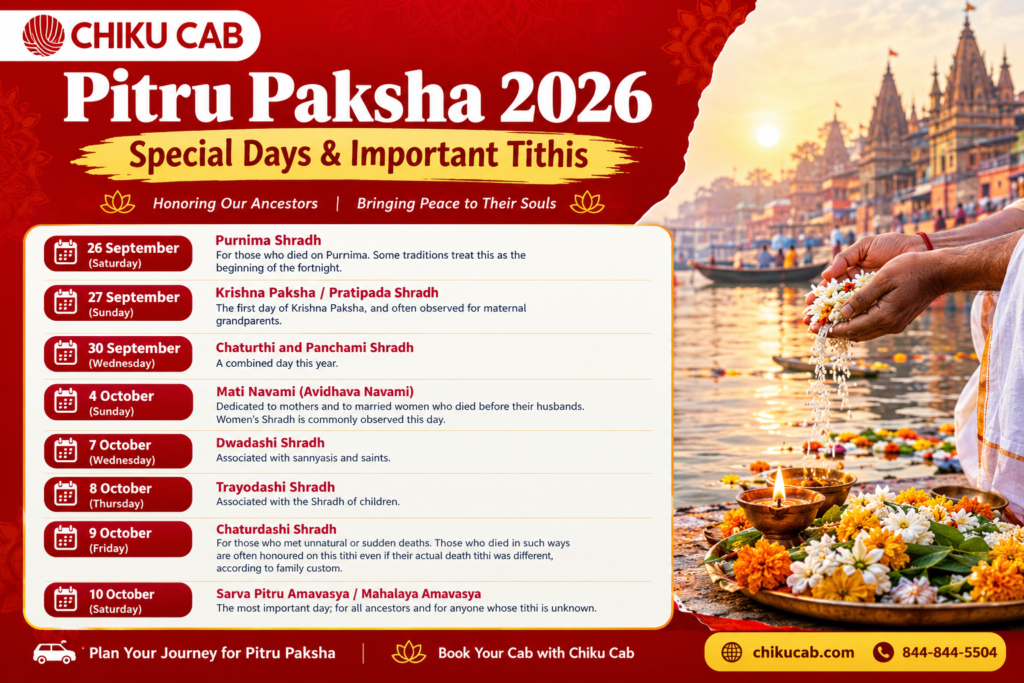
15. Special days in Pitru Paksha 2026
- 26 September: Purnima Shradh. For those who died on Purnima. Some traditions treat this as the beginning of the fortnight.
- 27 September: Pratipada Shradh. The first day of Krishna Paksha, and often observed for maternal grandparents.
- 30 September: Chaturthi and Panchami Shradh. A combined day this year.
- 4 October: Matri Navami (Avidhava Navami). Dedicated to mothers and to married women who died before their husbands. Women’s Shradh is commonly observed this day.
- 7 October: Dwadashi Shradh. Associated with sannyasis and saints.
- 8 October: Trayodashi Shradh. Associated with the Shradh of children.
- 9 October: Chaturdashi Shradh. For those who met unnatural or sudden deaths. Those who died in such ways are often honoured on this tithi even if their actual death tithi was different, according to family custom.
- 10 October: Sarva Pitru Amavasya / Mahalaya Amavasya. The most important day, for all ancestors and for anyone whose tithi is unknown.
Mahalaya in Bengal. In Bengal and Eastern India, Mahalaya marks the end of Pitru Paksha and the beginning of Devi Paksha. People offer Tarpan at the ghats, and the occasion signals the coming of Durga Puja.
16. Pitru Dosh and remedies
In Vedic astrology, Pitru Dosh is believed to arise from unresolved ancestral karma or unfulfilled rites. It is a matter of belief, and astrologers differ on its causes and effects. People often associate it with obstacles in marriage, children, career or health.
Common remedies cited in tradition
- Performing Shradh and Tarpan during Pitru Paksha
- Pind Daan at Gaya, which is believed to give lasting peace to ancestors
- Narayan Nagbali and Tripindi Shradh at Trimbakeshwar for specific concerns
- Feeding Brahmins, the poor, cows and crows
- Donating on Amavasya
- Planting a peepal tree
- Reciting the Bhagavad Gita (especially Chapter 7) or the Garuda Purana in the memory of ancestors
These are religious and cultural practices, not medical or guaranteed remedies. Consult a trusted priest for guidance specific to your family.
17. Where to perform Pind Daan
| Place | State | Significance |
| Gaya | Bihar | The most revered. Phalgu river, Vishnupad, Akshayavat |
| Varanasi (Kashi) | Uttar Pradesh | Ganga ghats such as Manikarnika and Dashashwamedh, and Pishach Mochan Kund |
| Prayagraj | Uttar Pradesh | Triveni Sangam |
| Haridwar | Uttarakhand | Narayani Shila and Har Ki Pauri |
| Ujjain | Madhya Pradesh | Siddhavat and the Kshipra river |
| Trimbakeshwar | Maharashtra | Narayan Nagbali, Tripindi Shradh |
| Pushkar | Rajasthan | Pushkar Lake |
| Badrinath (Brahma Kapal) | Uttarakhand | Pind Daan at Brahma Kapal |
| Rameshwaram | Tamil Nadu | Agni Theertham |
| Kurukshetra, Puri, Nashik | Various | Other well-known tirthas |
18. Gaya Pind Daan guide
Gaya is considered the foremost place for Pind Daan. A Pind offered here is believed to bring lasting peace to ancestors, so many families go once and complete the rite for all their forefathers. The Pitru Paksha Mela at Gaya draws a very large number of pilgrims every year.
Key sites
| Site | Why it matters |
| Vishnupad Temple | Houses the footprint of Lord Vishnu on a basalt rock; the central Pind Daan site |
| Phalgu River | Tarpan and Pind Daan are offered on its banks, mostly on the dry sandy bed |
| Akshayavat | A sacred banyan tree said to be eternal, where Pind is offered and a final rite is performed |
| Pretshila Hill | Linked to Pind Daan for those who met unnatural deaths |
| Ramshila Hill | Associated with Rama’s offering |
| Brahmayoni Hill | Sacred hill with a climb of several hundred steps |
| Sita Kund and Gayatri Ghat | Associated with Sita and Gayatri legends |
Duration of the Gaya Shradh. Traditionally, a complete Gaya Shradh covers many vedis (sacred sites) over up to 17 days. Pilgrims today often choose shorter schedules of 1, 3, 5, 7 or 15 days. A one-day option covers the main sites such as Phalgu, Vishnupad and Akshayavat. Decide with your priest how many vedis you want to cover.
Practical tips for pilgrims
- Book early. Hotels, dharamshalas, priests and transport fill up before Sarva Pitru Amavasya.
- Use a recognised priest (Gayawal Pandit). Gaya has a traditional community of hereditary priests. Many families have a specific Gayawal for their lineage. Agree on the schedule and the dakshina in advance. Avoid pressure from unknown touts.
- Check official notices. Bihar State Tourism and the Gaya district administration publish mela arrangements, helpline numbers and crowd-control guidance.
- Dress and carry. Wear light cotton clothes and comfortable footwear. Carry water, an umbrella (rain is possible), cash, ID and your family details (names, gotra, tithi).
- Plan your timing. Rituals usually start early. Avoid mid-afternoon sun and keep buffer time for crowds.
- Include the elderly carefully. Brahmayoni and Pretshila involve climbs, and some sites involve walking on sand. Consider a doli or assisted help.
- Combine with Bodh Gaya. Bodh Gaya, the place of the Buddha’s enlightenment, is about 12-15 km from Gaya and is worth a visit on the same trip. See our guide on things to do in Bodh Gaya.
For the complete ritual details, read our guide on Pind Daan in Gaya: ritual, date, time and significance.
19. How to reach Gaya
| Mode | Details |
| By air | Gaya International Airport (GAY) has limited flights. Patna Airport is a larger alternative, about 100 km away |
| By train | Gaya Junction is on the Delhi-Howrah main line with trains from major cities. Book early during Pitru Paksha |
| By road | Gaya connects to Patna, Varanasi, Ranchi, Kolkata and Bodh Gaya by national highways |
Approximate road distances (check live maps for the exact figure on your day): Varanasi to Gaya is roughly 250 km (about 4-5 hours), and Patna to Gaya is about 100 km (about 2-3 hours).
Travelling by cab. A pre-booked cab is convenient during the mela, as trains and buses are crowded and rituals have fixed timings. With Chiku Cab you can:
- Book an outstation cab for a one-way or round trip to Gaya from your city
- Take the Varanasi to Gaya taxi service
- Hire a local sightseeing cab in Gaya for Vishnupad, Phalgu, Akshayavat and the hills
- Book a Tempo Traveller for family groups
- Use the Chiku Cab app to book, choose your vehicle and get confirmation by SMS or email
Ask about toll, parking and driver charges when you book, so the quote is clear before the trip.
20. Pitru Paksha across the years
| Year | Pitru Paksha |
| 2024 | 17 September to 2 October |
| 2025 | 7 September to 21 September |
| 2026 | 26 September to 10 October |
The dates move each year because the Hindu calendar follows the lunar cycle, with adjustments for Adhik Maas.
Gaya: The Most Sacred Place for Pitra Daan in Hinduism
Gaya is one of the most sacred and divine places along with Kashi to perform pitra daan. It is place where thousands of people visit every year to help get their ancestors get moksh.
Falgu River is the holy spot where Shradh ceremonies are practiced every year on Sarva Pitru Amavasya. This place is considered divine and sacred. Gaya holds sanctity, divinity, and purity. Therefore, it is a path for the ancestors to travel from earth to the upper realms easily.
Thousands and lakhs of pilgrims travel to Gaya every year to do Pind Daan, Pitra Daan, and Tarpan. And in Gaya, it is celebrated as the Pitru Paksha Mela.
Peaceful Journey with Chiku Cab Shradh Puja Pilgrimage
Chiku Cab is undoubtedly the best travel partner for Shradh Puja in 2026 because it offers a peaceful and comfortable travel service for Shradh 2026. The cab service drives you to perform the most thoughtful journey to Gaya. This is a place where every corner whispers for solace, and in return, you get ancestral blessings.
If you wish to make your Gaya trip effortless and affordable, book the Chiku Cab so you can calmly connect with the divine ancestors to offer your Pind Daan.
Read More – Pind Daan in Gaya | Pind Daan Pooja, Ritual, Date & Time, Significance
Book Chiku Cab for One-Way or Round-Trip Outstation Cabs for Gaya
1. Excellent Cab Service with One-Way or Round Trip
Chiku Cab drivers can pick you up from your home to help you reach Gaya after you book its outstation cab service or one-way, or round-trip for Shradh Puja or Pind Daan. Its effortless services make your journey peaceful.
For that, you can hire the best vehicle from the Chiku Cab car rental options and book sedans like Etios or Indica, and Tempo Travellers for round trips.
2. Pocket-friendly-Transparent Pricing
With Chiku Cab, you can check the pricing of cabs and choose one-way or round-trip trips, checking the price per km.
3. Simple and Flexible Booking
You can book a Chiku Cab in advance after downloading the app.
And then you need to enter your destination, dates for Shradh Puja 2025, and pickup location.
You can choose the vehicle to travel in and pay for confirmation of your trip. You will get the confirmation details via SMS or email.
4. Affordable and Reliable Chiku Cab Service with Professional Driver Support
Chiku Cab, undoubtedly the best, is providing a professional service with experienced drivers. They ensure to look after tolls, parking, and other facilities with no hidden billing. It’s available 24/7 with cancellation and modification options.
5. Post Shradh Puja Round Trip or Travel Service with Chiku Cab
Once you complete your shradh puja 2025, the professional driver of Chiku Cab picks you up to drop you off at your home or station. And for that, you need to book your cab from the app.
21. Hindi summary (हिंदी सारांश)
पितृ पक्ष 2026 कब से कब तक है?
पितृ पक्ष 2026 की शुरुआत 26 सितंबर 2026 (शनिवार) को पूर्णिमा श्राद्ध से हुई और समापन 10 अक्टूबर 2026 (शनिवार) को सर्वपितृ अमावस्या (महालया अमावस्या) पर होगा। कृष्ण पक्ष की प्रतिपदा 27 सितंबर से शुरू होती है।
श्राद्ध किस तिथि पर करें?
जिस तिथि पर पूर्वज का निधन हुआ हो, उसी तिथि पर श्राद्ध करें। तिथि मालूम न हो तो सर्वपितृ अमावस्या (10 अक्टूबर) को श्राद्ध करें।
मुख्य तिथियां:
- 4 अक्टूबर: मातृ नवमी (अविधवा नवमी)
- 9 अक्टूबर: चतुर्दशी श्राद्ध (अकाल मृत्यु वालों के लिए)
- 10 अक्टूबर: सर्वपितृ अमावस्या
पिंडदान कहां करें? गया (बिहार) को सबसे पवित्र माना गया है। इसके अलावा वाराणसी, प्रयागराज, हरिद्वार और उज्जैन भी प्रमुख स्थान हैं।
22. Pitru Paksha 2026 FAQs
1. When is Pitru Paksha 2026?
From Saturday, 26 September 2026 to Saturday, 10 October 2026.
2. When does Pitru Paksha 2026 start and end?
It starts with Purnima Shradh on 26 September and ends with Sarva Pitru Amavasya on 10 October. Pratipada Shradh is on 27 September.
3. When is Sarva Pitru Amavasya 2026?
Saturday, 10 October 2026.
4. When is Mahalaya Amavasya 2026?
It is the same day as Sarva Pitru Amavasya: 10 October 2026.
5. When is Matri Navami 2026?
4 October 2026 (Sunday).
6. Why do Chaturthi and Panchami Shradh fall on the same day in 2026?
The two tithis overlap on 30 September, so both are observed that day.
7. What if I don’t know the date of death?
Perform Shradh on Sarva Pitru Amavasya, 10 October 2026.
8. What is the difference between Shraddha and Pitru Paksha?
Shraddha is the ritual of offering with faith. Pitru Paksha is the fortnight when it is performed.
9. Can I perform Shradh at night?
Traditionally, no. It is performed in the afternoon, during Kutup, Rohina or Aparahna.
10. Can daughters perform Shradh?
Many families and priests accept it today, especially when there is no male heir. Check with your priest.
11. Can women perform Pind Daan?
Practices vary. Some traditions allow it and some limit it. Consult your family pandit.
12. Can I do Shradh at home without a pandit?
Yes. A simple Tarpan with water and sesame, a satvik meal and charity can be done at home.
13. Which food is not allowed in Pitru Paksha?
Non-vegetarian food, alcohol, onion, garlic, masoor, rajma, chana, brinjal and radish are commonly avoided.
14. What are the three types of Shradh?
Nitya, Naimittika and Kamya are the most cited. Texts list up to twelve.
15. Is it okay to buy new things in Pitru Paksha?
Many believe big purchases and auspicious events should be avoided, while others buy daily essentials. Follow your family tradition.
16. Can I visit temples, including Vaishno Devi, during Pitru Paksha?
Temples remain open and worship continues. The period is considered unsuitable for celebrations, not for prayer. Some people postpone pilgrimages by choice.
17. Why are crows fed in Pitru Paksha?
Crows are traditionally regarded as messengers of the ancestors, so a portion of the food is set aside for them.
18. Why is Gaya the best place for Pind Daan?
Tradition links it to Vishnupad, the Phalgu river and the Gayasur legend. Many believe Pind Daan here brings lasting peace to the ancestors.
19. How many days does Gaya Pind Daan take?
The traditional programme is up to 17 days. Shorter options of 1, 3, 5, 7 or 15 days are common.
20. How far is Gaya from Varanasi?
About 250 km by road, roughly 4-5 hours depending on traffic.
21. What happens if I miss Pitru Paksha?
Tarpan can also be offered on Amavasya days of other months, and Pind Daan at Gaya is possible outside Pitru Paksha. Consult your priest.
22. Is Pitru Paksha inauspicious?
It is not considered inauspicious for prayer. It is a period of remembrance, so celebrations are generally avoided.
23. What is Pitru Dosh?
In astrology, a belief that unresolved ancestral karma can affect a person’s life. Views differ, so seek guidance from a trusted priest.
24. What should I donate during Pitru Paksha?
Food grains, sesame, clothes, ghee, and money to the needy and to Brahmins, according to your means.

I’m a wanderer who loves venturing on to unknown and unseen places. I explore freely to various fun and adventurous places, whether it be spiritual temple tours, captivating landscapes, and more. I wonder around in search of hidden gems and tourist attractions, temples, and other places.