
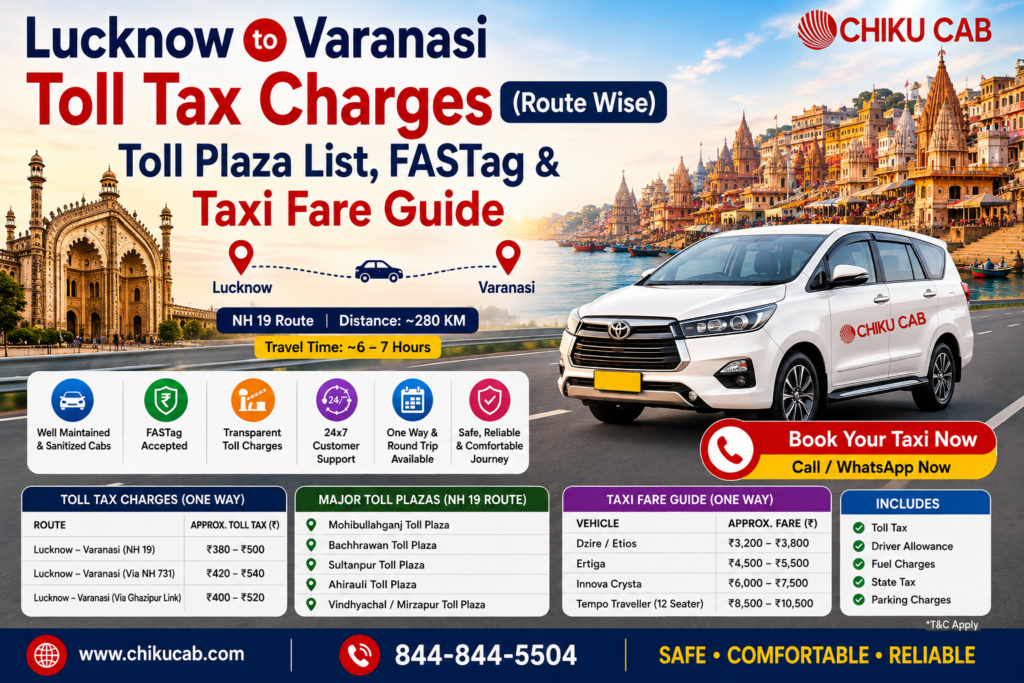
If you are planning a road trip or booking a cab from Lucknow to Varanasi, one of the first things you’ll want to know is how much you’ll actually pay in tolls. Lucknow to Varanasi taxi Toll charges depend entirely on which route you take the older national highway stretch or the newer Purvanchal Expressway and the vehicle you’re driving. This guide breaks down every toll plaza on both routes, current FASTag rates, distance, travel time, fuel cost, and total taxi fare including toll, so you can plan your trip without any surprises on the road.
Quick note: toll rates on Indian highways and expressways are revised periodically by NHAI and UPEIDA (usually once a year around April). The figures below reflect the latest publicly available rates at the time of writing. Always confirm the exact toll with your driver or on the FASTag app before you travel, and when you book with Chiku Cab, our team shares the current toll breakup with your fare quote.

Lucknow to Varanasi Taxi Service One Way & Round Trip – 24×7 Instant Service
24×7 Instant Service | Safe & Comfortable Ride
Lucknow to Varanasi Toll Tax Charges Overview
There are two main ways to drive from Lucknow to Varanasi, and the toll tax charges are quite different on each:
| Route | Approx. Distance | Approx. Travel Time | Toll Plazas | Approx. Car Toll |
|---|---|---|---|---|
| NH Route (via Sultanpur, Jaunpur, old NH) | 300–320 km | 5.5–6.5 hours | 2 | ₹180–₹200 |
| Purvanchal Expressway + NH31 (via Ghazipur) | 410–430 km | 6–7 hours | 6+ (mostly on expressway) | ₹650–₹750 |
The NH route is shorter in distance and lighter on the pocket in terms of toll tax, while the Purvanchal Expressway route is longer in kilometres but offers a smoother, faster, and safer highway surface for most of the journey. Which one is “better” really depends on whether you’re optimising for lowest toll or most comfortable drive.
Lucknow to Varanasi Route Map
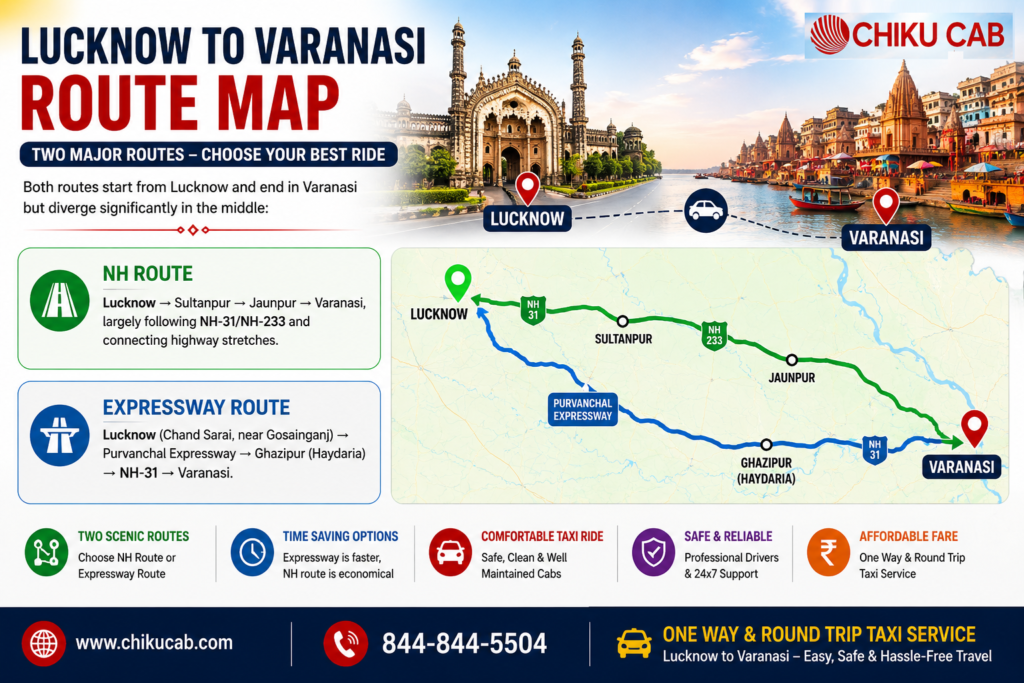
Both routes start from Lucknow and end in Varanasi but diverge significantly in the middle:
- NH Route: Lucknow → Sultanpur → Jaunpur → Varanasi, largely following NH-31/NH-233 and connecting highway stretches.
- Expressway Route: Lucknow (Chand Sarai, near Gosainganj) → Purvanchal Expressway → Ghazipur (Haydaria) → NH-31 → Varanasi.
If you’re using a GPS app, search for both options before starting — traffic conditions on any given day can shift which route is actually faster, even if the expressway is built for higher speeds.
Best Route from Lucknow to Varanasi
For most travellers, the Purvanchal Expressway route is the more comfortable option because it’s a controlled-access, 6-lane expressway with far less local traffic, fewer market crossings, and better road surface. It does mean paying a higher toll and covering more kilometres, since the expressway itself runs to Ghazipur and you then continue on NH-31 into Varanasi.
If your priority is keeping the trip cost down and you don’t mind a mix of highway and semi-urban stretches, the direct NH route through Sultanpur and Jaunpur is shorter and charges a much smaller toll tax.
Our suggestion for most one-way taxi bookings: take the expressway during the day for speed and comfort, and consider the NH route if you’re travelling with a tighter budget or starting late at night when expressway visibility matters less than a familiar road.
Route-wise Toll Charges Comparison
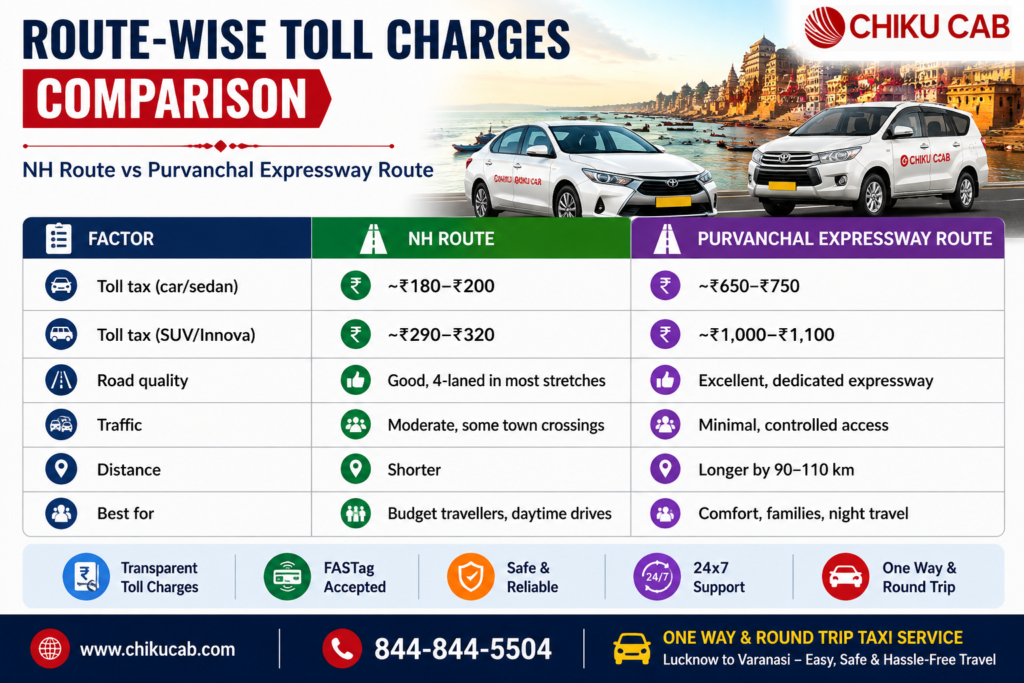
| Factor | NH Route | Purvanchal Expressway Route |
|---|---|---|
| Toll tax (car/sedan) | ~₹180–₹200 | ~₹650–₹750 |
| Toll tax (SUV/Innova) | ~₹290–₹320 | ~₹1,000–₹1,100 |
| Road quality | Good, 4-laned in most stretches | Excellent, dedicated expressway |
| Traffic | Moderate, some town crossings | Minimal, controlled access |
| Distance | Shorter | Longer by 90–110 km |
| Best for | Budget travellers, daytime drives | Comfort, families, night travel |
confirmation!
Toll Plaza List Between Lucknow and Varanasi
On the NH route, you’ll typically cross two major toll plazas between Lucknow and Varanasi, both FASTag-enabled, spaced out along the Sultanpur–Jaunpur stretch.
On the Purvanchal Expressway route, UPEIDA operates a series of toll plazas along the 340+ km expressway between Chand Sarai (Lucknow) and Haydaria (Ghazipur). Since the expressway itself doesn’t reach Varanasi, you’ll pay the expressway toll as a single combined amount at entry/exit rather than at each individual plaza, and then continue toward Varanasi via NH-31 from Ghazipur, a stretch that is currently toll-free in most sections.
If you’re travelling by taxi, this entire toll list is handled by your driver — you simply see the total in your trip bill.
FASTag Charges on the Route
FASTag is accepted — and recommended — at every toll plaza on both the NH route and the Purvanchal Expressway. Using FASTag means:
- No cash queues or exact-change hassles
- Slightly discounted rates compared to cash payment at some plazas
- Automatic deduction as you pass through, keeping the journey uninterrupted
If you’re self-driving, make sure your FASTag has sufficient balance before starting the trip, since a low-balance tag can cause delays at the barrier. If you’re booking a Chiku Cab, the driver’s FASTag is already active and the toll amount simply reflects in your final fare.
Purvanchal Expressway Toll Charges
The Purvanchal Expressway runs 340.8 km <cite index=”7-1″>connecting Chand Saray village near Gosainganj in Lucknow district with Haydaria village on NH-31 in Ghazipur district</cite>. <cite index=”3-1″>Toll on this expressway is charged at roughly ₹2.15 per kilometre, with a 25% discount applied, which works out to around ₹675 for the full Lucknow-to-Ghazipur run in a car.</cite> Rates for larger vehicles are proportionally higher, and toll is typically revised each financial year, so treat this as an approximate figure rather than a fixed number.
Since your final destination is Varanasi and not Ghazipur, remember that the expressway toll covers only the Lucknow-Ghazipur leg — you’ll still need to travel the remaining stretch from Ghazipur to Varanasi via NH-31.
NH Route Toll Charges
The older NH route between Lucknow and Varanasi (via Sultanpur and Jaunpur) charges toll at two plazas, with a combined cost of roughly ₹180–₹200 for a car and somewhat more for SUVs and larger vehicles. This route has seen significant road upgrades in recent years, including four-laning of major stretches, which has improved travel speed even without expressway-level infrastructure.
Which Route Has Lower Toll?
The NH route clearly has the lower toll tax — it’s roughly a quarter of what you’d pay on the Purvanchal Expressway route, mainly because it’s a shorter distance and doesn’t include the higher per-kilometre expressway toll rate.
Which Route Saves More Time?
Despite covering more kilometres, the Purvanchal Expressway route often saves time for most of its length because you can drive at higher, more consistent speeds without navigating through towns, market areas, or slower local traffic. The final NH-31 stretch from Ghazipur into Varanasi does add some time back, so the overall time difference between the two routes tends to be smaller than the distance difference suggests — often just 30–60 minutes either way, depending on traffic and time of day.
Lucknow to Varanasi Distance
The direct NH route between Lucknow and Varanasi covers approximately 300–320 km, while the Purvanchal Expressway route (via Ghazipur) covers approximately 410–430 km due to the detour through eastern Uttar Pradesh before rejoining NH-31 toward Varanasi.
Estimated Travel Time
- NH Route: Approximately 5.5 to 6.5 hours by car, depending on traffic near Jaunpur and Sultanpur.
- Expressway Route: Approximately 6 to 7 hours by car, factoring in high-speed expressway driving plus the NH-31 stretch into the city.
Both estimates assume normal daytime driving conditions with standard rest stops. Night travel and monsoon weather can add extra time on either route.
Fuel Cost Estimate
Fuel cost depends on your vehicle’s mileage and current diesel/petrol prices in Uttar Pradesh, but as a rough guide for a sedan averaging around 15–16 km/l:
- NH Route (≈310 km): Roughly 20 litres of fuel for a one-way trip
- Expressway Route (≈420 km): Roughly 26–28 litres of fuel for a one-way trip
For an accurate number on the day of travel, multiply the expected litres by the current fuel price at your nearest pump, since rates vary by city and change frequently.
Total Road Trip Cost (Fuel + Toll)
Putting fuel and toll together gives you a realistic picture of what a self-driven trip costs, excluding food, parking, and other incidentals:
| Route | Fuel Cost (approx.) | Toll Cost (approx.) | Total (approx.) |
|---|---|---|---|
| NH Route | Fuel for ~310 km | ₹180–₹200 | Fuel + ~₹200 |
| Expressway Route | Fuel for ~420 km | ₹650–₹750 | Fuel + ~₹700 |
The NH route generally works out cheaper overall since it saves on both fuel and toll, while the expressway route trades a higher cost for a faster, more comfortable drive.
Taxi Fare Including Toll Charges
If you’d rather not deal with tolls, fuel budgeting, or navigation yourself, booking an outstation taxi is the simplest option. With Chiku Cab, toll charges are billed separately at actuals (or bundled into your quote, depending on the package you choose), and your driver handles every toll payment along the way — you just relax and enjoy the ride.
Sedan Taxi Fare
A sedan (like a Dzire or Etios) for a one-way Lucknow to Varanasi trip typically starts in the mid-thousands, plus toll charges of around ₹180–₹700 depending on the route taken. Sedans are a good fit for solo travellers, couples, or small families with limited luggage.
SUV Taxi Fare
SUVs offer more boot space and seating comfort for families or small groups, and come at a moderately higher fare than a sedan, with toll charges slightly higher too since SUV toll rates are a notch above car rates at every plaza.
Innova Crysta Taxi Fare
The Innova Crysta remains the most popular choice for Lucknow to Varanasi trips thanks to its comfortable seating for 6-7 passengers and generous luggage space — ideal for family trips or group pilgrimage travel to Kashi. Toll for Innova-category vehicles runs higher than sedans but is still a small fraction of the overall trip cost.
Tempo Traveller Fare
For larger groups — 9, 12, or 17-seater configurations — a Tempo Traveller is the practical choice for Lucknow to Varanasi group travel. Toll tax for Tempo Travellers falls under the light commercial vehicle category, which is priced higher than cars but lower than heavy vehicles at each plaza.
One-Way Taxi Cost
One-way taxi bookings from Lucknow to Varanasi are priced based on distance, vehicle type, and route chosen (NH vs expressway). Toll is usually charged at actuals for the route driven, so a one-way trip via the shorter NH route naturally costs less in toll than the same trip via the Purvanchal Expressway.
Round Trip Taxi Cost
For round trips, drivers often calculate toll for both legs of the journey (unless returning empty via a different route), and per-kilometre rates are usually a bit lower than one-way pricing since the cab isn’t running empty on the return leg. If you’re planning a Varanasi darshan trip with a return to Lucknow the same day or next day, ask for a combined quote that includes driver allowance, toll, and any night halt charges.
Airport Pickup Taxi Fare
If you’re flying into Lucknow’s Chaudhary Charan Singh International Airport and heading straight to Varanasi, or flying out of Varanasi’s Lal Bahadur Shastri Airport after a road trip, airport pickup fares include the same toll structure as a regular point-to-point trip, with a small airport pickup or parking charge added by most operators.
Railway Station Pickup Taxi Fare
Pickups from Lucknow Charbagh Railway Station or drops to Varanasi Junction/Varanasi Cantt follow standard city-to-city taxi pricing, with toll charged based on the route your driver takes out of the city.
Toll Charges for Different Vehicle Types
Toll plazas in India classify vehicles into categories, and rates step up accordingly:
- Car/Jeep/Van: Base toll rate
- Light Commercial Vehicle (LCV)/Mini-bus/Tempo Traveller: Roughly 1.5–1.6x the car rate
- Bus/Truck (2-axle): Roughly 2x the car rate
- Multi-axle/Heavy vehicles: Significantly higher, often 3x or more the car rate
This scaling applies on both the NH route and the Purvanchal Expressway, so if you’re travelling in a larger vehicle, budget accordingly.
FASTag Tips for Travelers
- Keep your FASTag topped up before a long trip — low balance is the most common cause of delays at toll booths.
- Carry a backup payment method in case of a technical glitch at any plaza.
- If you’re renting a self-drive car, confirm the FASTag is linked and active before you leave the city.
- For cab bookings, you don’t need to worry about this at all — it’s the driver’s responsibility.
Road Conditions & Safety Tips
- The Purvanchal Expressway has a strict speed limit and no pedestrian or slow-vehicle access, making it one of the safer stretches for long-distance driving.
- The NH route passes through busier town sections near Sultanpur and Jaunpur, so drive with extra caution during market hours.
- Avoid night driving on unfamiliar stretches if you’re self-driving; a pre-booked driver who knows the route is a safer bet for late departures.
- Keep emergency contact numbers, a charged phone, and basic supplies handy for any long highway trip.
Places to Visit En Route
If you have some flexibility in your schedule, both routes pass near a few worthwhile stops:
- Sultanpur: A good midway break point on the NH route with dhabas and fuel stations.
- Jaunpur: Known for the Shahi Bridge and Atala Masjid, a short detour if you have time.
- Ghazipur: Home to the historic Lord Cornwallis Tomb, near the expressway route.
Most travellers on a direct taxi trip skip sightseeing stops to save time, but they’re worth knowing about if you’re planning a leisurely road trip.
Frequently Asked Questions
What is the toll tax from Lucknow to Varanasi by car?
Toll tax by car ranges from approximately ₹180–₹200 on the NH route to approximately ₹650–₹750 on the Purvanchal Expressway route, depending on which road you take.
How many toll plazas are there between Lucknow and Varanasi?
The NH route has 2 major toll plazas, while the Purvanchal Expressway route includes multiple plazas along its 340+ km length between Lucknow and Ghazipur, followed by a largely toll-free NH-31 stretch into Varanasi.
Is the Purvanchal Expressway toll higher than the NH route?
Yes. Because the expressway toll is calculated per kilometre and the expressway route also covers a longer overall distance, its total toll works out several times higher than the direct NH route.
Does Chiku Cab’s taxi fare include toll charges?
Toll charges are typically billed at actuals separately from the base taxi fare, and our team shares the exact toll breakup with your quote at the time of booking so there are no surprises during the trip.
What is the toll tax for an Innova from Lucknow to Varanasi?
Innova-category vehicles fall under a slightly higher toll bracket than sedans, typically around 1.5x the car rate at each plaza, on both the NH and expressway routes.
What is the toll tax for a Tempo Traveller from Lucknow to Varanasi?
Tempo Travellers are classified as light commercial vehicles at most toll plazas, so their toll charge is higher than a car but lower than a bus or truck.
Which route should I take NH or Purvanchal Expressway?
Choose the NH route if you want the lowest toll and shortest distance. Choose the Purvanchal Expressway if you prioritise a smoother, faster, and more consistent driving experience, especially for family trips or night travel.
Can I pay toll in cash instead of FASTag?
Most plazas still accept cash, but FASTag lanes are faster and sometimes offer a small rate advantage, so it’s the recommended payment method for both routes.
How long does it take to travel from Lucknow to Varanasi by road?
Travel time is roughly 5.5–6.5 hours via the NH route and 6–7 hours via the Purvanchal Expressway route, depending on traffic, weather, and time of departure.
Do toll charges change frequently?
Yes, toll rates on national highways and expressways in India are typically revised once a year, usually in April. Always check current rates before travelling or ask your driver for the latest figures.

I’m a wanderer who loves venturing on to unknown and unseen places. I explore freely to various fun and adventurous places, whether it be spiritual temple tours, captivating landscapes, and more. I wonder around in search of hidden gems and tourist attractions, temples, and other places.