
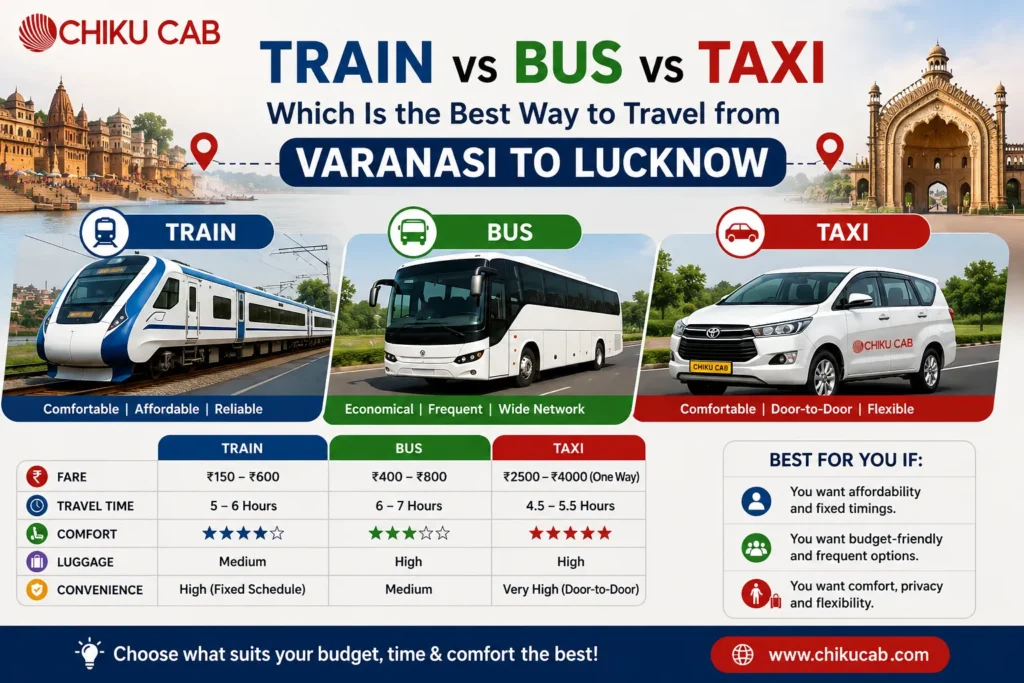
Varanasi to Lucknow cab service is ideal for travelers who want door-to-door convenience. The Journey is around 300–320 km, and the honest answer to “which is better” depends on what you’re optimizing for. If you want the lowest cost and don’t mind a fixed schedule, take the train. If you want door-to-door convenience, flexible timing, and privacy especially with family, luggage, or elderly travellers a taxi is the better choice. Buses sit in between: cheaper than a taxi but slower and less comfortable than either option.
That one-line answer works for most travellers, but the right choice really changes depending on your group size, budget, and how much your time is worth. This guide breaks down real fares, travel times, and comfort levels for all three options so you can decide in two minutes, not twenty.

Skip the Hassle – Book a Comfortable Taxi from Varanasi to Lucknow Today
Varanasi → Jaunpur Bypass → Sultanpur → Purvanchal Expressway → Lucknow available.
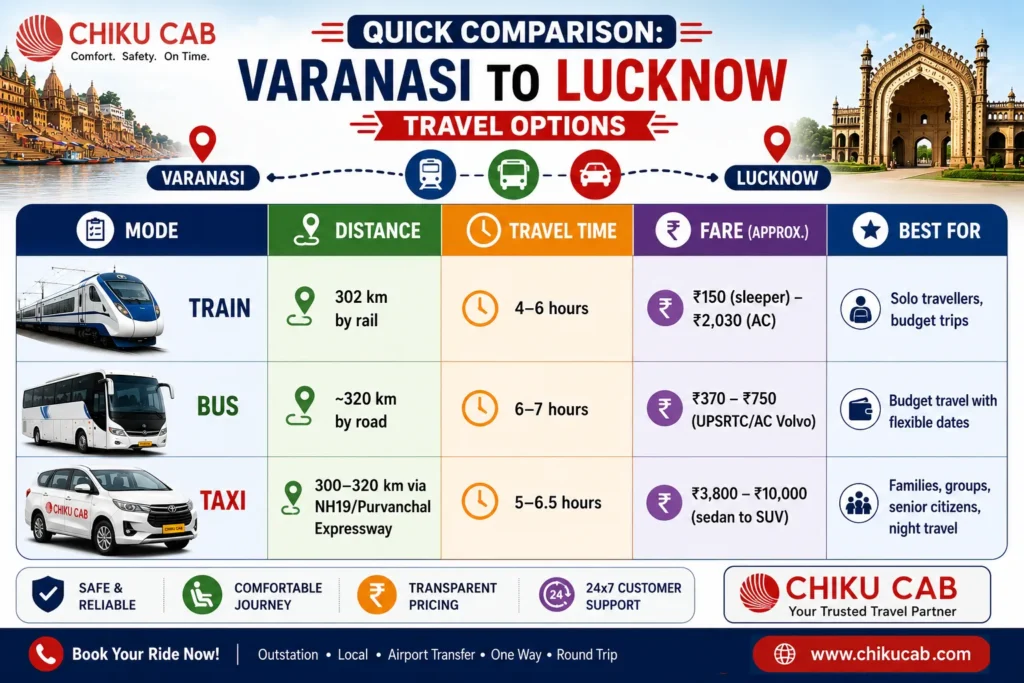
Quick Comparison: Varanasi to Lucknow Travel Options
| Mode | Distance | Travel Time | Fare (approx.) | Best For |
| Train | 302 km by rail | 4–6 hours | ₹150 (sleeper) – ₹2,030 (AC) | Solo travellers, budget trips |
| Bus | ~320 km by road | 6–7 hours | ₹370 – ₹750 (UPSRTC/AC Volvo) | Budget travel with flexible dates |
| Taxi | 300–320 km via NH19/Purvanchal Expressway | 5–6.5 hours | ₹3,800 – ₹10,000 (sedan to SUV) | Families, groups, senior citizens, night travel |
Numbers vary by season, vehicle type, and how far in advance you book but this table reflects what most travellers actually pay in 2026.
Travelling by Train: Varanasi to Lucknow
The rail distance between Varanasi and Lucknow is 302 km, and it is one of the busiest corridors in Uttar Pradesh, with more than two dozen trains running daily, including the Rajdhani Express and several superfast services.
Journey time: The fastest trains, like the Rajdhani Express, cover the route in around 4 hours. Regular express trains typically take 4 to 6 hours depending on the number of stops.
Fare range: Ticket prices depend heavily on class:
- Sleeper class: starts around ₹150
- AC 3-tier / AC chair car: ₹400–₹900
- AC 2-tier and premium classes: up to ₹2,030
Why people choose the train:
- It’s the cheapest way to travel from Varanasi to Lucknow by a wide margin
- No dependence on road traffic or highway conditions
- Reasonably fast if you book a superfast or Rajdhani service

Where the train falls short:
- You still need a cab or auto at both ends to reach the actual station and your final destination, which adds time and cost that isn’t obvious upfront
- Tickets in AC classes sell out fast during festival season (especially around Dev Deepawali and Kartik Purnima in Varanasi), and waitlisted tickets are a real risk
- Not practical for a group carrying heavy luggage, or for anyone who needs door-to-door movement
- Fixed departure times mean you’re planning your day around the train, not the other way around
Bottom line: the train is genuinely the best budget option, but it works best for solo travellers or pairs who are comfortable managing station transfers on both ends.
Travelling by Bus: Varanasi to Lucknow
For travellers comparing bus vs taxi from Varanasi to Lucknow, the bus is the middle-ground option — cheaper than a cab, but with a longer, less predictable journey.
Journey time: Around 6 to 7 hours by road, depending on traffic near Rae Bareli and the smaller towns along the route.
Fare range: UPSRTC (state transport) buses cost roughly ₹370–₹450 for standard service. Private AC Volvo operators charge more, typically ₹450–₹750, and can be booked through RedBus, AbhiBus, or MakeMyTrip.
Why people choose the bus:
- Cheapest way to travel from Varanasi to Lucknow after the train
- Frequent departures throughout the day, so there’s usually a bus within an hour or two of when you want to leave
- No advance booking pressure compared to trains during peak season
Where the bus falls short:
- Longest journey time of the three options
- Multiple stops along the route add unpredictability — a 6-hour trip can stretch to 7–8 hours during festivals or heavy traffic
- Shared seating means no privacy, and non-AC buses can be uncomfortable in UP’s summer heat
- Not ideal for senior citizens or anyone with mobility issues, since boarding, luggage handling, and toilet breaks are all on the bus operator’s schedule, not yours
Bottom line: the bus makes sense if you’re travelling solo on a tight budget and your schedule is flexible. It’s rarely the right call for families, senior citizens, or anyone in a hurry.
Travelling by Taxi: Varanasi to Lucknow
For private cab vs train comparisons, this is where the calculation changes based on group size. A taxi looks expensive per person if you’re travelling alone — but split across 3–4 people, it often costs about the same as AC train tickets, while saving hours of station-to-destination hassle. Varanasi to Lucknow cab fare starts from affordable rates and varies based on vehicle type
Route: The most common route runs via NH19 and the Purvanchal Expressway, connecting through Jaunpur and Sultanpur. This is a well-maintained highway route, and it’s the fastest road option compared to older state highways through Rae Bareli.
Journey time: 5 to 6.5 hours by taxi, door to door — no station transfers, no waiting for the next available seat.
Fare range: Sedan cabs typically start around ₹3,800–₹5,500 one-way. Larger vehicles (Ertiga, Innova, or SUVs for bigger groups) run from ₹6,000 up to ₹10,000, depending on the vehicle category and whether it’s a one-way or round trip.
Why people choose a taxi:
- Door-to-door travel — pickup from your hotel or home in Varanasi, drop directly at your address in Lucknow, no auto or cab needed at either end
- Fixed departure time you control — leave at 4 AM or 4 PM, it’s your call
- Best for families and groups — split the fare across 4–6 people and it often beats individual AC train tickets, while being far more comfortable
- Ideal for senior citizens — no platform stairs, no crowded coaches, no standing in queues; the car stops whenever you need a break
- Safer for overnight travel — a verified driver and a private vehicle are generally a more controlled environment late at night than a shared bus or a near-empty late train
- Flexibility for stopovers — if you want to break the journey at Jaunpur or stop for food, a taxi lets you do that without losing your seat
Where the taxi costs more:
- Highest per-person cost for solo travellers
- Total trip cost is more exposed to fuel prices and vehicle type than fixed train fares
Bottom line: for families, groups, senior citizens, or anyone travelling with meaningful luggage, taxi is usually the most comfortable way to travel from Varanasi to Lucknow, and it’s often not much more expensive once you divide the fare and account for what you’d otherwise spend getting to and from the station.
Which Is Better: Train or Taxi from Varanasi to Lucknow?
This is the question most travellers actually want answered, so here’s a direct breakdown by scenario.
Choose the train if:
- You’re travelling alone or as a pair
- Your budget is the main constraint
- You’re comfortable managing station arrival/departure logistics
- Your travel dates are flexible enough to book AC tickets in advance
Choose a taxi if:
- You’re travelling with family, especially with kids or elderly parents
- You have more than one bag or heavy luggage
- You want to leave at a specific time, not the train’s schedule
- You’re travelling overnight and prioritize a controlled, private environment
- You want to stop en route for meals, sightseeing, or rest breaks
- You’re arriving in Lucknow for a meeting, wedding, or event where you can’t afford delays
Choose the bus if:
- Budget is your only priority and train tickets are sold out
- You’re comfortable with a longer, less predictable journey
- You don’t have significant luggage
For most families and small groups, the honest math works in favor of the taxi: once you add up train fares for 4 people, plus two local cab rides to/from the stations, plus the extra time spent waiting and transferring, the total cost gap with a private taxi narrows considerably — while the comfort gap stays wide.
Varanasi to Lucknow by Road: Route and Travel Experience
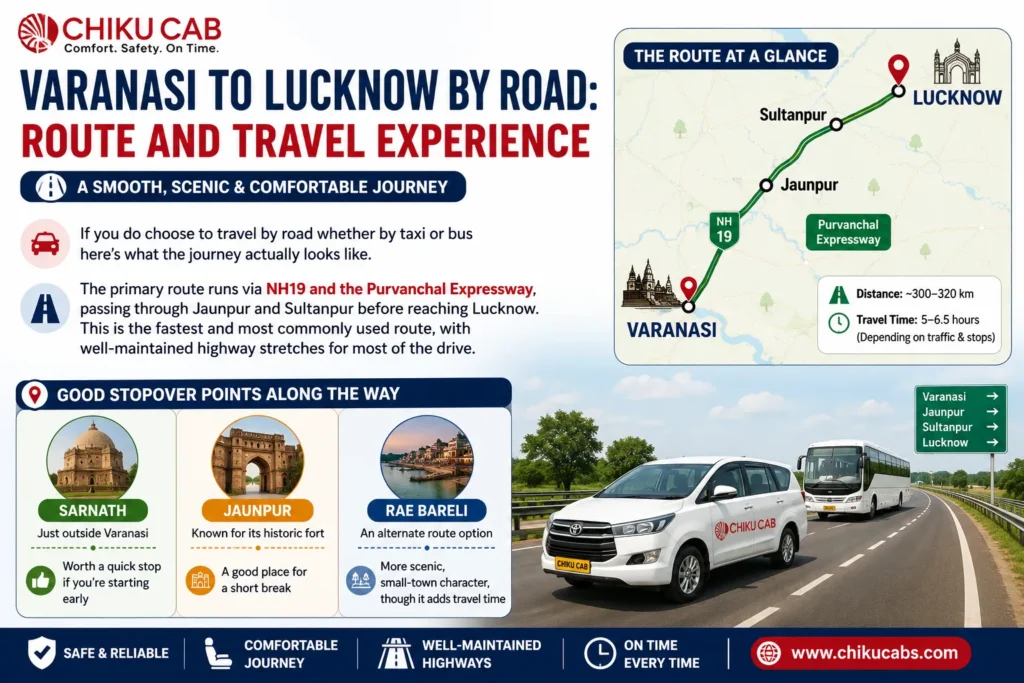
If you do choose to travel by road whether by taxi or bus here’s what the journey actually looks like.
The primary route runs via NH19 and the Purvanchal Expressway, passing through Jaunpur and Sultanpur before reaching Lucknow. This is the fastest and most commonly used route, with well-maintained highway stretches for most of the drive.
Good stopover points along the way:
- Sarnath (just outside Varanasi) — worth a quick stop if you’re starting early
- Jaunpur — known for its historic fort, a good place for a short break
- Rae Bareli — an alternate route option with a more scenic, small-town character, though it adds travel time
Overnight travel: If you’re doing this as a night journey — common for early-morning meetings or catching a flight from Lucknow — a taxi is generally the safer and more comfortable choice over an overnight bus. You get a private, locked vehicle with a single verified driver, rather than a shared cabin with strangers, and you can rest properly instead of sitting upright for 6–7 hours.
Best Travel Option for Senior Citizens
For older travellers, comfort and safety outweigh cost savings. Trains involve platform stairs, crowded coaches, and tight connection windows. Buses mean standing in queues, handling your own luggage, and no control over rest stops. A taxi solves all three problems: home pickup, no stairs or platforms, and the ability to stop whenever needed for rest, medication, or a washroom break. If you’re booking this trip for parents or grandparents, a taxi is worth the extra cost.
Cheapest Way vs. Fastest Way vs. Most Comfortable Way: A Quick Summary
- Cheapest way to travel from Varanasi to Lucknow: Sleeper class train (from ₹150), followed closely by UPSRTC bus (from ₹370)
- Fastest way to reach Lucknow from Varanasi: Rajdhani Express or another superfast train (around 4 hours), though this excludes time spent getting to/from the stations
- Most comfortable way to travel from Varanasi to Lucknow: Private taxi — door-to-door, private, and on your own schedule
There’s no single “best” answer here the right mode depends entirely on whether you’re optimizing for rupees, minutes, or comfort.
| Pickup Location (Varanasi) | Distance (KM) | Starting Fare | Book Now |
|---|---|---|---|
| BHU to Lucknow Cab | ~310 km | ₹3,670 | Book Now |
| Lanka to Lucknow Cab | ~305 km | ₹3,670 | Book Now |
| Sigra to Lucknow Cab | ~300 km | ₹3,650 | Book Now |
| Assi Ghat to Lucknow Cab | ~305 km | ₹3,670 | Book Now |
| Babatpur (Airport) to Lucknow Cab | ~280 km | ₹3,550 | Book Now |
| PDR Mall to Lucknow Cab | ~300 km | ₹3,650 | Book Now |
| Ramnagar to Lucknow Cab | ~310 km | ₹3,720 | Book Now |
| Shivpur to Lucknow Cab | ~290 km | ₹3,630 | Book Now |
| Godowlia to Lucknow Cab | ~300 km | ₹3,660 | Book Now |
Book a Taxi from Varanasi to Lucknow with Chiku Cab
If your trip involves family, luggage, a tight schedule, or simply a preference for not dealing with station crowds, Chiku Cab offers direct, door-to-door cabs from Varanasi to Lucknow with upfront pricing, verified drivers, and vehicle options ranging from sedans to larger SUVs for bigger groups. You can choose your own departure time, add stopovers along the way, and travel without the uncertainty of shared transport.
Frequently Asked Questions
Is taxi better than bus for Varanasi to Lucknow?
For comfort and travel time, yes. A taxi takes 5–6.5 hours door-to-door, while a bus takes 6–7 hours and involves shared seating and multiple stops. The bus is cheaper, but the taxi wins on time, privacy, and convenience — especially for families or overnight travel.
Which is better, train or taxi, from Varanasi to Lucknow?
It depends on group size. For solo travellers on a budget, the train is cheaper and reasonably fast. For families or groups of 3 or more, a taxi often works out to a similar per-person cost once you factor in station transfers, while offering far more comfort and a flexible schedule.
How to reach Lucknow from Varanasi?
You have three main options: train (4–6 hours, from ₹150), bus (6–7 hours, from ₹370), or taxi (5–6.5 hours, from ₹3,800 for a sedan). Taxis run via NH19 and the Purvanchal Expressway and offer direct door-to-door travel.
What is the cheapest way to travel from Varanasi to Lucknow?
Sleeper class train tickets, starting around ₹150, are the cheapest option. A UPSRTC bus, starting around ₹370, is a close second and useful when train tickets are unavailable.
What is the fastest way to reach Lucknow from Varanasi?
The Rajdhani Express and other superfast trains cover the 302 km rail distance in around 4 hours, making train the fastest single-leg option — though a taxi can be faster overall once you include the time it takes to reach and exit train stations.
Is it safe to travel from Varanasi to Lucknow by taxi at night?
Yes, when booked through a verified operator. A private taxi with a single background-checked driver is generally considered safer for night travel than a shared overnight bus, since there’s no cabin full of strangers and you control the stops.
What is the best transport from Varanasi to Lucknow for a family?
A taxi is generally the best fit for families, since it avoids station transfers, allows the whole group to travel together with luggage, and lets you set your own departure time and rest stops.
How much does a private cab cost from Varanasi to Lucknow?
Sedan fares typically range from ₹3,800 to ₹5,500 one-way, while larger vehicles like an Innova or SUV range from ₹6,000 to ₹10,000, depending on the vehicle type and season.
How far is Lucknow from Varanasi by road?
The road distance is approximately 300–320 km, taking 5.5 to 6.5 hours by taxi via NH19 and the Purvanchal Expressway.
Can I stop for sightseeing on the way from Varanasi to Lucknow?
Yes, if you’re travelling by taxi. Popular stopover points include Sarnath near Varanasi and Jaunpur Fort along the route. This flexibility isn’t available with train or bus travel.
Is the Varanasi to Lucknow train route reliable during festival season?
It can get heavily booked during major Varanasi festivals like Dev Deepawali, with AC classes selling out and waitlists common. Booking in advance or choosing a taxi during peak season is generally more reliable.
What is the best overnight travel option from Varanasi to Lucknow?
A private taxi is generally the more comfortable and controlled option for overnight travel between Varanasi and Lucknow, compared to an overnight bus or a late-running train.

I’m a wanderer who loves venturing on to unknown and unseen places. I explore freely to various fun and adventurous places, whether it be spiritual temple tours, captivating landscapes, and more. I wonder around in search of hidden gems and tourist attractions, temples, and other places.