
Cross the Chandigarh city limits at Panchkula, and within 45 minutes the road starts climbing. By the time you pass Parwanoo, the temperature has already dropped 3 to 5 degrees. The flat sectors you left behind feel like a different country. That’s the pull of this journey. Within a 7-hour drive of Sector 17, you can reach anything from a colonial-era cantonment at 6,400 feet to a snow-covered pass at 13,000 feet. The catch is Friday evening traffic on the Kalka highway, which can add a brutal 90 minutes to your drive. Leave before 7 AM on Saturday and you’re clear. These 10 destinations are ordered by drive time so you know exactly what you’re committing to before you plan.
At a Glance: Distance, Drive Time and Taxi Fare
Here’s the full comparison across all 10 destinations from Sector 17, Chandigarh.
| Hill Station | Distance (km) | Drive Time | Best Season | Approx. Taxi Fare (One Way) |
| Kasauli | 60 km | 1.5 to 2 hrs | Year-round | Rs. 1,500 to 2,000 |
| Shimla | 115 km | 3.5 to 4.5 hrs | Oct to Jun | Rs. 2,500 to 3,500 |
| Kufri | 130 km | 4 to 5 hrs | Dec to Feb (snow) | Rs. 3,000 to 4,000 |
| Mandi | 187 km | 4 to 4.5 hrs | Mar to Jun, Sep to Nov | Rs. 3,500 to 4,500 |
| Mussoorie | 200 km | 5 hrs | Mar to Jun, Oct to Nov | Rs. 4,000 to 5,500 |
| Rishikesh | 215 km | 4.5 to 5.5 hrs | Sep to Nov, Feb to Apr | Rs. 3,800 to 5,000 |
| McLeod Ganj | 245 km | 5 to 6 hrs | Mar to Jun, Oct to Nov | Rs. 4,500 to 6,000 |
| Dharamshala | 237 km | 5 to 6 hrs | Mar to Jun, Oct to Nov | Rs. 4,500 to 5,800 |
| Dalhousie | 313 km | 6 to 7 hrs | Mar to Jun, Sep to Nov | Rs. 5,500 to 7,000 |
| Kullu / Manali | 300 km | 8 to 10 hrs | Oct to Dec, May to Jun | Rs. 6,000 to 8,500 |
1. Kasauli: 65 km, 1.5 to 2 Hours
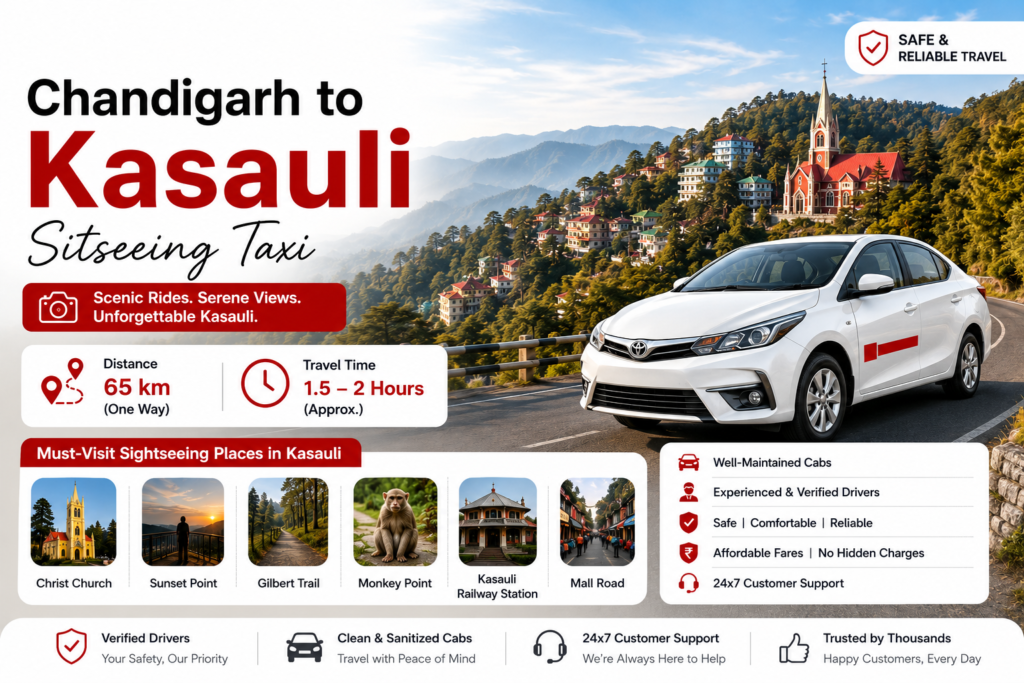
Kasauli is the one hill station near Chandigarh that makes sense for a day trip. You leave Sector 17, hit Kalka, and you’re climbing the Kasauli cantonment road before 9 AM. The town itself sits at 6,400 feet. The air turns piney and cool within the first kilometre past the cantonment gate.
The main draw here is the Upper and Lower Mall. Both are strictly pedestrian-only. No vehicles are allowed on either side, so park at the cantonment multilevel parking near the bus stand (Rs. 85 per vehicle after the 2023 entry tax removal) and walk in. The Upper Mall runs about 2.5 km and passes the Kasauli Club before opening to valley views. The Lower Mall is the market strip, lined with shops, small cafes, and old British-era buildings.
Monkey Point, the highest spot in Kasauli at the top of an Air Force Station, has a strict rule you need to know about before going. Bags and mobile phones are completely banned inside. You walk in, look out from one of the better panoramic viewpoints in the region, and walk out. No photography, no bags.
When to go: Weekdays between 8 AM and 10 AM. From April to June and October to January the Lower Mall gets very crowded from 11 AM onward on weekends.
What to eat: Kasauli has its own fruit wines. Peach wine, plum wine, and apple wine are sold in local shops around the mall. For food, try Sidu (a steamed wheat bread stuffed with walnuts or lentils), which you’ll find at small dhabas near the cantonment market. It’s the traditional Himachali breakfast staple.
2. Shimla: 112 km, 2.5 to 3 Hours
Shimla is the obvious first choice for anyone getting out of Chandigarh, and it earns that position. The route on NH-5 runs through Solan before the road starts winding up to 7,200 feet. Add 30 to 45 minutes to any estimated drive time if you’re leaving on a Saturday morning in peak season, because the Solan road gets slow.
The city’s vehicle rules are firm. Mall Road is a no-car zone entirely. Roads from Cart Road up to the Mall side are sealed and restricted. Your best move is to park near the Tourism Lift on Cart Road (about Rs. 200 per day for a small car), ride the government-run lift for Rs. 5 per person, and walk the rest. The lift stops running at 9 PM, so plan your evening accordingly.
Jakhu Temple (8,048 feet) is the practical sightseeing anchor. The walk from Mall Road takes about 45 minutes each way on a forest path. The monkeys at Jakhu are bold, not shy. Keep your snacks in closed bags and your sunglasses on your face, not your head.

When to go: On summer weekends (May to June), Mall Road and Ridge are packed solid between 11 AM and 5 PM. Get there before 9 AM or after 7 PM. January and February snowfall days see Jakhu and the Ridge fill up from 10 AM onward.
What to eat: Shimla’s food identity is Himachali Dham. Himachali Rasoi, near Mall Road, is the only restaurant in the city serving the full Kangri and Mandyali Dham thali on alternating days. Order the Siddu there too. It’s soft steamed bread, served with ghee and chutney, and it’s the kind of thing you eat slowly because it’s that good.
3. Kufri: 130 km, 4 to 5 Hours
Kufri is 16 km beyond Shimla on NH-22, which means it works best as an add-on to a Shimla trip rather than a standalone destination. If you’re going straight from Chandigarh, factor in 4 to 5 hours of total drive time. At 8,622 feet, it sits noticeably higher than Shimla, and the temperature difference is real even in summer.
The reason most people come to Kufri is the snow. December through February, the slopes above Mahasu Peak get good coverage for skiing. Himachal Tourism runs ski courses and equipment rental on-site. The beginner run, the advanced slope, and the slalom course all operate from the main ski area. Kufri also hosts the annual Winter Sports Festival in February.
Getting to Mahasu Peak means parking at the base lot and going up by mule or on foot. Cars cannot go all the way to the summit. Fun World amusement park sits at the peak and opens around 10 AM. On winter weekends, ski rental queues start forming at 9 AM.
When to go: Arrive before 9 AM on winter weekends to get good skiing conditions and avoid the rental queues. The 11 AM to 3 PM window is the worst crowd window on snow days.
What to eat: Kufri’s food scene runs on street stalls near the ski slope. Hot Maggi and corn on the cob are the reliable options. For a proper meal, drive back 5 km towards Shimla where local dhabas serve Chana Madra, a chickpea curry cooked in yogurt and ghee that’s been a hill-area staple for generations.
4. Mandi: 187 km, 4 to 4.5 Hours
Mandi doesn’t get the tourist attention it deserves. Most people drive through it on the way to Manali and don’t stop. That’s a miss. The town sits at the junction of the Beas and Uhl rivers at roughly 2,600 feet, which makes it warmer than the higher hill stations but genuinely scenic in its own way. The old town has 81 temples, some built over 1,000 years ago.
The route from Chandigarh runs on NH-205 through Kiratpur, Bilaspur, and then Mandi. The road is smooth for most of the way, but the Kiratpur to Bilaspur section has active tunnel and construction zones that can add 30 to 60 minutes on busy weekends. No permits are required for Mandi itself.
Parashar Lake, 49 km from Mandi town, is the one attraction that gets crowded on summer weekends. The 14-kilometre road from Bagi village up to the lake is a dirt track that requires a high-clearance vehicle or 4WD. Don’t attempt it in a sedan after rain.
When to go: Avoid Mandi during Shivratri (February to March). The fair brings the whole region to a standstill. The rest of the year, Mandi town itself is never overwhelmingly crowded.
What to eat: Sepu Wadi is the official Mandi district dish, served at traditional Dham feasts during local weddings. It’s made from urad dal and chana dal dumplings cooked in curd with spinach. Outside of private Dhams, Mandi’s big kachori is your best street food find. It’s larger than the Rajasthani version, stuffed with red chillies and urad dal, and served with mixed pickle. Find it near the Indira Market.
5. Mussoorie: 290 km, 7-8 Hours
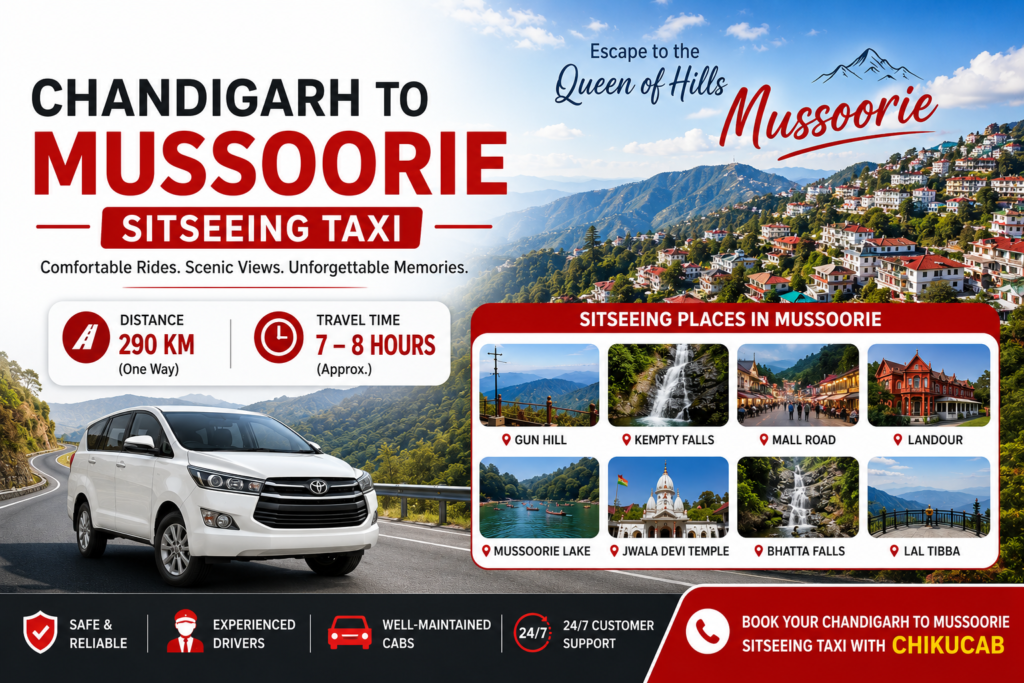
Mussoorie is the Uttarakhand option for anyone who wants a Shimla-type experience without going north on the Kalka road. The drive goes south on NH-7 through Ambala, then east toward Dehradun before climbing the 30-km ascent to Mussoorie. Five hours is the realistic figure from Sector 17. Budget an extra 30 minutes if you’re passing through Dehradun city on a weekend.
Mall Road in Mussoorie is pedestrianised. Vehicles park at the entry points and you walk the 2-km stretch. Parking near the road fills up fast on weekends during peak season (April to June). Kempty Falls, 15 km from Mall Road on the Yamunotri road, has its own parking problem in summer. The lot fills up completely by mid-morning, and visitors end up parking 1 to 2 km back on the road and walking in. The falls are open 9 AM to 6 PM. Ropeway to the lower pool costs Rs. 250 for a two-way ride.
Mussoorie has two entry roads. The Library Chowk side and the Picture Palace side both converge into a single-lane bottleneck at Barlowganj. On holiday weekends, this stretch can back up for 45 minutes.
When to go: For Kempty Falls, get there before 10 AM on weekends. Mall Road is at its worst between 12 PM and 5 PM on Saturday and Sunday during summer. October and November offer clear skies and noticeably thinner crowds.
What to eat: Aloo Ke Gutke is the Garhwali specialty you’ll find at dhabas all over Mussoorie. It’s boiled potatoes cut into pieces and sauteed in mustard oil with turmeric, red chilli, and mustard seeds. Eat it with Bhang Ki Chutney, made from roasted hemp seeds with cumin and lemon. Non-psychoactive and genuinely delicious. The Chaar Dukan area in the Landour neighbourhood above Mall Road serves the old-school baked goods that have been there since the British cantonment days.
6. Rishikesh: 215 km, 4.5 to 5.5 Hours
Rishikesh is not a classic hill station. It sits at 372 metres, which is foothills territory rather than mountain country. But it earns its place on this list for the mountain backdrop, the Ganga, and the fact that it’s a legitimate weekend escape from Chandigarh with proper outdoor activities.
The standard route from Chandigarh runs through Ambala, Roorkee, and Haridwar before reaching Rishikesh. About 4.5 to 5.5 hours on a clear day. During Kanwar Yatra or major Haridwar festival weekends, the Haridwar bypass becomes a parking lot. The alternate route via Paonta Sahib (through Kala Amb and Dehradun’s Thano Road) adds 20 km but can save you 2 hours of Haridwar-area gridlock. Know your travel dates before choosing a route.
Ram Jhula and Laxman Jhula are both vehicle-free. Park on the outer edges of Tapovan and walk in. The road network inside Tapovan and Swarg Ashram is narrow enough that driving in serves no purpose. Laxman Jhula area gets congested between 10 AM and 6 PM. Arrive before 9 AM or after 6 PM for easy parking.
One rule that surprises first-time visitors: Rishikesh is completely dry and fully vegetarian. No meat, no alcohol, anywhere in the town. This is a legal restriction, not a preference. The food scene compensates with good sattvic cafes and some of the best Israeli-influenced vegetarian cooking you’ll find in North India.
When to go: Triveni Ghat evening aarti at around 6 PM draws the biggest daily crowds. Get there by 5:30 PM to find a spot. Jhula parking fills from March to June. September to November and February to April offer the most comfortable weather.
What to eat: The Garhwali Thali is the anchor dish. It includes kafuli (a thick spinach curry), mandua ki roti (finger millet flatbread), and jhangora ki kheer (barnyard millet pudding). Chotiwala restaurant near Ram Jhula has been serving the classic North Indian thali and aloo puri since before tourism arrived in any significant way. Get there at opening for the freshest batch.
7. McLeod Ganj: 245 km, 5 to 6 Hours
McLeod Ganj sits 10 km above Dharamshala town at roughly 4,850 feet. The drive from Chandigarh follows NH-3 through Kiratpur, Una, Hamirpur, and Kangra before the final climb. Five to six hours on a normal weekend morning. The road is good for most of the route, with the last 20 km into the mountains being the slow part.
The main bazar in McLeod is genuinely narrow. There’s no vehicle ban on entering, but parking is the real problem. The two reliable options are the Temple Road parking lot in McLeod Ganj centre and the Bhagsu parking area, 2 km further up. Both fill up on peak weekends by 10 AM. Once you’re parked, Bhagsu Waterfall is a 1 to 2 km uphill walk from Bhagsu village. The trail has small cafes and stalls along the way.
The Tsuglagkhang (Dalai Lama Temple) complex is open to visitors during the day. Morning prayers run from 6 to 8 AM and draw mostly devotees, not tourists. The 10 AM to 2 PM window on weekends sees the highest tourist footfall.
When to go: The Bhagsu Waterfall trail is at its worst crowd-wise from 11 AM to 4 PM in April to June and October to November. Monsoon (July to September) makes the trail slippery but the waterfall is at its strongest flow.
What to eat: McLeod Ganj is where the Tibetan food culture in Himachal is at its most concentrated. Momos here are different from the generic versions found elsewhere. Both steamed and pan-fried, vegetarian and meat, served with house chilli sauce. Thukpa (Tibetan noodle soup) is the cold-evening staple. The Bhagsu Cake, a chocolate, coconut, and caramel dessert, is found only in the cafes around Bhagsu village and has become something of a local legend among repeat visitors.
8. Dharamshala: 237 km, 5 to 6 Hours
Dharamshala town (lower Dharamshala) and McLeod Ganj are often treated as the same destination, but they’re different places with different characters. Lower Dharamshala has the administrative town, the HPCA cricket stadium, Kangra Fort nearby, and roads wide enough to park a car without a crisis. McLeod Ganj is 10 km uphill and has the monastery, the Tibetan quarter, and all the tourist infrastructure.
If you’re travelling with family and want to split the difference, staying in lower Dharamshala and using a cab to go up to McLeod each day is the practical move. It costs Rs. 150 to 200 per cab ride and removes the parking headache entirely.
One specific warning: if there’s an international cricket match at HPCA Stadium, book your accommodation weeks in advance and plan your road approach carefully. The entire Dharamshala to McLeod Ganj road turns into a single lane of slow traffic on match days. Check the IPL and international cricket schedule before finalising your trip dates.
The road from Chandigarh via NH-503 through Una and Hamirpur is the most reliable option in monsoon season. The Kangra Valley approach from Pathankot can see landslides from July to September.
When to go: Dharamshala town market is manageable before 10 AM on weekends. Avoid the HPCA match days entirely unless you’re attending the match.
What to eat: Chha Gosht is the Himachali mutton curry you find in dhabas here, cooked in yogurt and gram flour gravy until the meat is tender. Tibetan butter tea (Po Cha) is available at the monastery cafeterias in McLeod. It’s salted, made with yak butter, and an acquired taste. Try it once.
9. Dalhousie: 313 km, 6 to 7 Hours
Dalhousie is a commitment. Three hundred and thirteen kilometres from Sector 17, and the last 75 kilometres from Pathankot are mountain road. Six to seven hours is a realistic estimate on a weekend morning with no incidents. For this reason, Dalhousie works best as a 2-night trip rather than a quick overnight.
The town sits on five hills at 1,970 metres. It has one-way traffic systems in place throughout, and the rules are enforced. Parking is allowed only at designated yellow-line zones along Thandi Sadak, Potreyn Road, Mall Road, MES Road, Subhash Baoli, and Jandrighat Road. Parts of the Khajjiar Road, Panchpulla Road, and CB Road are all no-parking zones. Speed limit inside town is 30 km/h.
Khajjiar, 24 km from Dalhousie, is the one place everyone lists as unmissable and they’re right. The meadow is 1.5 km across, ringed by tall deodar and pine. A small reflective lake sits near the centre. In the morning, before the day-trippers arrive, the dew is still on the grass and the only sound is the cattle bells from the pasture. By 11 AM on a summer weekend it’s packed. The meadow itself is flat and accessible, but no vehicle can drive onto it.
When to go: Khajjiar meadow before 9 AM for the quiet version. The 11 AM to 4 PM window on summer weekends is full capacity. Dalhousie Mall Road is small and best explored in the evening from 5 PM.
What to eat: Dalhousie follows Chamba district’s food traditions. Rajmah Madra is the dish to order: red kidney beans cooked slowly in ghee and yogurt with Himachali spices. At Kalatop, the rooftop local dhabas make bread pakoras that travellers specifically mention. Hot, with green chutney, with the mountain view on a cold morning.
10. Kullu and Manali: 300 km, 8 to 10 Hours
This is the longest commitment on the list, and it’s worth being direct about that. Eight to ten hours from Sector 17 on NH-205. The road goes through Kiratpur, Bilaspur, Mandi, Kullu, and finally Manali. Mandi town can add 30 to 45 minutes on a busy weekend. This is a 2-night minimum trip. Anyone telling you to do Manali in a day from Chandigarh is setting you up for a bad time.
Kullu sits at 4,000 feet in the valley, 45 minutes before Manali. It’s the trout fishing capital of Himachal. The Kullu valley is where the Beas River runs clear and wide and you start to feel the air change. Don’t rush through it to get to Manali.
Manali town is at 6,730 feet. Old Manali, 3 km from the main Mall Road, is the neighbourhood with the character. Hadimba Temple (1553 AD) is the centrepiece, surrounded by deodar forest. Get there before 9 AM or after 4 PM to avoid the queue.
The Rohtang Pass Permit System
Rohtang Pass (13,054 feet) is 51 km from Manali and requires a mandatory online permit. The daily limit is 800 petrol vehicles and 400 diesel vehicles. Permits are booked at rohtangpermits.hp.gov.in. They cost Rs. 550 online, open for booking 2 days in advance, and each vehicle can get a maximum of 3 permits per week. The pass is closed from December 1 to mid-May every year due to winter snowfall. When Rohtang is closed, tourists access snow at Marhi, 17 km before the pass, using the same permit system.
The Atal Tunnel (9.2 km, opened 2020) bypasses Rohtang to reach Lahaul. No tourist permit is needed for the tunnel. If you’re going to Lahaul or onward, you use the tunnel and skip the Rohtang permit entirely.
Solang Valley, 14 km from Manali, is where most of the snow activity happens from December to February. Rope-way queues run 1 hour or more from 11 AM to 3 PM on peak snow days. Go early.
When to go: Snow at Rohtang: May to November (when open). Snow activities at Solang: December to February. Summer escape from plains: May to June. Manali without tourist peak: October to November.
What to eat: Kullu Trout is the defining dish of this region. The fish is caught from the Beas tributaries, marinated in local spices, and shallow-fried. You find it at riverside dhabas in the Kullu valley and at Old Manali restaurants. Siddu at Old Manali is the breakfast staple. Chha Gosht (mutton in yogurt gravy) is the main non-vegetarian draw at local restaurants.
How to Plan a Chandigarh Hill Station Trip by Trip Length
For a Day Trip (Stay within 2 hours of Chandigarh)
Kasauli is the only realistic option for a true day trip. Leave Sector 17 at 7 AM and you’re walking the Upper Mall by 9 AM. Spend 3 to 4 hours on the malls, visit Monkey Point (leave the bags and phone in the car), get back to Chandigarh by evening. Shimla can technically work as a day trip but the 3.5 to 4.5-hour drive each way plus the time to walk and eat makes for an exhausting day. Better as an overnight.
For 2 Days (Stay within 5 hours of Chandigarh)
Shimla, Kufri (combined), Mussoorie, Dharamshala, or McLeod Ganj are the right choices. Leave on Friday night or Saturday before 7 AM. One full day at the destination. Return Sunday. For Shimla and Kufri together, day one at Shimla (Mall Road, Jakhu, Scandal Point), day two drive 16 km to Kufri for the morning, then return to Chandigarh.
For 3 Days or More
Manali, Dalhousie, and McLeod Ganj with Dharamshala all need 3 days minimum to feel worth the drive. Manali in particular: 2 nights at minimum. Factor in one day each for the Rohtang permit trip, Old Manali sightseeing, and Solang Valley. For Dalhousie, a 3-day trip lets you cover Dalhousie town, Khajjiar, and Chamba without feeling rushed.
Monsoon Warning (July to September)
The Dalhousie road from Pathankot and the Dharamshala approach from Kangra valley are both vulnerable to landslides from July to September. The Manali road through Mandi also sees frequent closures after heavy rain. Check the HPSDMA (Himachal Pradesh State Disaster Management Authority) website for road status before leaving on any monsoon-season trip. Mussoorie’s Barlowganj road also becomes slippery and fog-heavy in heavy monsoon. The safest hill station during monsoon from this list is Kasauli, which sits on a drier ridge.
Booking a Cab from Chandigarh for Your Hill Station Trip

Driving yourself to the hills on a busy weekend is a choice, not a necessity. The parking restrictions at Shimla’s Mall Road, Kasauli’s Mall, Mussoorie’s pedestrian zones, and McLeod Ganj’s narrow lanes mean your car often ends up parked somewhere remote anyway. A cab makes more practical sense for any trip longer than a day.
Chiku Cab has been running intercity cab services since 2018 and currently covers over 250 cities across India, including every destination on this list. For Chandigarh hill station routes, the pricing is straightforward: Chandigarh to Shimla starts at approximately Rs. 2,500 to 3,500 one-way depending on vehicle type, and Chandigarh to Manali runs Rs. 6,000 to 8,500 for the full distance. Billing is transparent with no hidden charges added at the end.
The drivers on the Chandigarh to Shimla and Chandigarh to Manali routes know the hill roads. That matters on the Kufri descent in winter or on the Dalhousie approach from Pathankot after rain. It’s not about convenience. It’s about not navigating a tight hairpin in a car you’ve never driven on a mountain road before.
For the Rohtang permit route specifically, Chiku Cab can handle the intercity leg from Chandigarh to Manali so you arrive rested, and local Manali taxis (which know the permit system and the Gulaba check post) handle the Rohtang day. Book your Chandigarh to hill station cab at chikucab.com. Fixed fares, GPS-tracked vehicles, and intercity coverage that extends to Dalhousie, Dharamshala, and every stop in between.
FAQs About Hill Stations Near Chandigarh
1. What are the top 10 hill stations near Chandigarh for a weekend trip?
The top 10 hill stations near Chandigarh are Kasauli, Shimla, Kufri, Mandi, Mussoorie, Rishikesh, McLeod Ganj, Dharamshala, Dalhousie, and Kullu-Manali. Distances range from 60 km (Kasauli) to 300 km (Manali). All are driveable from Sector 17 within a weekend, depending on how much time you have.
2. Which is the nearest hill station to Chandigarh?
Kasauli is the nearest hill station to Chandigarh, at roughly 60 km from Sector 17. The drive takes 1.5 to 2 hours via Kalka and Dharampur. It sits at 6,400 feet, has no vehicle access on its malls, and works as a genuine day trip without an overnight stay.
3. Which hill station near Chandigarh is best for a one-day trip?
Kasauli is the only hill station near Chandigarh that works realistically as a one-day trip. Leave Sector 17 before 7 AM, reach by 9 AM, spend the morning on Upper and Lower Mall, visit Monkey Point, and return to Chandigarh comfortably by evening. Shimla is too far for a relaxed day trip.
4. How much does a taxi from Chandigarh to Shimla cost?
Booking a taxi from Chandigarh to Shimla will cost around Rs. 2,500 to Rs. 3,500 one-way, depending on vehicle type. Chiku Cab charges a fixed fare with no hidden charges added at the end. Book at chikucab.com. The drive covers roughly 115 km and takes 3.5 to 4.5 hours.
5. Which is better: Shimla or Manali from Chandigarh?
Shimla suits a 2-day trip. It’s 115 km, 3.5 to 4.5 hours, and you’re back Monday morning without burning leave. Manali is 300 km, 8 to 10 hours, and needs a minimum of 3 days to feel worth the drive. For a quick weekend, Shimla wins. For a proper mountain trip, Manali.

I’m a wanderer who loves venturing on to unknown and unseen places. I explore freely to various fun and adventurous places, whether it be spiritual temple tours, captivating landscapes, and more. I wonder around in search of hidden gems and tourist attractions, temples, and other places.


