

When the full moon of Magh approaches every year, an ancient current of devotion and hope begins to rise in people’s hearts, a current tied to a simple cobbler-poet who dared to imagine a world without social barriers. Guru Ravidas Jayanti 2026 will be celebrated on Sunday, 1 February 2026, marking the 649th birth anniversary of Sant Ravidas Ji, a visionary saint whose teachings echo even today in the lives of people across India and the world.
I’ve witnessed Ravidas Jayanti celebrations in small town squares, in bustling city gurudwaras, and along the banks of holy rivers, and each year, the echoes of his hymns feel more beautiful and more human. But before we step into the sights and sounds of this festival, let’s trace the life and legacy of the saint whose birth we honour on this sacred day.
What is Guru Ravidas Jayanti?
Guru Ravidas Jayanti is the birth anniversary of Guru Ravidas Ji. He was a 15th-century saint-poet and one of the most inspiring figures of the Bhakti movement. It falls on Magh Purnima.
Unlike many festivals tied purely to myth or legend, Ravidas Jayanti highlights a saint whose poetry, social vision, and spiritual insights changed the lives and identities of millions. For his devotees and followers of the Ravidassia tradition, it’s a deeply sacred day of remembrance, introspection, and collective celebration.

Guru Ravidas Jayanti Date 2026
If you’re marking your calendar, here’s the key info:
Guru Ravidas Jayanti 2026 date: Sunday, 1 February 2026
Observed on: Magh Purnima
The date varies annually because it follows the lunar calendar, but in 2026, the festival arrives early in February, blessing the end of winter with spiritual warmth.
Guru Ravidas Ji: Life and Background
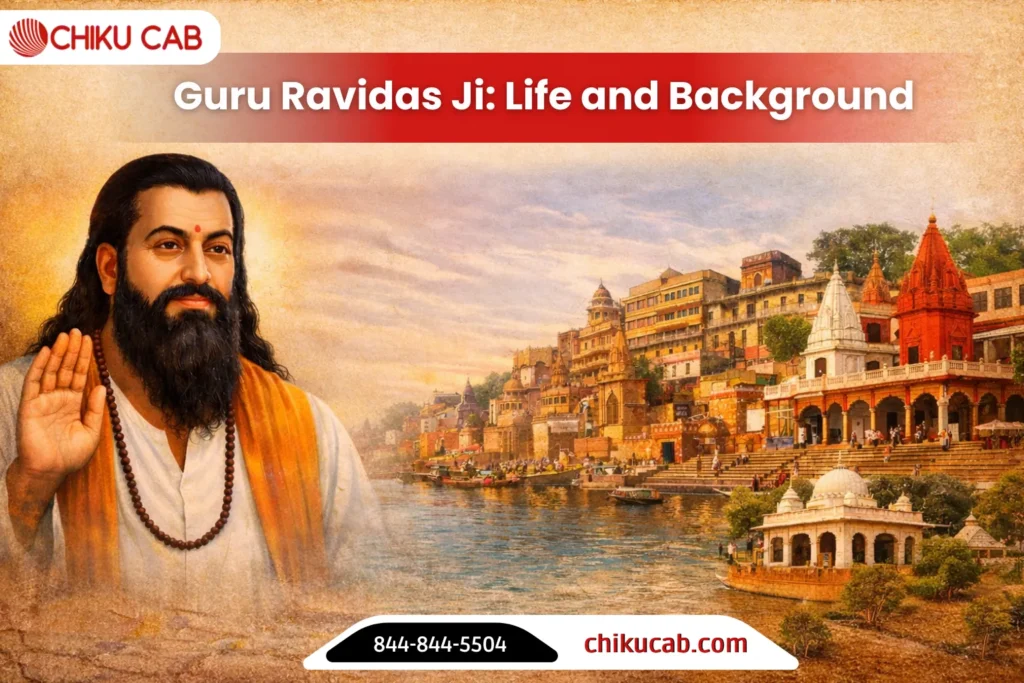
Growing up in Varanasi, I was always aware of the ancient city’s mystical aura. Yet it was only in college that I began reading the poems of Sant Ravidas and truly understood the transformative power of his life.
Guru Ravidas Ji was born in Seer Govardhanpur, near Varanasi, sometime between the late 14th and early 15th century. He was born into a family traditionally associated with leatherwork, a profession placed at the bottom of the caste hierarchy in medieval India. This detail matters, not because Ravidas accepted it, but because he challenged it at every possible level.
From his own verses, we know that Ravidas never hid his origins. In fact, he confronted them openly. Again and again, his poetry returns to the same truth: if the same Creator made all bodies from the same clay, then how can one human be superior to another? That single idea, expressed in plain language, was revolutionary in a society governed by rigid birth-based divisions.
Despite social exclusion, Ravidas Ji emerged as a spiritual figure of immense influence. He worked with his hands, repaired shoes, lived among ordinary people, and yet his words travelled far beyond his neighbourhood. Over time, he is believed to have journeyed across regions such as Rajasthan, Gujarat, and Maharashtra, sharing his lived experience. Predictably, orthodox elites resisted him. But artisans, farmers, and common people listened and followed.
Guru Ravidas Ji and the Bhakti Movement
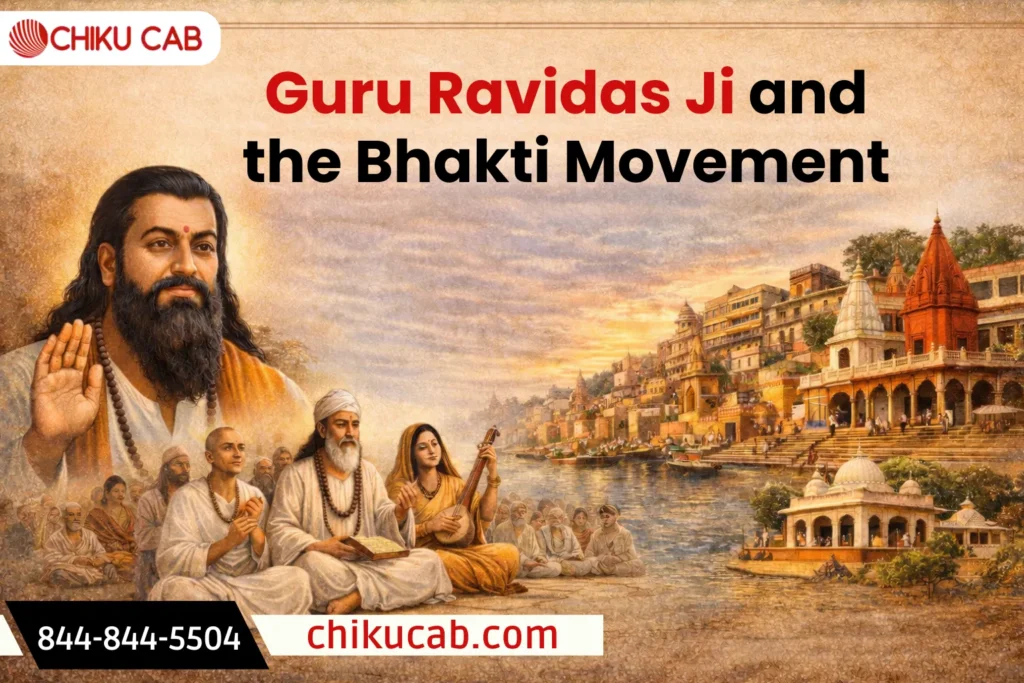
To understand Guru Ravidas Ji fully, you have to place him inside the larger Bhakti movement, but also recognise how distinct his voice was within it.
The Bhakti movement was already questioning ritualism and caste authority when Ravidas Ji appeared. Saints like Kabir, Namdev, and Trilochan were expressing devotion through poetry, music, and direct emotional connection with the Divine. Ravidas belonged to this nirguna Bhakti stream and his hymns openly acknowledge his spiritual kinship with these saints.
What fascinates me is how Ravidas Ji wasn’t just influenced by this movement; he expanded it. Traditional accounts place him within the spiritual lineage of Swami Ramananda, the same teacher associated with Kabir. Other narratives suggest a direct philosophical closeness between Ravidas and Kabir themselves. Whether teacher or peer, what’s clear is that Ravidas Ji moved in a circle of saints who believed devotion should be accessible, direct, and free of hierarchy.
Later texts even describe Mirabai seeking Ravidas Ji as her spiritual guide. It shows how Ravidas’s authority crossed social, gender, and political boundaries. Some Bhakti sects, such as the Dadu Panth, went further and placed Ravidas alongside Guru Nanak and Kabir, recognising in him the same uncompromising spiritual clarity.
This was not quiet spirituality. This was Bhakti as social resistance.
Teachings and Philosophies of Guru Ravidas Ji
Reading Guru Ravidas Ji’s verses today, what strikes me most is their calm confidence. There is no anger in his tone, no plea for validation. He speaks like someone who has already understood the truth and is simply inviting others to see it.
At the heart of his philosophy lies nirguna bhakti, devotion to a formless, indivisible Divine. Ravidas Ji used names like Rama, but he clarified that the name is not the truth, only a doorway to it. God, in his understanding, cannot be confined to idols, temples, or rituals. God exists in every human being equally.
One of his most quoted lines captures this perfectly:
“Ek matti sab ghat sirjai, eike sab ko bhanjanhaar”
All bodies are made from the same clay; the same Creator dwells in all.
This wasn’t abstract theology. It was a lived philosophy. Ravidas Ji believed that purity comes from devotion, not from birth, a stance that directly challenged Brahmanical authority.
And then there is Begampura.
Begampura is not just poetry; it is one of the most radical social visions to emerge from medieval India. In his hymns, Ravidas Ji imagines a city without sorrow, without caste, without fear. There are no kings, no landlords, no hierarchies. Everyone belongs.
When I read about Begampura, I saw aspiration. Ravidas Ji was exposing the injustice of the present by imagining something better. He also spoke of sahaj, a natural, effortless state of spiritual union. Devotion, according to Ravidas Ji, should not be forced or ritualised. It should flow naturally, like water absorbing fragrance from sandalwood. Even the lowest-born devotee, he insisted, could experience divine union without intermediaries.
Perhaps the boldest expression of his philosophy was symbolic: Ravidas Ji is known to have worn the sacred thread and tilak, markers forbidden to his caste. This was not imitation. It was defiance. A declaration that spiritual authority cannot be monopolised.
Guru Ravidas Ji’s Hymns in Sikh Scriptures
One of the strongest validations of Ravidas Ji’s spiritual stature came from the Sikh Gurus. By the 17th century, his hymns were widely circulated, and when the Adi Granth was compiled, around forty hymns of Ravidas Ji were included.
This inclusion is profound.
The Sikh tradition recognised in Ravidas Ji the same truth it upheld: devotion over ritual, equality over hierarchy, inner purity over social rank. His hymns appear in the Ramkali section of the Guru Granth Sahib and continue to be recited daily in Sikh congregations.
There are traditions suggesting that Guru Nanak himself met Ravidas Ji in Varanasi. While historians debate the timeline, the philosophical alignment is unmistakable. Ravidas Ji is honoured in Sikhism as a Bhagat.
Even today, listening to Ravidas’s bani sung alongside Sikh shabads feels seamless. The message is the same. The source is the same.
The Ravidassia Tradition and Modern Identity
Over centuries, Guru Ravidas Ji’s followers grew, especially among Dalit communities who saw in him as a mirror of their own dignity. This eventually crystallised into the Ravidassia tradition.
For a long time, Ravidassia devotees worshipped within Sikh frameworks while maintaining a distinct reverence for Ravidas Ji. However, after the 2009 Vienna attack on Ravidassia leaders, a turning point arrived. In 2010, the Dera Sachkhand Ballan formally declared a separate Ravidassia religious identity and introduced the Amritbani Satguru Ravidas Maharaj Ji, a scripture containing around 200 of his hymns.
Today, some Ravidassias follow Sikh practices, others follow independent traditions, but all centre Guru Ravidas Ji as their spiritual axis. His legacy has become both religious and cultural, shaping identity, pride, and collective memory.
Legacy and Contemporary Significance of Guru Ravidas Jayanti
In modern India, Guru Ravidas Ji is no longer only a Bhakti saint but a symbol.
His birth anniversary is marked by massive celebrations across Punjab, Uttar Pradesh, Haryana, and Delhi. Political leaders visit the Sant Ravidas Janam Asthan in Varanasi. His image appears in social justice marches. His verses are quoted alongside those of Dr B. R. Ambedkar, whom some communities view as carrying forward Ravidas’s unfinished social revolution.
What moves me most is how Ravidas Ji’s teachings remain alive. In joint Jayanti celebrations, in community kitchens, in young people forming Ravidas study circles, his vision of Begampura keeps reappearing, reshaped for every generation.
Centuries later, Guru Ravidas Ji still asks the same question:
If we are made from the same clay, why do we keep building walls?
And maybe that is why Ravidas Jayanti still matters as a reminder.
How Guru Ravidas Jayanti is Celebrated?
As I am from Varanasi, I saw firsthand how this festival is a living, breathing tapestry of devotion and community spirit.
Early Morning Rituals: On the day of Jayanti, devotees wake up early, take a holy bath, and proceed to temples for special puja and kirtans. I can still picture the sun rising over the Ganges as bhajans played in the distance.
Nagar Kirtans and Processions: In many cities, especially in Punjab, Uttar Pradesh, Delhi, and Bihar, streets are filled with vibrant nagar kirtans. People carry banners, sing Ravidas’s verses, and distribute food and sweets to bystanders.
Kirtans, Satsangs & Discourses: Temples and community halls host devotional singing and discourses on Ravidas Ji’s teachings, bringing together scholars, singers, and devotees to reflect on his wisdom.
Community Meals (Langar & Annadan): Just like many Bhakti and Sikh traditions, langar are served to all, irrespective of caste or creed, symbolising the very equality Ravidas preached.
Cultural Programs: Poetry recitations, folk dances, and seminars also mark the day.
Everywhere I’ve seen it celebrated, from closing temples to open stadium stages, Ravidas Jayanti feels alive as tradition and as a call to the values that made Ravidas Ji’s life meaningful.
Guru Ravidas Jayanti Wishes and Messages
Spiritual: “May the eternal light of Guru Ravidas Ji’s teachings guide us toward compassion, equality, and peace. Happy Guru Ravidas Jayanti 2026!”
Reflective: “On this Guru Ravidas Jayanti, let’s commit to dignity, unity, and empathy — qualities that make humanity truly divine.”
Community: “Wishing everyone a blessed Ravidas Jayanti — may his vision of Begampura inspire every heart and community.”
Walking through a Ravidas Jayanti procession once, I noticed the songs blend with laughter, the drumbeats mingle with prayers, and strangers stand shoulder to shoulder as one community. There’s a raw and beautiful honesty in that moment, which serves as a reminder that Ravidas Jayanti is an invitation to see every human as a reflection of the Divine.
If you’re planning to attend a celebration this year, whether in Varanasi, Amritsar, Delhi, or another city, Chiku Cab offers reliable and affordable mobility services in all the cities where Ravidas Jayanti is celebrated.
“All barriers fall when love and devotion rise.”
Happy Guru Ravidas Jayanti 2026! May his light guide us into Begampura, not just in spirit, but in our everyday lives.
FAQs About Ravidas Jayanti 2026
Q. Who is Ravidas?
A. He was a 15th-century saint, poet, and social reformer from near Varanasi whose songs and teachings emphasised devotion, equality, and human dignity.
Q. Is Ravidas Jayanti a school holiday?
A. Yes. All the government offices, public sector firms, corporate offices, schools, colleges, and other autonomous bodies remain closed on Guru Ravidas Jayanti.
Q. When is Guru Ravidas Jayanti?
A. Guru Ravidas Jayanti falls on the Magh Purnima day of the Magh month each year. In 2026, it’s on 1 February.
Q. What is the significance of Guru Ravidas Jayanti?
A. The festival honours his birth and legacy, reminding devotees to uphold his values of universal love, equality, and spiritual devotion.
Q. Which communities celebrate Guru Ravidas Jayanti?
A. It’s widely observed by the Ravidassia community, followers of the Bhakti tradition, and many others in India and abroad who are inspired by his teachings.

I’m a wanderer who loves venturing on to unknown and unseen places. I explore freely to various fun and adventurous places, whether it be spiritual temple tours, captivating landscapes, and more. I wonder around in search of hidden gems and tourist attractions, temples, and other places.


